Categories
book

“The power of the glasses.”

A collage,

The power of the glasses, “Seeing the world through the lenses of complain. After this the world can’t be unseen. It gives you an capacity. An capacity to explain what is happening”. This can be a curse and a blessing. We didn’t choose to wear these glasses. They’ve been put on our faces without requests. They’ve been put on our faces, and now they’ve become a part of who we are.

The morning the glasses found the body.

The morning dawn settled on the empty streets of Ghent. The city is still sleeping. The light is wrestling its way in. The curtains won’t let the morning lighting in.

My footsteps can be heard on the stairs. I’m finding my way to the door. Everything feels surreal. The scent inherent in this ‘famous house’. The posters decorating the white, broken walls. When the front door opens, the light hits my eyes. The glasses rest on my nose bridge.

These glasses reach further than the eyes.
From the neck,
to the breasts,
tummy, hips, right and left leg,
the ankle and the feet.

As a fear of the memorie that the skin beholds.
Lines fill up the empty roll of paper.
Hoping that this second skin will wear off. That the glasses will fall.
Blue and black lines become conscious and subconscious reality’s on paper.

The body starts moving,
the hip makes a sound, the bones form an orchestra.
The violin, cornet, trumpet, bugle, euphonium and trombone are screaming.
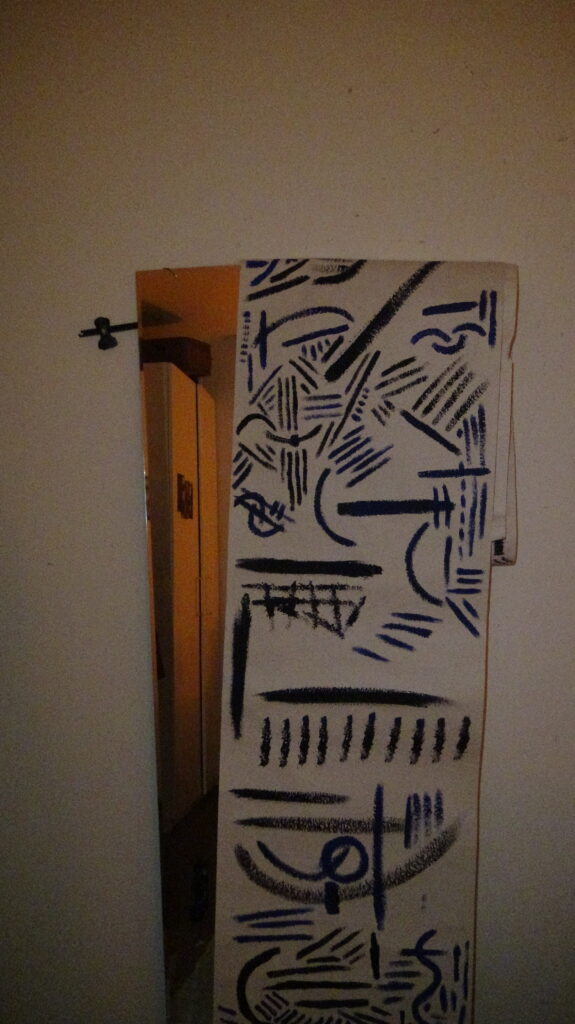
the lines of movement, by Sofie Bussé.

As these glasses slowly become the reality.

As these glasses slowly become the reality.
In one of my nightly walks in Weimar, I passed a brown café. Filled with testosterone, men leaving the house to sit around a table with their male friends and get drunk. And the cliché doesn’t stop here, one woman. At the corner of the bar, multiple layers on her face. In need of validation from all those misogynistic men around her. This is a preconceived opinion, my opinion. Soon the café disappears from my sight. And I walk further into the cold.

As these glasses slowly become the reality.
The body makes a movement on the experimental sound the speakers are telling us. Intoxicated body’s are filling up the room. In our own world, we move. And as this is my reality, in which movement is an outlet, I move. The memorie of the skin, the memorie of the body, the memorie of these eyes which wear the glasses happens. The white walls of the room fill up my vision. Girls and boys dancing. Flashlights, in neon colors. The sweat finds a spot on the forehead, the heart is pounding.

As these glasses slowly become the reality the mind and body live in. We try to move and try to live with it. A new lens is placed on the world we live in today.

Categories
book

“Migration + Complaining”

A personal reflection on migration 

In part II: “The immanence of complaint” of the book “Complaint!” by Sara Ahmed, some examples regarding migration were pointed out to show how complaints are related with this phenomena and this precise topic opened a new vision of understanding complaints for me.

Throughout the reading of the book, I have asked myself in which situations have I made complaints, if the environments were safe, if my complaints were good and fair enough; also, in which ways have I complained in the past that were not necessarily through verbal means, among many other questions. I doubted in my interior: “is emigrating a way to complain?” and that question has been following me for 2 weeks and now, I want to break this idea down, understand it and try to find an answer.

(Understanding emigrating as leaving one’s own hometown/country to settle for a permanent or long time in another). In my experience, I emigrated from Colombia to Germany because I wanted to pursue my studies abroad. Besides of all of my reasons to have chosen Germany as the country in which I would started to study, and all of its influence on my specific career (graphic design); the insurance of a higher quality access to study, a better future and a better panorama of what my working life would be, were also big part of the motives to have decided to begin with this journey.

All of this could have not been possible without the finance of my parents of course and the privileges I have access to. 

In my case to emigrate was a decision, taken based on the environment I was being formed into and how I do not fit in it. It was not that I was forced to. It was not that I had no other option; which I know is the only reason some people have to emigrate. It was my choice to come and in some way try to find the place I feel I belong to.

“You might make a complaint because you do not want to remain in that situation; a complaint can be an effort to get out of a situation you are in.” (Ahmed, 103). Even though a wide part of my personality and identity is influenced by latinx culture, I was not really connected to the environment I was born in. I left Colombia maybe to unconsciously stop that feeling and to allow myself to find the places, people and new experiences with which my beliefs and principles are aligned, and the previous quote of the Chapter 3 “In the thick of it” made me realize that.

Of course many of the aspects that bothered me about my city and my country: including the insecurity in the streets, especially for a woman my age, the inequality and many other sad realities that fortunately I have not had to live: hunger, corruption, violence at all levels, the complete abandonment of the government, among many others, still bother me to this day. And every time I have the chance to complain even in the distance, I take it. Every time something happens and I feel the need to express it through words or with my art I do it. But the part that confronts me is when as a consequence of my words comes the typical: “you don’t even live here anymore” as if once you emigrate you’re not allowed to complain.

I have to admit it: in the past I also did that comment. I also was that person that said: “if you left in the first place, then why do you care now?”. Well, Gabriela of 2013, because it is still a part of them!!!. Every problematic still touches their roots, their families, the things and people they know; basically it affects their realities in most of the cases. Just because they leave, it doesn’t mean it stops being part of their stories, and that’s my story too now. The things that I didn’t like before are still happening and as they are not fair, I still have the right to complain.

It is hard enough to be an immigrant. One does not belong completely to any of both places, which make us feel sometimes as passengers, or something on the line. The following quote retrieved from Chapter 4 “Occupied” describes what I exactly feel:

“A misfit occurs when the environment does not sustain the shape and function of the body that enters it.” (Ahmed, 140). 

Categories
book complaints example

Beschwerden bei Institutionen Ⅱ

Wie wir alle wissen, ist es für Einzelpersonen sehr schwierig, mit Beschwerden gegen Institutionen Erfolg zu haben. Aber es gibt auch Beispiele für Erfolge. Ich erinnere mich an eine der größeren erfolgreichen Beschwerden in China im Winter 2015. Damals erregte es viel Aufmerksamkeit. Es ging ungefähr so:

China Mobile ist der größte Mobilfunkbetreiber in China (China Mobile ist wie Vodafone in Europa). 2015 führte China Mobile eine neue Regelung für Datenvolumen auf Mobiltelefonen ein: die in einem Monat verbleibende Menge an Datenvolumen würde nun nicht bis zum nächsten Monat aufbewahrt und direkt verrechnet werden. Diese neue Regelung sorgte für viel Unmut unter den Internetnutzern. Doch China Mobile ignorierte diese Beschwerden.

Im November jedoch postete die Schauspielerin Han Xue plötzlich einen Text auf Weibo und @ChinaMobile. (Weibo ist ähnlich wie Facebook.) Sie beschwerte sich, dass diese neue Regel von China Mobile unangemessen sei. Sie argumentierte: “Ich habe dafür bezahlt, warum sollten meine verbleibenden monatlichen Daten auf Null gesetzt werden? Ist das nicht nur eine Mobbing-Klausel?”

Han Xue ist als Star zwar nicht knapp bei Kasse, aber angesichts der Ungerechtigkeit hat sie sich dennoch entschieden, eine Beschwerde einzureichen. Nachdem dies geschehen war, drückte die Mehrheit der Internetnutzer ihre Unterstützung für Han Xue aus. Es war nicht leicht für sie, mit ihrer Beschwerde Erfolg zu haben. Sie selbst rief damals die Beschwerdeabteilung von China Mobile an, um die Angelegenheit zu klären. Der Service war zwar gut, aber das Problem wurde nicht richtig behandelt. Später hatte sie einige kleinere Rechtsstreitigkeiten mit China Mobile in dieser Angelegenheit. Das Endergebnis fiel zu Gunsten von Han Xue aus: China Mobile hat die Regelung eingestellt.

Obwohl die Beschwerde erfolgreich war, lohnt es sich, über die Angelegenheit nachzudenken. Han Xue ist ein Star und hat im Vergleich zu anderen Menschen bereits einen großen Einfluss. Ihr Beschwerdeverfahren war jedoch nicht einfach und sie verließ sich auf das Gesetz, um die Angelegenheit zu regeln. Darin kann sich auch widerspiegeln, wie schwierig es ist für Menschen, die keine Stars sind, sich über “Über-Institutionen” zu beschweren.

Ein Zitat aus dem Buch “Complaint!” von Sara Ahmed lautet:

“As far as the university is concerned, because it is the superior body, everything they say is legitimate by reason of it being the superior body. The more you challenge, the more they come back. I also found the more clearly evident the university was wrong, the more I was challenged.“ (S. 48)

Categories
book chapter complaints

Beschwerden bei Institutionen

Dem ersten Abschnitt der Lektüre von MIND THE GAP! (Ahmed 2021: Complaint!) kann ich nur zustimmen. Es erinnerte mich an viele ähnliche Erfahrungen. Es ist nicht einfach, eine Beschwerde einzureichen, und es kann viel Zeit und Mühe kosten. Wir müssen eine Menge zusätzlicher Vorbereitungen treffen, vor allem, wenn wir eine Beschwerde gegen eine größere Organisation einreichen wollen, z. B. gegen eine Regierungsbehörde, ein großes Unternehmen oder eine Universität. Obwohl es bei all diesen Organisationen eine Beschwerdestelle gibt, ist das Verfahren in der Regel recht kompliziert. Oder es gibt eine lange Wartezeit, bis man es fast vergessen hat.

Ich erinnere mich an einen Vorfall in China vor einigen Jahren, er wurde durch eine Fernsehserie bekannt. Die Fernsehserie hieß “Ren Min De Ming Yi” und war seinerzeit sehr beliebt. Es ging um den Prozess, in dem sich Menschen über Regierungsstellen beschweren. Das Fenster der Beschwerdestelle war sehr niedrig und überhaupt nicht ergonomisch gestaltet. Die Beschwerdeführer mussten also eine sehr schwierige Körperhaltung einnehmen, um mit dem Personal im Inneren zu kommunizieren. Diese Haltung führte dazu, dass die Person im Inneren überlegen wirkte (wie auf den Bildern unten zu sehen).

Außerdem konnte es sein, dass sich eine lange Schlange bildete, bevor man das Fenster erreichte. Dies nahm bereits einen Großteil der Zeit und Energie in Anspruch. Und doch musste man in einer so unbequemen Position kommunizieren, dass man es wahrscheinlich keine fünf Minuten aushalten konnte. Aber es konnte eine halbe bis eine Stunde dauern, um Unterlagen vollständig einzureichen. Und dann musste man nach Hause gehen und warten, bis man eine Nachricht für den nächsten Schritt erhielt. In einer solchen Situation hat die Person, die sich beschwert, vielleicht schon ein- oder zweimal aufgegeben. Es war wirklich eine schreckliche Erfahrung und sehr anstrengend. Der Prozess war sowohl eine psychische als auch eine physische Folter. Aufgrund der Ausstrahlung der Fernsehserie wurden diese Fenster inzwischen entfernt.

Dies ist nur ein Beispiel oder vielleicht nur eine Art von Schwierigkeit, die bei der Bearbeitung von Beschwerden auftritt. Und in der Tat gibt es wahrscheinlich Tausende von ähnlichen Schwierigkeiten wie diese. Daher ist es für eine Einzelperson sehr schwierig, sich bei einer Institution zu beschweren, und die Einzelperson wird immer die schwächere Partei gegenüber der Institution sein. Es ist nicht einfach, eine erfolgreiche Beschwerde einzureichen. Zwei Zitate aus dem Buch “Complaint!” lauten:

 “It’s messy and it’s cyclical: you file the complaint, this process happens, which can cause another complaint.” (S. 37)

 “Complaints end up referring to complaints; you have to keep dealing with what is not being dealt with; yes, once you start the process, it is hard to get out.” (S. 37)

Categories
book

A few questions

Virginia Woolf in A Room of one’s own cleverly pointed out there is so much written about women by men. But not in a good way. Instead of writing about the feminist ear, I would rather write about the Marxist eye, or the postcolonial tongue or the psychoanalytical nose. The feminist ear however opens up very interesting topics where a male point of view might not be absolutely redundant. 

Sarah Ahmed introduced the concept of the feminist ear on her book, Living a Feminist Life. It comes up again on Complaint!. It is a very structured concept with many interesting characteristics. The feminist ear hears those who are not heard, it is attuned to the sharpness of words, it is willing to receive complaints, it is a research method, it is an institutional tactic. The feminist ear is definitely powerful but to me is not clear who gets to wield it. As a man, my question would then be can I use it too? Or rather may I use it?

Is the feminist ear subject to the laws of physics? A complaint is definitely affected by the Doppler effect: a complaint sounds different when it’s coming your way. As a man, this is a real concern.

Before diving into the feminist ear, lets do something more simple. Lets just go inside the ear, any ear. The ear is cavernous, to venture inside would be the beginning of a journey of discovery, self discovery. The ear as a tool for introspection. Volunteers that dare to enter the world’s quietest room, another sort of cavern, report being able to listen to the inner workings of their digestive tract in full detail before asking to be removed from the room immediately for fear of losing their mind.

There’s two ears, not unlike the marxist eye(s). People are normally born with two ears and one mouth. My mother would often say one must try to listen at least double the amount one speaks. But the two ears follow a purpose, to be able to listen all around you. Surround sound. To be immersed in sound is to be able to create (or recreate) a sort of architecture of resonance. 

(To be continued)

Categories
art book general thoughts

A drop in the bucket – about feeling disillusioned and gaining hope

Making a complaint can evoke a feeling of futility.

Giving so much, receiving so little.

Like a drop in the ocean, 

dissolving in a system that has not been waiting for your concern. 

Like a drop on a hot stone, 

dissipating with a hiss in a system not willing to see its own wrongs.

Like a drop in the bucket,

adding another one, and another,

until you are dried out.

The drop, the hiss, not heard, 

rendered invisible, inaudible, by the institutional barriers.1

Drop after drop,

until you end up dropping your complaints.

Making a complaint can drain you.

It’s exhausting, while what you complain about is already exhausting.2

Soon you realize that there are certain rules that define if you will be heard.

You have to find the right paths,

paths made so entangled; they seem to be made in order for you not to find them.

A paperwork so user unfriendly, as if build to avoid its own purpose.3

In fact, you even have to be right person to complain, 

and often if you are in a position where you need to complain,

you are not that right person.4

Making a complaint can disillusion you and your belief that you have a saying in a system.

How many drops do we need to break the barriers of institutions?

How many drops do we need to be heard by those who cover their ears?

Those avoiding seeing their mistakes, not willing to allow change. 

How many drops do we need to create a river that forms its way through the impassable structures of institutions? 

We might need so many drops.

Making a complaint can be very painful

But sharing pain can be a relief,

sharing energy can be empowering. 

Let’s unite, hear those who complain, join their voice,

Let the rain fall,

let the drops become one.

Making a complaint can bring about sea change.

“A drop is just a drop is just a drop

until she meets another

combined they run together

she rinses stone, gets through walls, she crosses borders, never holds

until all the drops become one

big deep blue

where every drop

is just a drop

is just a drop

is just a drop” 

Faraway friends – Intro (Rain is coming)

1 See: Ahmed, S. (2021): Complaint! 2021, p.6.

2 See: ebd., p.5

3 See: ebd., p.31

4 See: ebd., p.4

Categories
book

“El que no chilla no mama”

Better not to complain:

We are used to not complaining because it is easier. The person who wants to complain about something is seen as the weak. We have to be strong no matter the conditions or situations that we are going through.

If a kid it’s been bullied and complains with the teacher about his bully, he will receive a social punishment with their pairs. Because of his complaint, it’s been seen as something wrong.

If a woman complains to her family about her new husband, she will be told to fix her marriage. Because of her complaint, it’s been seen as something wrong.

If a worker complains to their coworkers about their boss, they will be told to be thankful for a job. Because of his complaint, it’s been seen as something wrong. 

El que no chilla no mama:

In Colombia, there is a saying that is: “El que no chilla no mama” that could be translated like: “A baby that doesn’t cry gets no milk” or “If you don’t cry, you get no treatment.” And it is the opposite of what we have been told. The idea of a baby crying is clearly a complaint, and then the baby gets the reward for the milk.

Nevertheless, Colombian people do not make so many complaints. Even when the social gap in Colombia is enormous, people tend to hold a lot with their jobs, the inequity, the social problems, etc.

Colombians also say that they are “gente berraca” which means: that they are “brave people” and always going forward no matter how difficult the situation is.

It’s a contradiction to feel brave when you hold and tolerate, but not when you make a complaint. The “berraca” (brave) people do not cry and do not complain.

But, sometimes, something breaks.

Last week a driver of the public transport system of Bogotá (SITP, Sistema integrado de transporte público) stopped the bus in the middle of a route, asking the people inside the bus to go down and quit his job. He replies that he could not tolerate this job more, and social media explodes. Many people made fun of him, but also some people supported him. He complained out of the system; he did not write a resignation letter or talk to his boss. He tried to hold and hold as much as possible. But, sometimes, something breaks someone breaks.

“no aguanto más” – I can not take anymore

Now I understand that complaining does not make me less brave (less “berraca”). I do not need to walk on the edge, waiting to support as much as possible before complaining. Even if you do not make a formal complaint inside the system, complaining with your friends makes you feel lighter. The importance of the complaint is first to be heard and second to change something. To make a change, we all need to complain or hear the other one complaining.

Categories
book complaints

The first page turning

Even before the book “Complaint!” starts with the so-called half-title, the first page preceding the title page, it is preceded by 4 pages entitled “Praise for Sara Ahmed”. These are words of praise from colleagues or reviewing media (such as Library Journal or Los Angeles Review of Books) for six of Ahmed’s earlier publications, for “What’s The Use. On the Uses of Use” (2019), “Living a Feminist Life” (2017), “Willful Subjects” (2014), “On Being Included. Racism and Diversity in Institutional Life” (2012), “The Promises of Happiness” (2010) and “Queer Phenomenology. Orientations, Objects, Others” (2006), published by Duke University Press.

Sara Ahmed is a prolific freelance researcher and writer who explores how power operates in language, families, everyday life, institutions and cultures, assigning/performing gender identities and steering them into traditional hetero-patriarchal trajectories, how power is abused, but also how abuses of power can be identified and existing hierarchies and inequalities dismantled, what forms of resistance exist and what it “costs” to speak out and behave in a resistant way. In her now eleven books, she uses the tools of intersectional feminist cultural analysis to make visible institutional structures and effects of heteronormativity, racialisation, colonial power, and heteropatriarchal gender assignment. Her book publications, like her blog posts on https://feministkilljoys.com, stand amidst the investigations and methodologies of affect theories, cultural studies, critical race studies, queer theory and feminist theories. Ahmed is interested in how governments function and how they can be challenged and changed to alternative futures. By reflecting on bullying, harassment, emotional abuse, violence, assault, or rape in domestic and academic settings, she examines the tangled and intertwined processes, most of which are difficult to penetrate and dissect, that intersect amidst (also institutionalised) sexism, racism and colonial violence.

But @publisher Duke, to start a publication with 4 pages of praise and then get to the title page with the author’s name and the title of the publication is a publishing decision that is difficult to comprehend. Advertising should (perhaps) be placed where potential readers can be addressed or reading decisions can be influenced: on the back cover, on the publisher’s website, in flyers, in social media. This is where praise can (perhaps) attract attention and make an impact. On the other hand, promoting a book within the reading section and even before the book begins is incomprehensible to me. The inside section of a book is reserved for the author and her text. I would be curious to see how Ahmed herself would deconstruct these 4 pages and put them into a mechanism of action of institutional operations of power, knowledge and truth. But now I am looking forward to reading …

Categories
book complaints

Das erste Blättern

Noch bevor das Buch „Complaint!“ mit der sogenannten Schmutztitelseite, der ersten, dem Titelblatt vorangestellten Seite startet, sind ihm 4 Einzelseiten vorangestellt, die mit „Praise for Sara Ahmed“ übertitelt sind. Hierbei handelt es sich um lobende Worte von Kolleg*innen oder rezensierender Medien (wie Library Journal oder Los Angeles Review of Books) für sechs frühere Publikationen von Ahmed, für „What’s The Use. On the Uses of Use“ (2019), „Living a Feminist Life“ (2017), „Willful Subjects“ (2014), „On Being Included. Racism and Diversity in Institutional Life“ (2012), „The Promis of Happiness“ (2010) und „Queer Phenomenology. Orientations, Objects, Others“ (2006), die im Verlag Duke University Press erschienen sind.

Sara Ahmed ist eine sehr produktive, freie Wissenschaftlerin und Autorin, die erforscht, wie Macht in Sprache/n, Familien, Beziehungen, Alltag, Institutionen und Kulturen wirkt, Geschlechtsidentitäten zuweist/performiert und in tradierte hetero-patriarchale Bahnen lenkt, wie Macht missbraucht wird, aber auch, wie Machtmissbrauch identifiziert sowie existierende Hierachien und Ungleichheiten abgebaut werden können, welche Formen des Widerstands existieren und was es „kostet“, sich widerständig zu Wort zu melden und zu verhalten. In ihren mittlerweile elf Büchern setzt sie die Instrumente der intersektionalen feministischen Kulturanalyse ein, um institutionelle Strukturen und Auswirkungen von Heteronormativität, Rassifizierung, kolonialer Macht und heteropatriarchaler Geschlechterzuweisung sichtbar zu machen. Ihre Buchpublikationen stehen ebenso wie ihre Blogeinträge auf https://feministkilljoys.com inmitten der Untersuchungen und Methoden von Affekttheorien, Cultural Studies, Critical Race Studies, Queer Theory und feministischer Theorien. Ahmed interessiert, wie Regierungen funktionieren und wie sie herausgefordert und zu alternativen Zukünften verändert werden können. Indem sie Mobbing, Belästigung, emotionalen Missbrauch, Gewalt, Körperverletzung oder Vergewaltigung im häuslichen und akademischen Umfeld reflektiert, untersucht sie die verworrenen und verschlungenen, meist kaum durchdring- und sezierbaren Prozesse, die sich inmitten von (auch institutionalisiertem) Sexismus, Rassismus und kolonialer Gewalt überschneiden.

Aber @Verlag Duke, eine Publikation mit 4 Seiten Lob zu starten, um dann zu der Titelseite mit dem Namen der Autorin und dem Titel der Publikation zu kommen, ist eine Verlagsentscheidung, die kaum nachzuvollziehen ist. Werbung ist (vielleicht) sinnvoll an den Stellen zu platzieren, an denen potentielle Leser*innen angesprochen oder Leseentscheidungen beeinflusst werden können: auf der Buchrückseite, auf Verlagswebseiten, in Flyern, in den sozialen Medien. Hier können Lobeshymnen (vielleicht) Aufmerksamkeit und Wirkung erzielen. Ein Buch hingegen innerhalb des Leseteils und noch vor Beginn des Buches zu bewerben, ist mir nicht verständlich. Der Innenteil eines Buches ist der Autorin und ihrem Text vorbehalten. Ich wäre neugierig, wie Ahmed selbst diese 4 Seiten dekonstruieren und in einen Wirkmechanismus von institutionellen Macht-, Wissens- und Wahrheitsoperationen setzen würde. Aber nun bin ich gespannt auf die Lektüre …

Categories
book

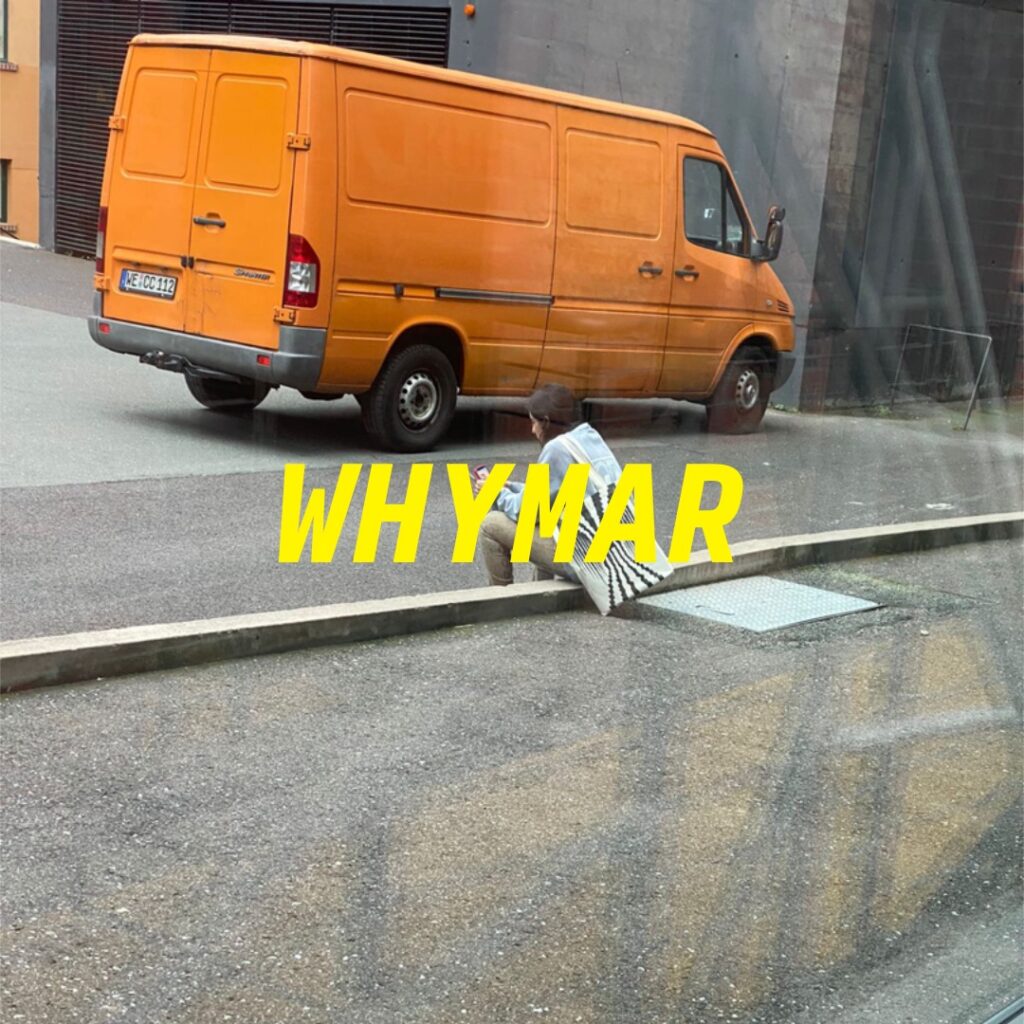
“WHYMAR” – a series of photos in Weimar while I complain about why I am here (and not in Berlin).

WHYMAR. 2021. Parra.
  1. Me + Tote Bag “Why”. Early this year i casually designed some tote bags that say WHY. Maybe it was my unconscious expressing the feeling I had when I moved from Berlin to Weimar and could not start my studies there. This picture was taken by a friend of mine while I was sitting waiting for him.
  2. The place I learn in. Since 2018 I was manifesting my desire to pursue my studies in Germany, mostly to have the chance to get in touch with the Bauhaus somehow. Life has been so magical that I’ve had the chances to be in the places I’ve always wanted. Life shakes me and moves form place to place. This picture was taken by me in the room of Graphic Design in M1. (please don’t misunderstand me. i feel very fortunate and the proudest to be studying here.)
  3. The place I live in. I feel very grateful to have the chance of having my own safe space and have all the privileges I have. I started living in this new room since Oct.2021 and it is the place where I have lived where I have felt the best. It is big, bright and I really feel at home in here. This picture is of my desk.
  4. The road to Weimar. This year I stated as a purpose to travel to Berlin as much as I can. I’ve done it 2 times since I said it would be a goal from now on until I finally go back and live there. The feeling that I embody every time I am on the road in the highway going out of Berlin is something I can not explain with words, but even though I try to explain it I know it is hard that someone relates to that emotion. I took this picture on my trip Berlin-Weimar the 01.11.2021.
  5. Things I do. Last Sunday my roommate and I decided to explore our creativity in a more analog/crafty way so we decided to take out some paper, watercolours and start drawing. We decided the topic was Weimar. She represented in her own way what Weimar means to her. Mine was more of a rebranding of the city’s name and what it causes me. This picture contains the final result of our drawings.
  6. Things I feel. As autumn settles in and winter approaches, nostalgia is also coming to Weimar to knock my door. I love the cold, but it doesn’t feel the same if it’s shared. I am still adapting myself to the seasons, as im adapting too to many other changes. This photo was taken yesterday at 16:45 and I wanted to send it to my parents to show them how homesick this panorama made me feel.