The voice with no differents in tone, a computer speaking words it doesn’t even understand. As I sit on the white chair of the room in Jakobsplan, I listen to the computer voice reading Complaint by Sara Ahmed. The standard voice of an electronic device artificially pronounces the words.
The phenomenology approach, Philosophical method developed by Edmund Husserl, which proposes a whole new approach to knowledge. The phenomenological method does not focus on the concrete things and their coherence, but wants to penetrate to the essence and meaning of things, through spiritual-intuitive contemplation.
Cultural dictionary, 30.11.2021, https://dictionary.cambridge.org/dictionary/english/phenomenology
Thus, I will experience the chapter “mind the gap” from a detached perspective. Not “my own voice” telling the written down words. Interactive.
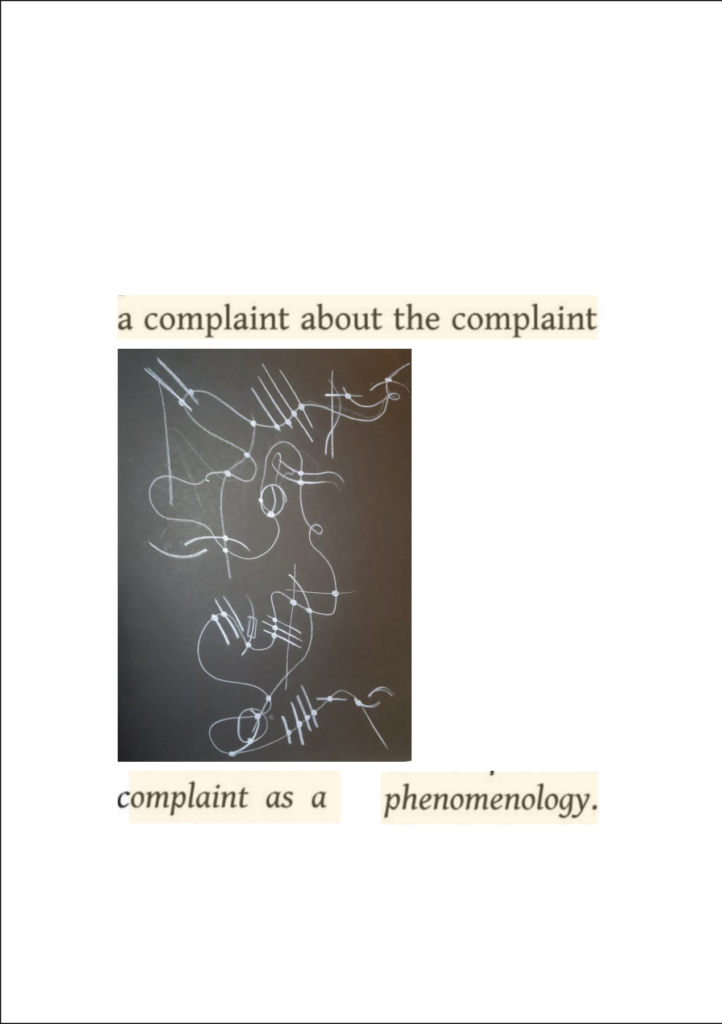
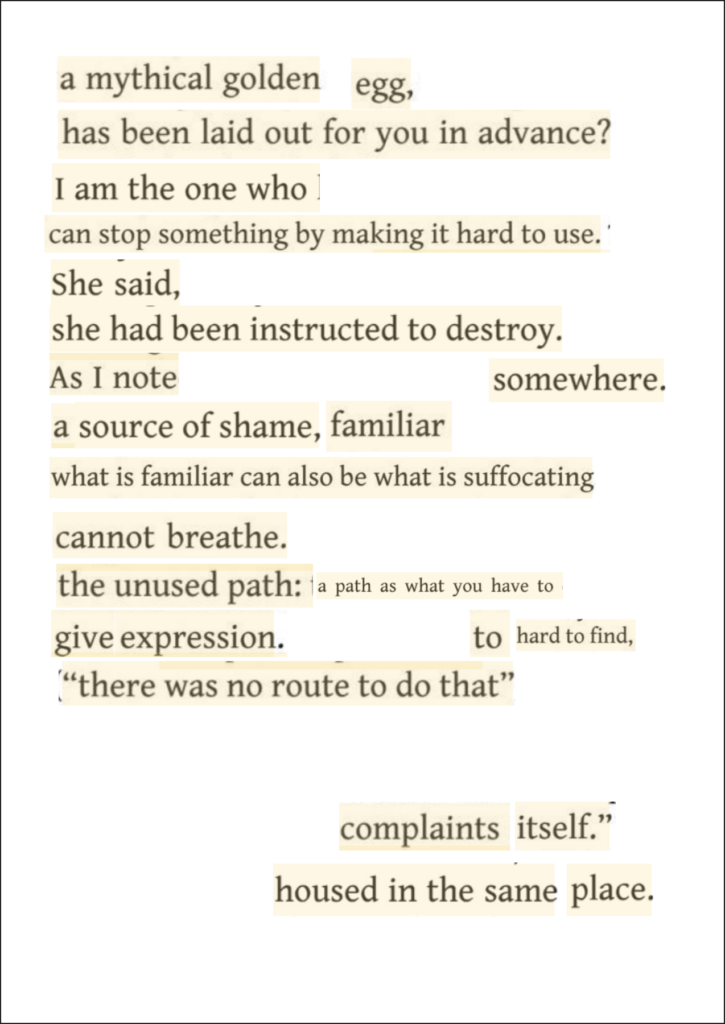
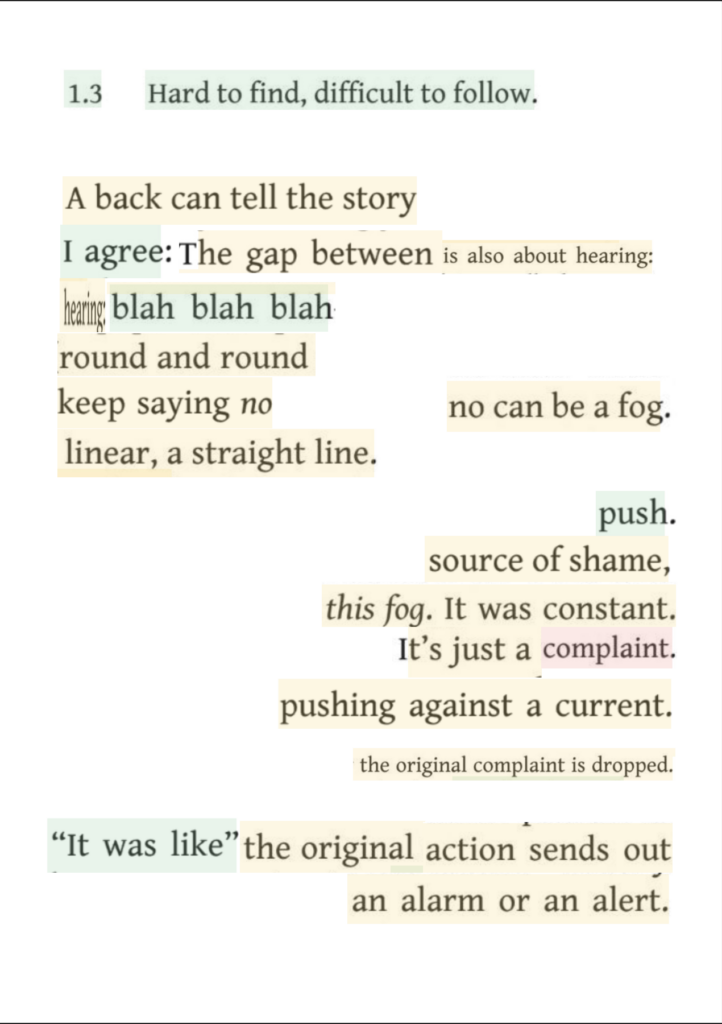
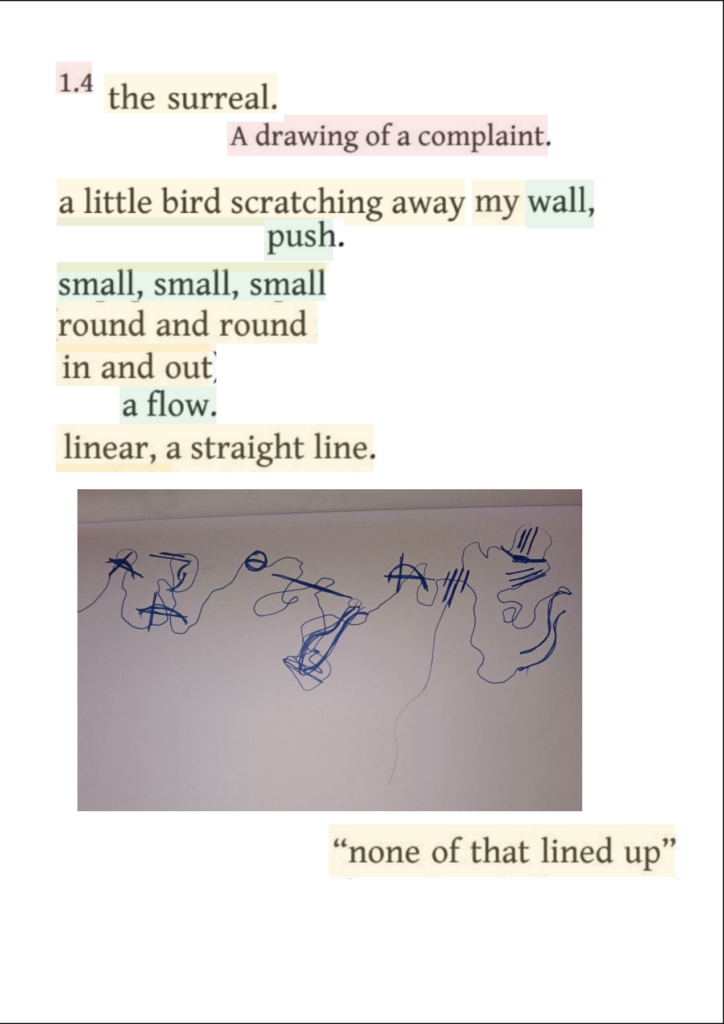
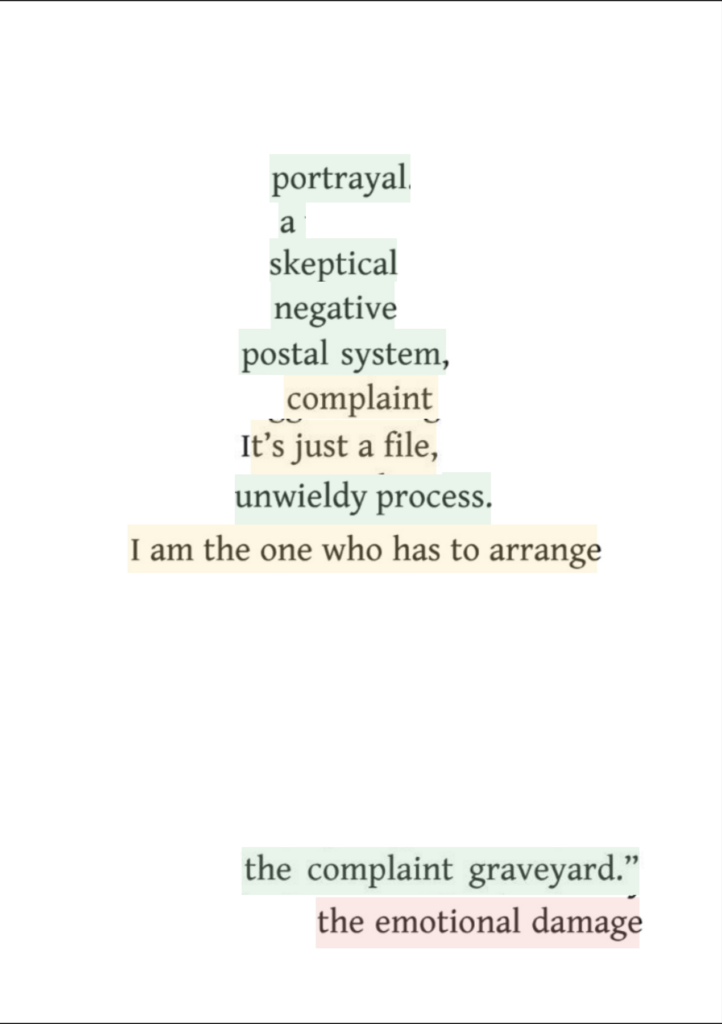
Collage work of the captured sentences.
Page 1, collage, a complaint about the complaint. drawing by Sofie Bussé (symbols of moving, lines of the path). Page 2, collage, a mythical golden egg.Page 3, collage, hard to find, difficult to follow. Page 4, collage, the surreal, a drawing of the complaint. drawing research body movement performance.Page 5, collage, The complaint graveyard, the emotional damage.
IT IS SO DIFFICULT TO ACCESS TO ALL THE PLATFORMS AT THE UNIVERSITY, THERE ARE SO MANY, AND EACH ONE WITH BAD DESIGN, BAD INTERFACE, NOT PEDAGOGIC, NOT INTUITIVE, NOT FRIENDLY. A LOT OF BUREAUCRACY, UNNECESSARY PROCESSES. STOP, STOP, STOP.
IT´S INCREDIBLE! I´M FED UP OF LOGIN NAMES, USER NAMES, PASSWORDS.. OPEN MORE ACCOUNTS…AND MORE… AND MORE…. DIFFICULT TO GET HERE… EVERYTHING IS SO COMPLICATED, LABYRINTHINE, WHY NOT MAKE IT EASIER?
MY FIRST COMPLAIN IS THE INFRASTRUCTURE OF THE DIGITAL COMMUNICATION SYSTEM IN THE UNIVERSITY.
What’s the difference between complaining and criticizing and how do I see myself in con- and reaction with proposed definitions ?
Complaining in process.Mapping talks with and thoughts about father in between criticizing and complaining.
What’s the difference between complaining and criticizing and how is it seen: a) in my family ? b) in society? c) published on “simplicable”? And Why ?
Collective perception of complaining vs. criticism.
I would like to start this post by stating: Everyone is allowed to complain, anytime, anywhere, concerning any issue.
What does this sentence provoke in you? Do you agree? Do you disagree?
I myself have to say that I am not so sure about this, even though I am also not so sure who should be deciding over this. Complaining means expressing discontent or dissatisfaction about something, making an accusation, stating that something is (done) wrong. I want to specify here that I will focus on complaining when you are treated unfairly, such as for example by a person, a procedure, or an institution.
Who is allowed to complain? A complaint starts with the reason why you want to complain, and this reason starts with a feeling. A feeling of something being wrong: feeling hurt, suffocated, excluded, offended, hence unfairly treated. And this is where it already gets complicated. “Am I allowed to complain?” starts with a: “Am I allowed to feel wronged?”. The fact that it is so difficult to define right or wrong, especially when emotions are involved, makes the whole process somewhat subjective and easily determined in the end by whoever is in power (with this often being whoever you complain about). So, who decides over right or wrong? The complainer or the “being-complaint-to”?
Who is allowed to complain? The right to complain is also a matter of privilege. On this issue there is a conflict between the fact that some people are too privileged to complain and some not privileged enough to get through with a complaint. Are you the right person to complain? While going through with a complaint “we learn how only some ideas are heard if they are deemed to come from the right people; right can be white.”1 There is absurdity in the fact that if you are in the position to make a complaint, hence if you are suffering under certain power relations that put you in an unjust situation, you are most probably not being heard. “You might not feel confident that your complaint is being taken seriously when your complaint is about not being taken seriously.”2 Thus when you chose to complain you take a huge risk, which might lead to self-damage. More than often, you are already in a precarious situation and can’t afford to lose your job or hurt your image. If you find yourself in this situation, you might be reminded of your dependence on the one you want to complain to. Hence your issue is not being taken seriously by those in power to do something about it. In addition to this “complaints are more likely to be received well when they are made by those in power.”3 Those who are already more influential are more likely to get through with their complaint. This is widening the already existing inequality gab in hierarchies.
Who is allowed to complain? Those who are heard are those who are in the “right” place to complain: those in a stable state, those with enough power, those who have the right connections, those with the resources to do so. But isn’t it ironic that when you find yourself in a situation of suffering, without support, and hence file a complaint, you are not supported by the system? And if you are in the “right” place to complain you are actually not really in the right place to complain, meaning the reason why you complain might not be that severe, because you don’t find yourself in a precarious situation.
In conclusion when is complaining justified? When is your state alarming and legitime enough to be entitled to do so? When are you well enough positioned to complain? When are you allowed to take away people’s oh-so-precious time to criticize and tackle the system they are so desperately trying to uphold? To complain is to make yourself vulnerable. Be aware of the burden that comes your way, whether it is the burden of your privilege to be able to do so, or your struggle or even your inability to get through with it.
Part III of “Complaint!” by Sara Ahmed is called “If these doors could talk?”.
During the two chapters contained in this part, various testimonies are told in which doors have represented a role amid sexual harassment and assault situations, encounters of oppression and misuse of power in different institutions, mostly against women.
In some examples, the infrastructure of the places where such violence occurred was justified as allowing the abuse to take place or even used as a weapon against the victim. For example: if the space between the oppressor and the abuser was too narrow, then the victim won’t come out of the room easily.
My concern was, how in many situations the behaviour of someone is justified by the scenario in which the scene occurred, if there were witnesses or not, if their reputation doesn’t match with the acts, among many other things. I also related this questions with the name of Part III of the book: What if all of those doors of the rooms in which once many misconducts and violations have occurred could talk? What would they say? Who would they put into the spotlight? What would change in the institution?
But what if the door and its big role had a shift? What if all of these doors were made of glass? And everyone around could have seen through. Would the oppressor acted the same way? Which would have been the outcomes of the different violences? Also, would anyone dare to force a violent act against the door knowing how fragile it is?
This also leaves me a question on if these barriers were more transparent and the physical infrastructures of institutions were reformed, then would people act completely different? Their actions would be justified if there were witnesses or not. But most importantly, injustices will be visible for everyone.
And at some point it seems to be what most matters when doing a complaint… if you don’t show enough proof, if there is not any witness, if there is no footage to support your complaint then it is not viable.
I made a poster to support the big question Part III of the book left in my head.
Image 1. Poster, “IF THESE DOORS COULD TALK? WERE MADE OF GLASS?”, Weimar, 2021, Parra.
Ich hatte eine Menge Gefühle, als ich das zweite Kapitel “ON BEING STOPPED” (Ahmed 2021: Complaint!) las. Wenn man unzufrieden ist und sich beschweren will, wird man oft von jemandem davon abgehalten: Beschwere dich nicht, die Konsequenzen werden schwerwiegend sein. Das kommt in China aufgrund der traditionellen Kultur und des Einflusses der Bildung häufig vor.
Einige Sprichwörter, über die wir oft sprechen: “以和为贵。Yi He Wei Gui.” “大事化小,小事化了。Da shi hua xiao, xiao shi hua liao.” “吃亏是福。Chi kui shi fu.”
“以和为贵。Yi He Wei Gui.” bedeutet, dass es am wichtigsten ist, dass die Menschen in Frieden miteinander leben. Konflikt vermeiden.
“大事化小,小事化了。Da shi hua xiao, xiao shi hua liao.” Bedeutet: Wenn es einen Konflikt gibt, lass die Situation nicht wachsen. Lass den Konflikt stattdessen allmählich abklingen. Wie kann man ihn reduzieren? Zum Beispiel zeige ich zuerst Großzügigkeit und mache Zugeständnisse. Dann wird sich die Person, mit der ich im Konflikt stehe, auch zurückziehen. Wenn wir alle einen Schritt zurücktreten, wird der Konflikt reibungslos gelöst werden. Natürlich ist das der Idealzustand. In der Realität ist es möglich, dass andere dich stärker unterdrücken, nachdem du nachgegeben hast.
“吃亏是福。Chi kui shi fu.” Es geht darum, den Leuten zu sagen, dass sie eine bestimmte Einstellung entwickeln sollen. Wenn es Ungerechtigkeiten gibt, versuche nicht zu streiten oder zu kämpfen, sondern lerne, geduldig zu sein. Wenn du diese Geduld lernst, kannst du eine Menge Ärger vermeiden. So kann das Leben glücklich werden.
Aufgrund dessen ist unsere erste Reaktion auf eine ungerechte Behandlung, dass wir uns damit abfinden und Konflikte und Ärger vermeiden. Wenn jemand in einer solchen Situation steht, raten viele Menschen davon ab, sich zu beschweren. Sie werden Ihnen viel über die schlimmen Folgen erzählen, die nach einer Beschwerde auftreten. Und sie glauben, dass sie dabei weise und erfahren sind. Aber einige von ihnen haben vielleicht gar keine Erfahrung, sondern sind einfach von der traditionellen Kultur beeinflusst. Beschwert man sich also weiter, nachdem man diese Rückmeldungen erhalten hat oder nimmt es einfach hin? Schwer zu entscheiden.
Zwei Zitate aus dem Buch “Complaint!” lauten:
“you are being encouraged not to complain, to “let it go” by resolving things in some other way or by hop- ing for some other resolution.” (S. 72)
“A complaint is heard as making waves, as stopping things from being steady.” (S.77)
“Thank you for calling Expedia lodging support; my name is Lucía. May I have your property ID please?”
The sentence above accompanied my early mornings through the last 11 months before coming to Weimar. I worked as a call center agent for the known French company Teleperformance. I answered the phone and replied to emails in a campaign called Expedia.
-------
Thought 1. Working as a call center agent is nobody's dream.
Thought 2. I am feeling ashamed of being a call center agent.
Thought 3. I did a 5-years bachelor's in Fine Arts in the best university in Colombia; a call Center should not be my place. ( I felt terrible of thinking about this after)
Thought 4. Whatever...I need money to do my MFA in Germany.
Thought 5. This is an experience I have to live. I should be grateful for having a job during a world pandemic.

STOP LUCY... This complaint of not having job opportunities as an artist in a country like Colombia should be a future post because this post, as I already said, is about talking to a wall.
------
Expedia is another vast “American”* company that provides services to find the “best prices” in the market to book flights and hotels (same as Booking.com). I was backstage since I only attended property owners, front desks, and other hotel employees. So, the complaints I received, I heard, were more “polite,” less “aggressive,”…
Less complaint.
It is called “customer service.” However, it is never truly about them.
The kind of complaints that came to me was usually about money. Let me explain to you how payments work for this company: the giant offers two ways to pay hotels the funds collected from travelers. On the one hand, the Expedia Virtual Cards. EVCs could be processed as soon as the guest had left the hotel; the hotelier already has the number Expedia assigned to the card. They only need to charge it. On the other hand, there are the Invoices. Invoices were always a problem because people, I mean, the hoteliers, couldn’t understand why they needed to ask for payment instead of being paid as soon as they provided the service. I heard voices comparing “our” services (Expedia’s services) with Airbnb more than once. This platform pays property owners what is owed to them as soon as travelers check out. To me, this should be the right way to act. However, big corporations never work like that; they ask for money or work in advance, but they pay in terms of 90-180 days. Thus, small entrepreneurs wear out and die.
That is what an Argentine man precisely told me once. He was distraught because Expedia had not paid the last three months to him. He tried several times to contact Customer Service to understand what was happening, but no one answered. He had the right to be upset; he had been fighting for weeks, always against a vast wall. After working a couple of weeks in his case, I realized the whole problem was absurd and easy to solve. However, internal teams passed the ball from one to the other, and anyone did anything to help this man. Almost three weeks later, I could release the money (by his right) even if it was to the detriment of my “quantitative performance,” or usually called metrics.
I felt proud of myself for having been able to solve the problem. And it was not the only case actually. After all, I was a great call center agent.
Nevertheless, during the 11 months, I always felt frustrated working for a company like this one. The trouble with capitalism and these giant money-producing monsters is that they do not have a face, they have hundreds of people spread around the world…
wait … they are not really from all over the world, they are people who, like me, live in developing countries where labor is cheaper. I cost less money than an American.*I cost less money than an American.*I cost less than an American.*
So, Expedia, as well as Teleperformance, are no human beings.
And, it was not me on the phone. It was Expedia.
It was nobody.
It was an entity that cannot be spoken to.
It was a wall. It is a wall.
Thought 5. Is this frustration the same felt by Winston Smith trying to fight against Big Brother?
Thought 6. However, Big Brother was no more than a vast machine fueled by fear and worship of the ignorant.
* Being Colombian, I shouldn’t say American to refer to the USA. I am American too. But, this is another story, another complaint.
Welcome to the Strange Fruits episode of the Voiced Displeasure. Maybe the least favorite one, but tasty, for sure. Poetic, inevitably. The main protagonist relates to the 3 sections: Juice, danger, and joy; Systems, sugar, skin, and stain; The land of rightness, emptiness, and gray color. Next time instead of the external keyboard, you might bring the fork.Have you ever heard a fruit talking? Did you find it uncomfortable? Understandable. No judgments. This is a safe space. Let´s bite.
JUICE, DANGER, AND JOY
”I am a little parasite stuck on your ceiling, watching and waiting for the right moment to grab your face. I am an angry skeleton under the thousand layers of this skin blanket. I want to get out of my colonized past.
I am the one you want to squeeze. My lemonish, bitter body is hanging on the walls of your borders. Experience the haptic touch of this nectarous object – me. Me, the stranger. You – domestic. Me – the dirt on Your floor. You – the boundary. My amorph shape stands out from the crowd, breaks the concrete, entering the void.I produce joy. Try me. I am a violent inhabitant trying to break your comfort. I am the stain spot of this system.
These little hands were holding the poles in the foreign trains and buses, being observed. My hands are being watched – the way they move, how the fingers fold and dance around the strange objects. I am the sensation. My legs are making the gaps between the foreign feet, stepping into the unknown. Kissing the strange ground, while dropping the strange juice into the dry field. My earlobes are made of sugar, melting in the strange air. My lungs are suffocating from the bizarreness of this place. Its mystifying inner shakes my foreign outer. Its breeze freezes me. I must get out.”
My charming existence. My strange fruits. Its juicy resistance, that shoots the roots.
The alluring, strange chain, keeps my existance remain.
My omnipresent stain melts the acid rain.
The land of rightness, emptiness, and gray color
Welcome to Saxony, the land that tears the skin of the beast.Welcome to the act of peeling one’s outer. Chemnitz means stones, coming from the language that I can understand, for some reason. Welcome to Chemnitz, friends. Welcome these words that are coming and be free to dive into the experience.
”The strangeness climbs through my spine, from the bottom. Slowly and precisely it covers the whole backside. I feel the structure and heaviness of my skull. My earlobes are collapsing. My head leans towards the shoulders as if it is going to fall. I feel alienated from the outside.
Some parts of my body feel numb. There is a space around my inner skin that I have no contact with. I turn my head to the right I look at one point. My attention stays in the corner of my eye creating the tension of the eye muscle. I can see the small humans inside a human, I sense how they move around me. I see the shadows of these bodies, I feel the coldness piercing my outer strongly through the borders. IAM THE OTHER. The other on many that are the same.
I slowly pull my own inside towards the outside shell. I humbly tore the skin of a creature. I peel the layers of its skin and try to get out. It lasts and feels like forever. I am the stain spot on this map. Pulling. Vibrating. Pushing. I am so alive.”
PS: NEVER EAT THE FRUITS YOU HAVE NEVER SEEN BEFORE.
The power of the glasses, “Seeing the world through the lenses of complain. After this the world can’t be unseen. It gives you an capacity. An capacity to explain what is happening”. This can be a curse and a blessing. We didn’t choose to wear these glasses. They’ve been put on our faces without requests. They’ve been put on our faces, and now they’ve become a part of who we are.
The morning the glasses found the body.
The morning dawn settled on the empty streets of Ghent. The city is still sleeping. The light is wrestling its way in. The curtains won’t let the morning lighting in.
My footsteps can be heard on the stairs. I’m finding my way to the door. Everything feels surreal. The scent inherent in this ‘famous house’. The posters decorating the white, broken walls. When the front door opens, the light hits my eyes. The glasses rest on my nose bridge.
These glasses reach further than the eyes. From the neck, to the breasts, tummy, hips, right and left leg, the ankle and the feet.
As a fear of the memorie that the skin beholds. Lines fill up the empty roll of paper. Hoping that this second skin will wear off. That the glasses will fall. Blue and black lines become conscious and subconscious reality’s on paper.
The body starts moving, the hip makes a sound, the bones form an orchestra. The violin, cornet, trumpet, bugle, euphonium and trombone are screaming.
the lines of movement, by Sofie Bussé.
As these glasses slowly become the reality.
As these glasses slowly become the reality. In one of my nightly walks in Weimar, I passed a brown café. Filled with testosterone, men leaving the house to sit around a table with their male friends and get drunk. And the cliché doesn’t stop here, one woman. At the corner of the bar, multiple layers on her face. In need of validation from all those misogynistic men around her. This is a preconceived opinion, my opinion. Soon the café disappears from my sight. And I walk further into the cold.
As these glasses slowly become the reality. The body makes a movement on the experimental sound the speakers are telling us. Intoxicated body’s are filling up the room. In our own world, we move. And as this is my reality, in which movement is an outlet, I move. The memorie of the skin, the memorie of the body, the memorie of these eyes which wear the glasses happens. The white walls of the room fill up my vision. Girls and boys dancing. Flashlights, in neon colors. The sweat finds a spot on the forehead, the heart is pounding.
As these glasses slowly become the reality the mind and body live in. We try to move and try to live with it. A new lens is placed on the world we live in today.
Das Wort „Complainer“ wird in Übersetzungsmaschinen neben „Beschwerdeführer“ auch als „Jammerlappen“ [ˈjamɐlapn̩] übersetzt. „Jammerlappen“ bezeichnet umgangssprachlich abwertend eine Person, die sich wehleidig über etwas beklagt. In Wictionary wird „Jammerlappen“ als „Flasche, Heulsuse, Schlappschwanz, Würstchen“ übersetzt, im Woxikon als „Pfeife, Loser, Taugenichts, Krücke, feiger Mensch, Unfähiger Weichling“. Zur Etymologie heißt es bei DWDS: „Jammerlappen m. ‘wehleidig klagender Mensch, Feigling’ (berlin. 19. Jh.), eigentlich (scherzhaft) ‘das zum Abwischen der Tränen benutzte Taschentuch’.“, hier heißt es zur Bedeutung: „feiger, willensschwacher Mensch“. Der Duden schreibt: „allzu ängstlicher, feiger Mensch, der sich alles gefallen lässt und nicht aufzubegehren wagt“ und informiert zur Herkunft: „ursprünglich = Tuch zum Abwischen der Tränen, dann auf seinen Benutzer übertragen“.
Dieses Übersetzungsergebnis des Wortes „Complainer“ in die deutsche Sprache durch Übersetzungsmaschinen macht Diskriminierungsprozesse sichtbar, die zum einen über den Vorgang des Übersetzens stattfinden und zum anderen durch den Einsatz von Codes verursacht werden, wobei Diskrimierungen im Code mit einem Anschein technischer Neutralität umso wirksamer sind. Diese Beobachtungen machen Gründe sichtbar, warum sich zu beschweren bedeutet, so Ahmed, nicht gehört zu werden: „To be heard as complaining is not to be heard.“ (Ahmed 2021, S. 1). Wer schenkt sein/ihr Ohr jemandem, der als ein „Jammerlappen“ stigmatisiert ist und dessen Beschwerden damit herabgewürdigt und erniedrigt werden?
Deshalb meine Beschwerde am 17.11.2021 an ein KI-System, an DeepL Translator, info(at)deepl.com:
Sehr geehrte Damen und Herren,
wir möchten Sie gern darüber informieren, dass wir bei unserer Arbeit an der Bauhaus-Universität Weimar zu dem Buch „Complaint!“ von Sara Ahmed https://bkb.eyes2k.net/BauhausUni-2021-22-S2.html festgestellt haben, dass das Übersetzungssystem deepL den englischen Begriff „complainer” u. a. in den deutschen Begriff des abwertenden „Jammerlappen“ übersetzt.
Da es in dem Buch und unserem Seminar unter anderem darum geht, Ablehnungen, Barrieren und Widerstände gegen das Beschweren und gegen Beschwerden zu reflektieren, möchte ich Sie stellvertretend für mein Seminar gern um eine Stellungnahme hierzu bitten. Denn hier scheint es sich um ein Beispiel für eine Diskrimierung im Code zu handeln, die in dem Anschein technischer Neutralität umso wirksamer ist?
Danke & freundliche Grüße
DeepL, Customer Support Specialist I Support, antwortete mit am 22.11.2021:
Sehr geehrte Frau Kleine-Benne,
vielen Dank, dass Sie uns kontaktiert haben.
Es tut uns leid zu hören, dass Sie auf diese Fehlübersetzung gestoßen sind.
Möglicherweise liegt das Problem darin, dass es sich um ein Wort ohne Kontext handelt. Aus diesem Grund raten wir in der Regel davon ab, einzelne Wörter zu übersetzen. Am besten ist es, das Wort zusammen in seinem Kontext zu übersetzen, da unser Übersetzer in der Regel den Kontext überprüft, um eine bessere Übersetzung zu liefern. Selbstverständlich werden wir Ihr Feedback an unsere Entwickler weiterleiten, um die zukünftige Verbesserung unserer Übersetzungsmaschine zu ermöglichen.
Außerdem möchte ich Sie darüber informieren, dass unser Übersetzer nicht mit den Übersetzungen von Kunden lernt, sondern mit Hilfe unserer Sprachexperten und unserer Algorithmen. Außerdem gibt es für einzelne Begriffe je nach Kontext unterschiedliche korrekte Übersetzungen. Daher kann es leider vorkommen, dass unser Übersetzer eine unpassende Übersetzung auswählt.
Wie Sie z. B. unten sehen können, wird das Wort complainer als Beschwerdeführer übersetzt, aber Beschwerdeführerin wird auch als Alternative angeboten.
Vielen Dank für Ihre Geduld. Sollten Sie noch Fragen haben, zögern Sie bitte nicht, uns erneut zu kontaktieren. Ich wünsche Ihnen einen schönen Tag im Namen des gesamten DeepL-Teams.
Mit freundlichen Grüßen
Ich habe daraufhin am 23.11.2021 Folgendes geantwortet:
Sehr geehrter xx,
zunächst vielen Dank für Ihre Antwort.
Sie haben Recht, dass das Übersetzungsergebnis des isolierten Wortes zu genau diesen Ergebnissen führt, die Sie in Ihrem angehängten .png abgefragt haben.
Ich möchte Sie dennoch bitten, sich noch einmal den folgenden Satz von deepl übersetzen zu lassen, um zu sehen, dass es sich nicht nur um ein Kontextproblem (bzw. um ein Entkontextualisierungsproblem) handelt: “You can become a complainer because of where you locate the problem. To become a complainer is to become the location of a problem.“
Danke, dass Sie unsere Beobachtung an Ihre Entwickler*innen weiterleiten,
freundliche Grüße
Wird eine Fortsetzung folgen?
Nachtrag: Am gleichen Abend des 23.11.2021 erhielt ich die folgende Antwort:
Sehr geehrte Frau Kleine-Benne,
vielen Dank für Ihre Rückmeldung.
Manchmal kann es immer noch vorkommen, dass unsere automatische Übersetzungsmaschine Übersetzungsfehler macht. Wir werden Ihr Feedback an unser Team weiterleiten, um die zukünftige Verbesserung unserer Übersetzungsmaschine zu ermöglichen.
Vielen Dank für Ihre Geduld. Sollten Sie noch Fragen haben, zögern Sie bitte nicht, uns erneut zu kontaktieren. Ich wünsche Ihnen einen schönen Tag im Namen des gesamten DeepL-Teams.