Categories
art

Complaining in Process: Painting

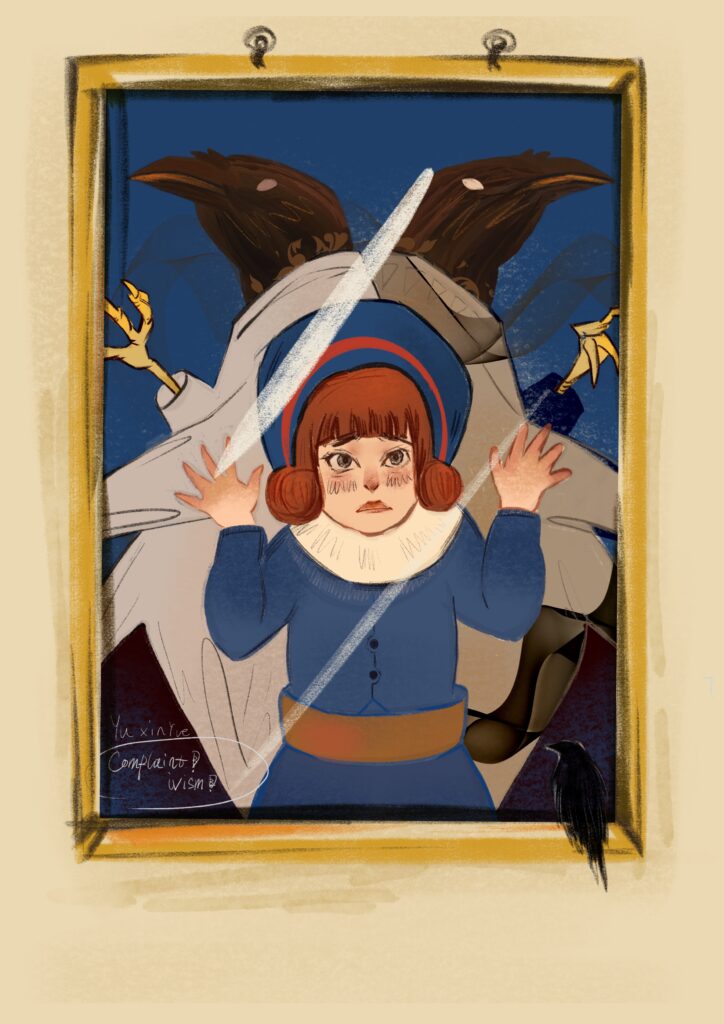
After sharing my personal experience with complaining and having F too close at the same time, I let anger directly bleed on paper. 

First outburst to leave doesn’t feel good, doesn’t feel right. 
Another layer should calm down outspoken words, should offer time to reflect on them.

However complaint need time, it will not erase. To cover complaint, to drown it doesnt quite work. The complaint is there no matter how much you put on it.

It gets calmer through times YES, but it still wants to achieve. It is motivated, it is alive, it wants to succeed and it will come out again…

… different this time: slower, with caution based on the history of complaint.

Justice, equality and freedom are things in life we might all want. But how to deal in a system where this is only valid for one? To change the system, to break down borders, to achieve a respectful communication demand work and patience. It means to understand, to explain, to react, to reflect, to act, to react, to reflect, to understand, to explain again -> for justice, equality and freedom. For love and communication, to stay connected and not alone.

However you want to stay connected: Getting to close involves risk for damage. Its a game, a steady negotiation of distance and participation. There is tension to eat each other, to destroy, to fall apart again…

Categories
art

Complaining in Process: Performative Storytelling

Reading Sara Ahmed’s Book Complaint! let me think of my personal experience with complaining in an institution:family. Ahmed describes how hard it is to get a complaint through within an institution and so I do. 

#complaint#activsm
#saraahmed

Categories
art complaints genre

“There is no future, but at least there is coffee”.

There is no future, but at least there is coffee.
Not the kind of coffee they sell in fancy places.
Not the kind my mother used to make.
There is no future, but at least there are shoes.
Not those comfortable shoes.
Not even uncomfortable ones, but sexy ones.
There is no future, but at least there is music.
The kind that makes me dance, makes me sweat, makes me stink.
There is no future but there is saliva. Of the slippery kind that makes me retch
and the dry kind when there are no more words.
There is no future but at least the printer works.
After ten tries and even though the cartridges were full.

#stopcomplaining

Categories
book

Lützi Bleibt! – Lützerath stays!

Incredible violence is happening where people are being displaced and places destroied forever. Despite of a climate catastrophy that is already happening the german governments still allows corporations to enlarge open coal mines like the one called “Garzweiler” close to cologne that is one of the largest in Europe. Twelve villages had to be demolished for it in the past, homes, protected monuments, fertile soil, insects and other creatures, roman excavation sites the whole complexity of a peace of Earth taken out by a huge digger. What remains is a incredibly large and deep whole that seems to be empty but that is actually full of complaints and suffer, of ignored voices of protest. There is a fracture on GoogleEarth were the view of 2009 and 2020 meet each other. On the satellite picture we see the village of Borschemich that stopped existing in 2017 and we see at the same time, more that 100 meters below, the ground of the new coal mine. The next village that should fall is Lützerath were only one farmer was able to stay but that is accompanied now by hundreds of squatters that moved into the abandoned houses and selfmade treehouses. They try to amplify not only the complaining voices of those who are affected locally by displacement but also those who are and will suffer from the massive CO2-Emissions of the coal. Lützerath became a fertile space of complaining, of resistance and of the creation of an alternative sphere in opposition to capitalisms extractivism.

Squatted house in the village of Lützerath that is currently under threat of destruction due to enlargement of the coal mine Garzweiler.

The village of Borschenich (satellite image from 2009) that disappeared 2017 and the open coal mine Garzweiler (satellite image from 2020) in Germany near Cologne. Fracture found on GoogleEarth.

Categories
art basic book complaints general ideas thoughts

Voicing Displeasure #0 Fault and Default

The summary was urging to be done and therefore, we are coming back to the roots: the place where the complaints were planted, watered, and let out by the complainer-creator, to the #0.

I do wonder sometimes why I have started voicing the itchiness I encountered. The following question would be why I do art. Then again, after rereading the displeasures once in a while I always bump into the satisfying answer. Moreover, I love my army of complaints. The question would pop up: how is it possible to have an emotional connection to the displeasure? I might not be able to explain it well, but assume that for me it comes from the joy of complaining, the power of reflecting, something very personal, one-man therapy, the empathy with the protagonists of my story, and most importantly, being able to be vulnerable somewhere, more than anywhere else. The topics that I touched through my displeasures are a good base to realize what are the itchy places and triggers, more precisely the base for future complaints and that is, my complainers, what I was looking for a while. I might be my own feminist ear.

What a lovely way to burn!

STICKY DATA: Complaints framed as self-damage

Is it, now when I opened these very personal, but very public questions and realized how sticky they are? Now, when I am aware of the damage that has been made? It can not be more of destruction than actually taking the words and bringing them into action. I and my displeasures are already here, which is, as I experienced, definitely not enough. Otherwise, Ahmed would call it a fatalist process (opened and started just in order to be initiated). But I would say that if my voices are burning now, there must be the next stage. Therefore, let me complete this action until it gets visible.

Fatal procedures, poster

WHAT A LOVELY WAY TO BURN

After voicing displeasure #The Code of Visibility, I could finally cry my life off, after months of holding it back. The wonderful moment of being able to tell him how hurt I was is not the pathetic story about my father, as I always thought. It is the voice of all the girls in the world that were abandoned, living with the thought that they made a mistake. It is the voice of the anger, the spit of the tension that pierced my belly for years. Thinking about the children that are very present in my everyday life, I pictured the visibility that their complaints are creating: the contrast of being taken too seriously, or not at all. I have been observing both their creation of visibility and complaining in front of the authorities and I actually found something useful to apply in my own practice.

Never mentioned before that I have always been disguised and repelled by the way my family structure is described in the official documents. It gave many people the right to comment and construct their own perceptions of the two members of my nuclear family. I hated the way they victimized my mom seeing her as a tortured, poor woman, the single parent left alone. Once, in the report of a school psychologist, she wrote: the child’s lack of motivation due to the consequences of her broken family. Whatever would change in my behavior, that was considered weird, it was always attributed to the crack I was born in.

Once, I cried in front of a 5 years old girl I babysat because her toy/doll family construction matched mine very well. Instead of stopping the professional cry, I started the professional complaint in front of her and the game was successful. The feminist ear has no gender and no age.

voicing the burning

#The Professional Cry is a fusion that gravitates and connects displeasures written before and after it. It is, indeed very much connected to the first displeasure #Feminine Masculinity. Both empowered my female/male voice and helped me understand the NO complaint. I was not respecting my own body, and my own little girl cried inside me every time I gave it to them. I was sexually harassed, taken advantage of. I experienced verbal abuse not knowing that what has been happening is wrong. I never told that to anyone, because they would immediately give credit to the broken family situation: seeking love more than others, daddy issues, loneliness, not having a man figure to look after, etc. I am not saying that traces of the crack are not present, but how dare you? Developing masculine femininity is a process and I prefer saying that my deep voice is therefore a social construct.

The fatal calculation, poster

This must be a professional crying class, voicing up and healing the cracks.

#The Crying Honk was, on the other hand, at the beginning very general, global, touching something outside of my body. I started writing it after the second day of my trip to Egypt thinking about the reflection on the way. After a while, it became strongly personal and I noticed that this was the task of mine, the one this life urges me to have: I am the voice of the children. I always felt this whisper more than others and whatever is the context, I ended up working with kids. At least I know whom I inherited this complaining skill from. Therefore, the more honest and radical I was, the more visible I became. This might also be called radical softness because my words are written faster than my brain can check them. I am simply unloading and emptying my cabinets within each letter.

NOWHERE TO GO, BUT READY TO BURN

So, how to treat these empty pieces of furniture that are piling up? How to fold all these tears and screams-soaked napkins? Where to store them? The collection of the voices, cabinets of displeasure, university of ears, feminist laboratory, collective hug, complaining choir – (some)where to go?

I have a trillion questions while burning on my own and some of them are adding oil on fire, while some are swallowing me even more into the topic. I am asking:

What is the difference between psychotherapy (type of a feminist ear), official complaint (including administrative process e.g), and art practice here, for me? What am I proposing and voicing? What would happen when the voices are heard and the cabinet is exposed, becoming visible? Will my writings hug the people, motivate them? What do the complainers need? Is it more of the introspection and individual complaining experiences or the instruction of how to make an act? 

Will anything voiced drastically change anything existing?

Until all of them are answered,
until it all burns.

Categories
art complaints general ideas thoughts

Voicing displeasure #5 The Crying Honk

The sound of collective praying made me tremble. I heard the voice coming from the top of Ibn Tulun mosque communicating with the other voices, the choir of Al-Qāhirah. The collective vibration transmitted through the architecture gave birth to a sobbing city I had a chance to encounter.

Why are you crying? ارجوك لا تبكي.

All the best from the West

Scared for my white skin, I walk through the dusty bubble and pray for my white skin not to get dirty. For my white skin not to get raped. For my white skin not to experience poverty. My privileged, white body prays for the kids from this street, for the mango traders of Bazar, and the mothers feeding their newborns on the pedestrian zones, beyond the legs of passengers. The white privilege that I have not chosen but was given to me. With the whiteness and ability to wash my face after a long day on the streets, I dare to ask: how can we be part of the same planet? Me and this little girl in front of me, being alone on the street? We, small humans spreading inequality. We, mute humans, do not hear the cry.

On day 4, I slowly accepted these scenes as a part of the landscape and got used to poverty.

Honk for the existence

Being loud or visible has many purposes: from the simple joy of having attention to the emergency blankets, danger alert, and simple, everyday fear. I find the ambivalence of the honking orchestra here being disturbing and meditative simultaneously. The sound of confirming the presence on the road. Another form of crying, right? Traffic tears, polluted breath, screaming brakes.

Somehow, this typical Egyptian honking practice sounds very much like my own cry – hysteria, anger, the language of the unique emotions. Imagine honking as the only voice you can use. The honking makes you want to explode in your own anxiety and drown in your own tears. Or in mine, if you wish.

Cairo, Egypt

Who takes the pictures of the otherness and who is the otherness?

“The relationship between Occident and Orient is a relationship of power, of domination, of varying degrees of a complex hegemony.”

Said, Edward W. 2003. Orientalism

The postcolonial studies introduced us to the Westerns depicting the Orient as an irrational, strange, weak, feminized “Other”, contrasted with the rational, familiar, strong, masculine West. I would gladly comment on something that opposes the otherness, the one belonging to Orient (from the previous view), and reflect on my own, Occident otherness experience in Egypt. It is very important to underline my position here: I am not a scientific researcher on the topic, nor competent to discuss postcolonialism on any deeper level. The fact that these were my first steps out of Europe and the ways I used to experience each of them urged this reflection and made it very personal.

As I have already voiced in one of my displeasures, it feels that my everyday purpose is to be visible wherever I am and no matter what I do, say, or behave, my visibility was never so present (I dare to say even successful visibility in my case) like here. It is not me, Nadja, being exotic otherness in Egyptians eyes, but us, Nadjas that came to enjoy the heritage of their country and leave a few pounds more, possibly. And here I was even more white and prestigious, being considered a German within the group of German students I came with. What fascinates me among many things here is the way of communication that consists (besides the honking) of a couple of questions as where are you from; what is your name; and multiple versions of welcome to Egypt. These questions are never meant to actually be responded to, but to deepen the conversation, lead to the possible trade, and give them ”the promise”. Each word answering their conversation starter is a permission to enter the platonic friendship where you are the one promising to buy, to sit there and, necessary, come again. Such intensity in everything happenings. Welcome, to Cairo, they said.

What is your name?

My name is Nađa, that, according to Russians comes from Nadezhda (Надя) meaning hope. According to Arabs comes from Arabic Nadia (Nadiya) meaning moist; tender; delicate. One of the sellers from Bazar told me that the meaning is a short, but very fast river. I wanted to run aweay, that's true. 

So, you are Egyptian? I was asked.

The first time in this symbolic 25 years I exist in this world, somebody took the picture of me because I was different than everybody else there. I was the exotic, fascinating alien among the ordinary, everyday man on this continent. Instead of giving the superiority that attention usually does, I felt the opposite. I felt small and different in front of the whole world that I had no idea about. I felt the heaviness of the cloak of otherness that was worn by the people of color in Europe, Muslims praying on the street of the Orthodox country I came from, the women with hijabs, etc. Their unusual, extraordinary behavior or look was taking the attention of ”normal” white people and now, it is was me: an alluring, foreign subject.

I would revive the Serbian saying ”Šta je, jel igra bela mečka?‘ (eng. Is the white bear dancing or what?), the term we use for an event that evokes the curiosity of random passers-by. Apropo this saying, I wonder, who is the white bear and who is the spectator, actually? It might be that the white bear is the observer and he does not need to be tamed.

Gold-coated, crying city

Not goldening it more than it is, it is the fact that Egypt has been visited for its archeological heritage as a golden civilization that left magnificent traces dating back from the world we have no idea about. This golden coat kicked me after I left Cairo and woke up the following morning on the night train in Luxor. There I understood the massive tourism of the Serbs used to go to Hurgada every year, as well as other people visiting Egypt and seeing just Lux(or). Nobody enjoys truly the 67 layers of dust on their faces while being trapped in the traffic sandwich between the cars, buses, auto-rickshaws, and running pedestrians in Cairo. Rarely who want to live in these conditions. I do not. Yes, we are contributing through tourism and we should keep doing it. No, Egypt is not just a sandy kingdom and Giza. That is all I wanted to comment on.

Again, how to be sure that this is not one more reflection fabricated by a western explorer?

Now, poetry for the poor. (ref. Architecture for Poor, Hasan Fathy)

Granite poverty,
she, however, bravely smiles.
Sculptured, structured valleys
and these little brown eyes.

I dare to feel,
feel quickly and escape.
Never in your skin.
Never in this shape.


My apologizes for just being,
and existing as I am.
I must create a blanket
so I can protect them!
All of them.

Scared and aware,
of the white nightmare
my foot in dirth,
completely bare.
My skin somehow shines.
And they stare.

Nevertheless, I am the other
My eyes are bigger
then my own hunger.

They are the one,
one of the same.
Non-existing trone,
just a pile of chairs.

The voices are raised,
the voices that dare.
They exist so much,
one can feel it in the air.

I have never seen the crying city before.

West Bank Poetry, chalk on the wall
New Gourna Village, Luxor, Egypt

A special hug goes to all my children.

Categories
book

EL TENDEDERO

Los Angeles, 1979
Museo de Arte Moderno de la Ciudad de México en 1978
Mónica Mayer. Si tienes dudas… pregunte, MUAC, Mexico city, 2016

Mónica Mayer is an artist who has dabbled in drawing, photography, digital graphics and performance. Her work is characterized by being a precursor of feminist art in Mexico. Mónica Mayer was born in Mexico City in 1954. She studied visual arts at the National School of Plastic Arts of UNAM. The author began making feminist art when she was frowned upon in our country. The artists who raised their voices to express their dissatisfaction with machismo and violence against women were immediately considered lesbians and hating men. I like the idea of sharing it on this blog because I find that she is an artistic reference in the Mexican context that makes direct allusion to the idea of the complaint already in the late 70’s.

Her work “Tendedero” was exhibited for the first time in 1978 and has been replicated to this day in various educational, cultural and university institutions, even in virtual form. This work is based on hanging sheets of various sizes and colors and invites women to hang their own paper with phrases, questions, complaints or opinions. This work has been a great success because women have found a way to report and express themselves anonymously and without retaliation, especially in disadvantaged situations such as between students and teachers.

The work has been reproduced in different contexts, dates and cities throughout these 40 years.

In the mid-1970s Mónica Mayer became part of a group of artists who conceived their work within the context of artistic feminism. (POLVO DE GALLINA NEGRA) In 1978 she moved to Los Angeles to study at the Feminist Studio Workshop at the Woman’s Building. It was there that she encountered artists who were central to the US feminist art movement, such as Judy Chicago and Suzanne Lacy.

In 1978 she produced El tendedero (The Clothesline Proyect) at the Museo de Arte Moderno in Mexico City. She invited visitors to hang up small sheets of paper on which they had completed the phrase “As a woman, the thing I detest most about the city is . . .” in order to encourage a dialogue about the violence experienced by women in public spaces.

Mayer said in 2017:
What has changed in forty years?
The only thing that is different now is that I am not the only one doing it.

El tendedero, México, 1987

Categories
book

“Beschweren” or “to make heavy”

As a popular way to translate “complaining” into german one finds the word “beschweren” which has a very similar use and meaning but means, literally translated, to make something/someone heavy”. The notion of complaining that revealed so many personal and emotional stories in the context of our Seminar felt like a key to a otherwise hidden box that we all have somewhere. To share a complaint is to open this box partly, to make oneself vulnerable but also to allow strong connections to others. But the act of complaining seems to always be an interaction that transforms both the complainer and the receiver. After a seminar session of listening to a lot of complaints I understood the german word “beschweren” because I acutally felt heavier somehow. To share the burden of a complaint means to carry it together. At the same time it brings relief to the complainer which could be translated to “Erleichterung” in german (what literally means “making light”).

We all want to get rid of our heavy complains – we want to feel light. But with a full box of complaints there is no real lightness.

How could we create spaces of a collective “Erleichterung” without loosing the core of the complaint? How should the complaint be responded to enable “Erleichterung”? How can we find a balance?

Thomas Sarraceno – On Space Time Foam 2012 (Milano)

The artwork by Thomas Sarraceno came into my mind while writing the post but my text has no direct connection to the artists work or texts.

Categories
book complaints thoughts

Causing drama – about complaining as a woman

“You are being oversensitive.”

I don’t know how often I have heard this sentence before. And to be honest, it took me a while to realize that being oversensitive wasn’t in fact a bad thing. Yes, I was being oversensitive, but what if that didn’t mean I should have let go, don’t care, feel less. It meant that I have a good intuition for what feels right for me and what feels wrong. The problem is that this is often not what people want to hear from you. And I was not intimidated to tell them what they didn’t want to hear. So, I ended up being the complainer. “Oh, Fabienne disagrees with something? Is she again causing a drama? Well, that’s just how she is.” Whether at school, in my dance classes or at home: I would probably get the award of causing dramas. 

What is even meant by drama? 

It means not accepting everything just as it is. Running the risk of disrupting the apparent peace of a situation. Being uncomfortable. Making people face their wrongs and maybe with-it face certain emotions. Which can be hard to bear. But it also means running the risk of being wrong yourself and creating a drama over nothing. And don’t you dare causing a drama over nothing.

If you complain as a woman, you very quickly fall into a certain drawer. There is an exaggeratedly distorted image of women complaining too fast and too much. When you raise your voice, you are causing a drama. Your actions are constantly on the edge being seen as an overreaction. Keep your voice down, keep your opinion down and most importantly, keep your emotions down. If you do find the courage to speak up, don’t run the risk of mixing it up with your feelings because you will most probably end up being defined as hysterical. Hysterical: women’s favorite word. Defined as hysterical you are not just a concerned person anymore that found itself in a difficult situation it wanted to change or has experienced unfair treatment. No, now you are just “always” overreacting. Hence as a woman, if you complain you have to be even more rational, come even more strong, be even more neutral and base what you experience even more on facts, than man have to do. US-psychologists around Victoria L. Brescoll from the University of Yale noticed that when a woman is angry, she loses her status, no matter what position she is in. Within an experiment they found out that being angry as a man is seen as positive, while coming from a woman it is seen as negative.1 Women should not be uncomfortable. They should care and encourage peace. Because a woman who does not complain and does not get angry, won’t change anything about the inequality between man and women.2 As a consequence there is a tendency of women not expressing their anger and their concerns outwardly. They make it out with themselves. So, while there is this image of women complaining too much, they actually learn from very early age on to be quiet and smile.

Furthermore, as a feminist you might find yourself losing your credibility when it comes to criticizing men as for example a feminist PhD student expresses in the book “Complaint!”: “I think they thought almost that I was looking for it, like a feminist thing, you are always overreacting, blowing things out of proportion because that’s what you see everywhere.”3 It might even come to the point of questioning yourself, your own judgment when you experience sexism. “She tells herself off, even: she gives herself talking to; she tells herself to stop being paranoid, to stop being a feminazi, to stop being a feminist, perhaps.”4 When complaining as a woman and as a feminist you run the risk of being seen as a “man-hater”, one that discards everything men do. Hence everything you criticize is not perceived as being expressed because there is something wrong about what a certain man did but simply because you despise man. You are not listened to and the louder you get, the less you are heard. “The could-be complainer is also the feminist complainer, feminism it-self being charged with complaint through the exercising of old and familiar negative stereotypes (feminists as “man-hater”). Feminist complainers are called vermin, polluting agents who need to be eliminated.”5 Being afraid of endangering their status and their position within a structure might lead to woman not speaking up anymore. 

Speaking up and making abuses visible is seen as a danger. It is seen as a danger and tried to be avoided, when it meaningful and impactful. Analyzing who is trying to avoid it makes visible who is in power and who wants the status quo as it is, meaning who benefits from it. “One way a complaint can be dismissed is by magnifying the demand; a demand for “equality and safety” is treated a wanting to bring an end to what or who already exists, or as separatism, a wanting not to share a space or culture.”

Being told that you are overreacting and being oversensitive is very dangerous, as by time you might lose your sense in trusting in your own judgment. We need to learn to trust in our senses. In addition we need to be open for criticism and change. Being sensitive is not something negative and is also not tied to a gender. Everybody should develop a certain level of sensitivity so we can create a space of awareness and of living with and not against each other.

1 See: Hoeder, C-S. (2021): Wut und Böse. München: hanserblau, p.38.

2 See: ebd., p.11.

3 Ahmed, S. (2021): Complaint!, p.105.

4 ebd., p.104.

5 ebd., p.131-132.

Categories
book complaints thoughts

Sich weiter beschweren

Im letzten Teil ihres Buches “Complaint!” erwähnt die Autorin Sara Ahmed eine Reihe von Ideen zu Beschwerden. Einigen von ihnen stimme ich wirklich zu. Und die Sätze sind eine große Inspiration für diejenigen, die sich beschweren wollen.

“I believe in complaining, even when it’s a bad outcome, just creating that record of what happened. I am glad that it exists for me, and that if any questions are raised I have it. I did lodge a grievance, I had a go, I did try.”

“A record can be what matters to the one who assembles it; a record can be a reminder that you made an effort, that you had a go, even if that effort did not lead to institutional change.” (S. 288)

Dieses Zitat erinnert mich an einen Spruch, der mich schon oft inspiriert hat: “Wenn man sich anstrengt, hat man nicht immer Erfolg, aber wenn man sich nicht anstrengt, wird man definitiv keinen Erfolg haben.” Mit Beschwerden verhält es sich genauso: Man muss eine Beschwerde einreichen und sich die Mühe und Zeit nehmen. Letztendlich hat die Beschwerde möglicherweise keinen Erfolg. Aber wir müssen es trotzdem versuchen, um gegen die dunklen Dinge zu kämpfen.

“I leave no trace of wings in the air, but I am glad I have had my flight.”— Rabindranath Tagore

“Even going through an exhausting of processes can have creative potential. Yes, we can be in a state of exhaustion because of that process. But complaints, even formal ones, slow and tedious ones, long and drawn out, can be creative. ”(S. 289)

“I suggested earlier that even when our complaints end up in filing cabinets, we take them with us. I also noted that we don’t always know where complaints go, before they are filed. But even when complaints end up in filing cabinets, they can get out; we can get them out. Filing cabinets are temporary shelters. The more letters written, the more letters to leak.” (S. 298)

Wir alle wissen, dass die meisten unserer Beschwerden im Aktenschrank verbleiben. Der Aktenschrank ist eine sehr verbreitete Methode, um Beschwerden zu vertuschen. Aber er hat einen begrenzten Platz und kann nicht alle Beschwerden abdecken. Wenn wir also weiterhin auf unsere Beschwerden beharren und uns wehren, werden diese Beschwerden irgendwann ernst genommen werden.

Natürlich hat eine Beschwerde viel mehr Aussicht auf Erfolg, wenn sie von einer Gruppe unterstützt wird. Die Realität ist jedoch, dass viele Beschwerden von Einzelpersonen eingereicht werden. Wenn also diese ähnlichen Beschwerden als Kollektiv zusammengefasst und zusammengeführt werden könnten, wäre die Wirkung der Beschwerde sehr groß. “Two heads are better than one.” Die Autorin Sara Ahmed hat viele individuelle Beschwerden zu einem Kollektiv zusammengefasst, um dieses Buch zu schaffen. Das Buch enthält eine große Anzahl von Vorfällen aus dem Leben der Beschwerdeführer und berührt viele Aspekte des Lebens. Ja, es ist die Kraft einer kollektiven Beschwerde.