Categories
book

“El que no chilla no mama”

Better not to complain:

We are used to not complaining because it is easier. The person who wants to complain about something is seen as the weak. We have to be strong no matter the conditions or situations that we are going through.

If a kid it’s been bullied and complains with the teacher about his bully, he will receive a social punishment with their pairs. Because of his complaint, it’s been seen as something wrong.

If a woman complains to her family about her new husband, she will be told to fix her marriage. Because of her complaint, it’s been seen as something wrong.

If a worker complains to their coworkers about their boss, they will be told to be thankful for a job. Because of his complaint, it’s been seen as something wrong. 

El que no chilla no mama:

In Colombia, there is a saying that is: “El que no chilla no mama” that could be translated like: “A baby that doesn’t cry gets no milk” or “If you don’t cry, you get no treatment.” And it is the opposite of what we have been told. The idea of a baby crying is clearly a complaint, and then the baby gets the reward for the milk.

Nevertheless, Colombian people do not make so many complaints. Even when the social gap in Colombia is enormous, people tend to hold a lot with their jobs, the inequity, the social problems, etc.

Colombians also say that they are “gente berraca” which means: that they are “brave people” and always going forward no matter how difficult the situation is.

It’s a contradiction to feel brave when you hold and tolerate, but not when you make a complaint. The “berraca” (brave) people do not cry and do not complain.

But, sometimes, something breaks.

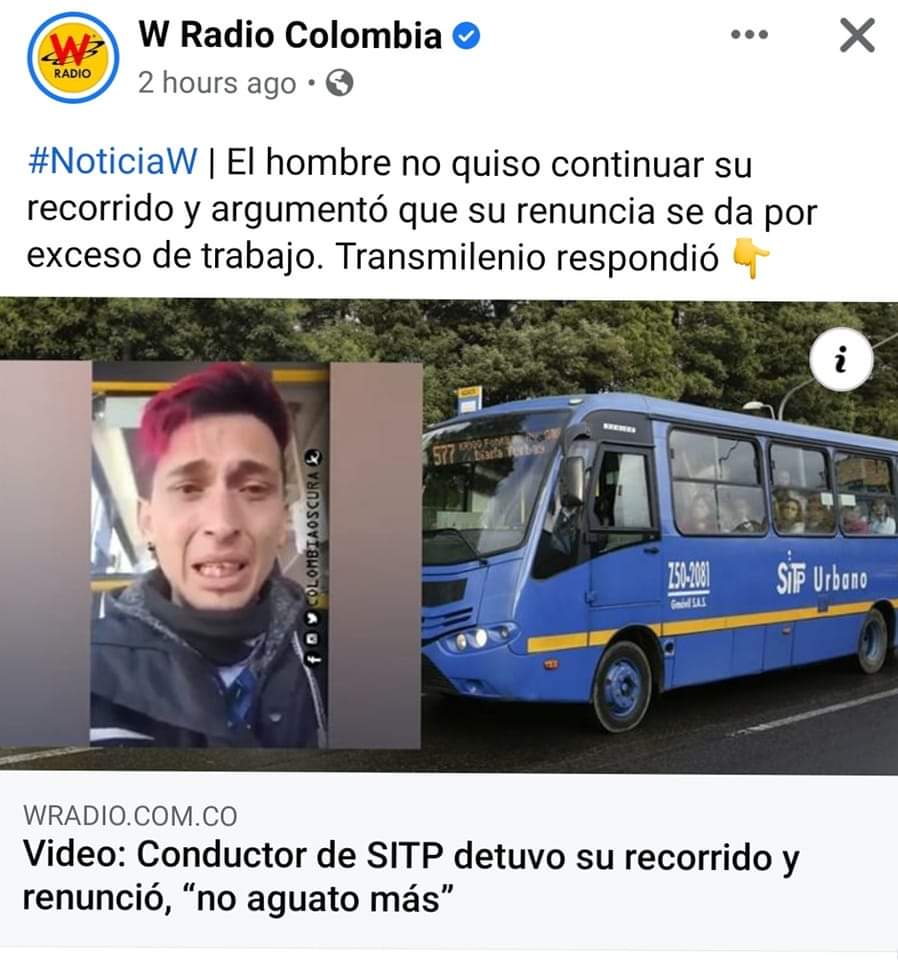
Last week a driver of the public transport system of Bogotá (SITP, Sistema integrado de transporte público) stopped the bus in the middle of a route, asking the people inside the bus to go down and quit his job. He replies that he could not tolerate this job more, and social media explodes. Many people made fun of him, but also some people supported him. He complained out of the system; he did not write a resignation letter or talk to his boss. He tried to hold and hold as much as possible. But, sometimes, something breaks someone breaks.

“no aguanto más” – I can not take anymore

Now I understand that complaining does not make me less brave (less “berraca”). I do not need to walk on the edge, waiting to support as much as possible before complaining. Even if you do not make a formal complaint inside the system, complaining with your friends makes you feel lighter. The importance of the complaint is first to be heard and second to change something. To make a change, we all need to complain or hear the other one complaining.

Categories
book complaints

The first page turning

Even before the book “Complaint!” starts with the so-called half-title, the first page preceding the title page, it is preceded by 4 pages entitled “Praise for Sara Ahmed”. These are words of praise from colleagues or reviewing media (such as Library Journal or Los Angeles Review of Books) for six of Ahmed’s earlier publications, for “What’s The Use. On the Uses of Use” (2019), “Living a Feminist Life” (2017), “Willful Subjects” (2014), “On Being Included. Racism and Diversity in Institutional Life” (2012), “The Promises of Happiness” (2010) and “Queer Phenomenology. Orientations, Objects, Others” (2006), published by Duke University Press.

Sara Ahmed is a prolific freelance researcher and writer who explores how power operates in language, families, everyday life, institutions and cultures, assigning/performing gender identities and steering them into traditional hetero-patriarchal trajectories, how power is abused, but also how abuses of power can be identified and existing hierarchies and inequalities dismantled, what forms of resistance exist and what it “costs” to speak out and behave in a resistant way. In her now eleven books, she uses the tools of intersectional feminist cultural analysis to make visible institutional structures and effects of heteronormativity, racialisation, colonial power, and heteropatriarchal gender assignment. Her book publications, like her blog posts on https://feministkilljoys.com, stand amidst the investigations and methodologies of affect theories, cultural studies, critical race studies, queer theory and feminist theories. Ahmed is interested in how governments function and how they can be challenged and changed to alternative futures. By reflecting on bullying, harassment, emotional abuse, violence, assault, or rape in domestic and academic settings, she examines the tangled and intertwined processes, most of which are difficult to penetrate and dissect, that intersect amidst (also institutionalised) sexism, racism and colonial violence.

But @publisher Duke, to start a publication with 4 pages of praise and then get to the title page with the author’s name and the title of the publication is a publishing decision that is difficult to comprehend. Advertising should (perhaps) be placed where potential readers can be addressed or reading decisions can be influenced: on the back cover, on the publisher’s website, in flyers, in social media. This is where praise can (perhaps) attract attention and make an impact. On the other hand, promoting a book within the reading section and even before the book begins is incomprehensible to me. The inside section of a book is reserved for the author and her text. I would be curious to see how Ahmed herself would deconstruct these 4 pages and put them into a mechanism of action of institutional operations of power, knowledge and truth. But now I am looking forward to reading …

Categories
book complaints

Das erste Blättern

Noch bevor das Buch „Complaint!“ mit der sogenannten Schmutztitelseite, der ersten, dem Titelblatt vorangestellten Seite startet, sind ihm 4 Einzelseiten vorangestellt, die mit „Praise for Sara Ahmed“ übertitelt sind. Hierbei handelt es sich um lobende Worte von Kolleg*innen oder rezensierender Medien (wie Library Journal oder Los Angeles Review of Books) für sechs frühere Publikationen von Ahmed, für „What’s The Use. On the Uses of Use“ (2019), „Living a Feminist Life“ (2017), „Willful Subjects“ (2014), „On Being Included. Racism and Diversity in Institutional Life“ (2012), „The Promis of Happiness“ (2010) und „Queer Phenomenology. Orientations, Objects, Others“ (2006), die im Verlag Duke University Press erschienen sind.

Sara Ahmed ist eine sehr produktive, freie Wissenschaftlerin und Autorin, die erforscht, wie Macht in Sprache/n, Familien, Beziehungen, Alltag, Institutionen und Kulturen wirkt, Geschlechtsidentitäten zuweist/performiert und in tradierte hetero-patriarchale Bahnen lenkt, wie Macht missbraucht wird, aber auch, wie Machtmissbrauch identifiziert sowie existierende Hierachien und Ungleichheiten abgebaut werden können, welche Formen des Widerstands existieren und was es „kostet“, sich widerständig zu Wort zu melden und zu verhalten. In ihren mittlerweile elf Büchern setzt sie die Instrumente der intersektionalen feministischen Kulturanalyse ein, um institutionelle Strukturen und Auswirkungen von Heteronormativität, Rassifizierung, kolonialer Macht und heteropatriarchaler Geschlechterzuweisung sichtbar zu machen. Ihre Buchpublikationen stehen ebenso wie ihre Blogeinträge auf https://feministkilljoys.com inmitten der Untersuchungen und Methoden von Affekttheorien, Cultural Studies, Critical Race Studies, Queer Theory und feministischer Theorien. Ahmed interessiert, wie Regierungen funktionieren und wie sie herausgefordert und zu alternativen Zukünften verändert werden können. Indem sie Mobbing, Belästigung, emotionalen Missbrauch, Gewalt, Körperverletzung oder Vergewaltigung im häuslichen und akademischen Umfeld reflektiert, untersucht sie die verworrenen und verschlungenen, meist kaum durchdring- und sezierbaren Prozesse, die sich inmitten von (auch institutionalisiertem) Sexismus, Rassismus und kolonialer Gewalt überschneiden.

Aber @Verlag Duke, eine Publikation mit 4 Seiten Lob zu starten, um dann zu der Titelseite mit dem Namen der Autorin und dem Titel der Publikation zu kommen, ist eine Verlagsentscheidung, die kaum nachzuvollziehen ist. Werbung ist (vielleicht) sinnvoll an den Stellen zu platzieren, an denen potentielle Leser*innen angesprochen oder Leseentscheidungen beeinflusst werden können: auf der Buchrückseite, auf Verlagswebseiten, in Flyern, in den sozialen Medien. Hier können Lobeshymnen (vielleicht) Aufmerksamkeit und Wirkung erzielen. Ein Buch hingegen innerhalb des Leseteils und noch vor Beginn des Buches zu bewerben, ist mir nicht verständlich. Der Innenteil eines Buches ist der Autorin und ihrem Text vorbehalten. Ich wäre neugierig, wie Ahmed selbst diese 4 Seiten dekonstruieren und in einen Wirkmechanismus von institutionellen Macht-, Wissens- und Wahrheitsoperationen setzen würde. Aber nun bin ich gespannt auf die Lektüre …

Categories
book

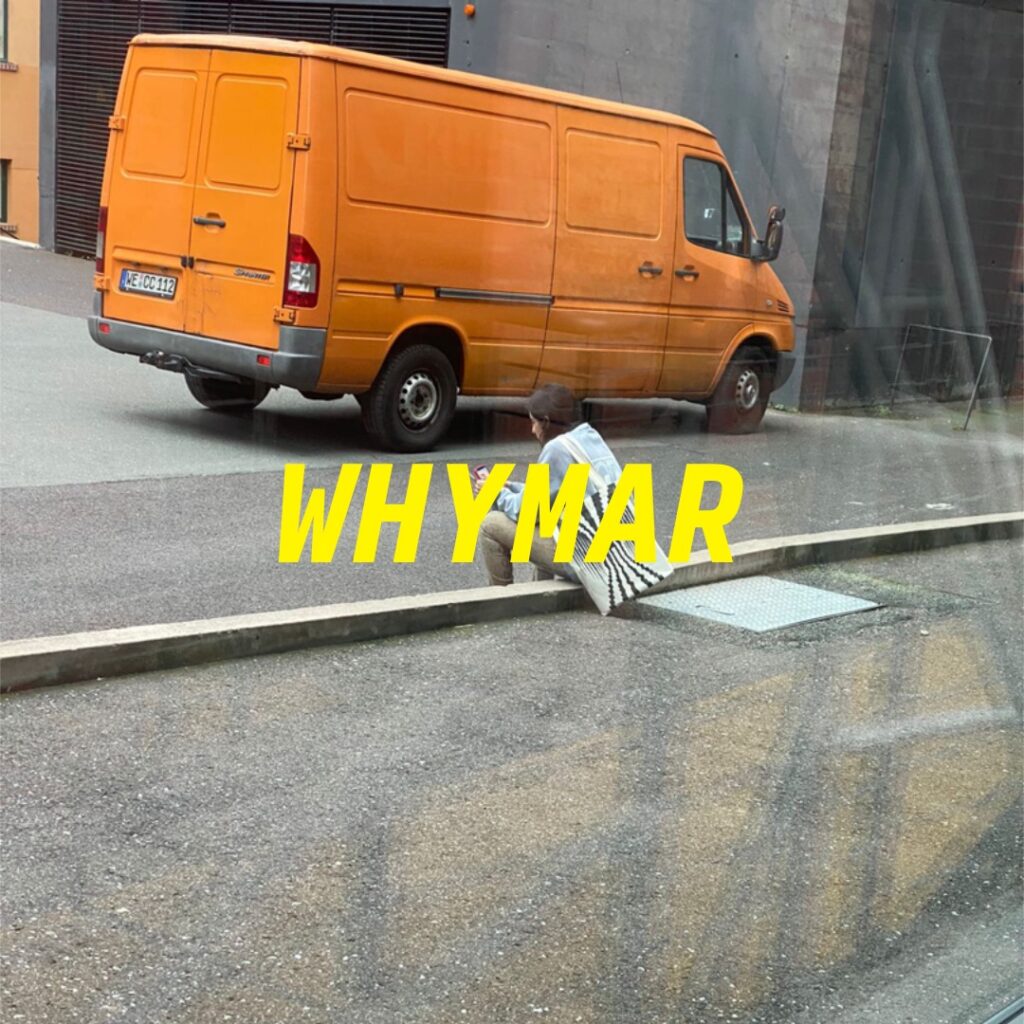
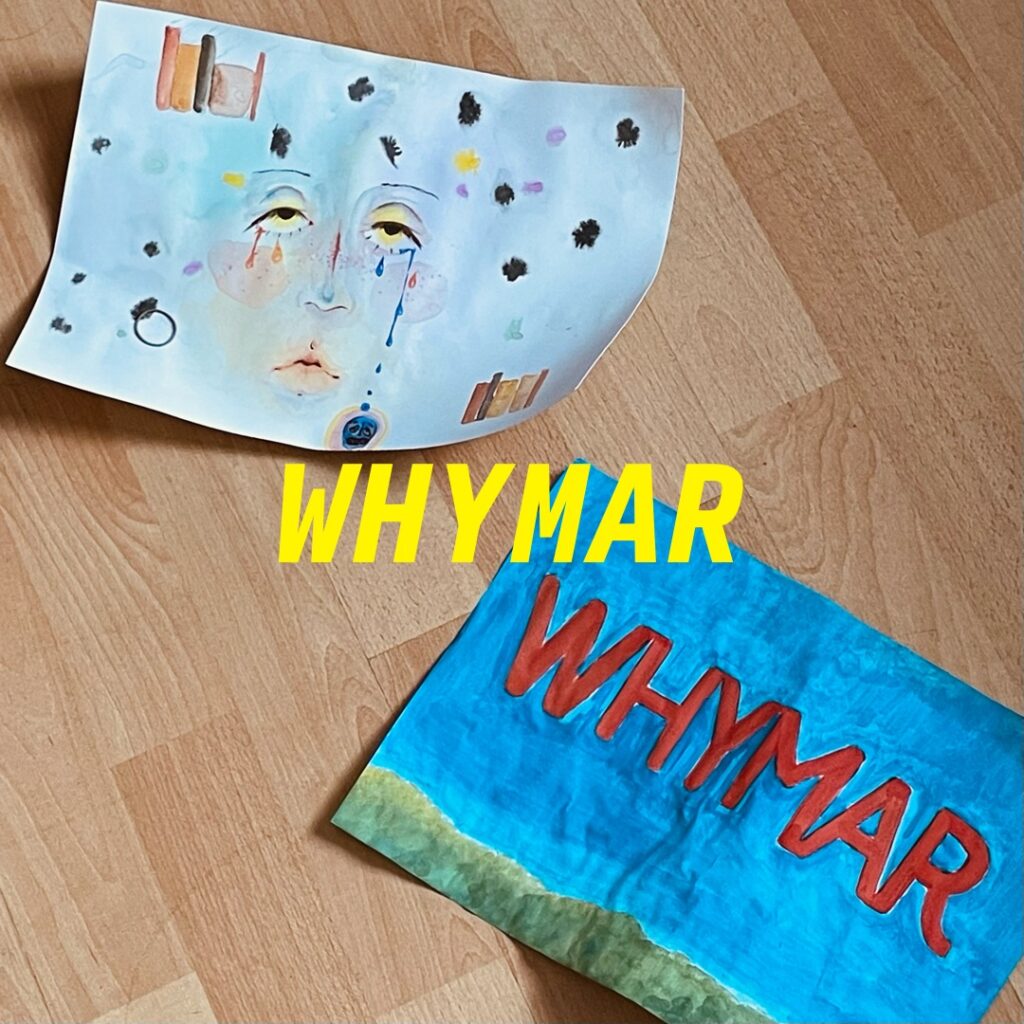
“WHYMAR” – a series of photos in Weimar while I complain about why I am here (and not in Berlin).

WHYMAR. 2021. Parra.
  1. Me + Tote Bag “Why”. Early this year i casually designed some tote bags that say WHY. Maybe it was my unconscious expressing the feeling I had when I moved from Berlin to Weimar and could not start my studies there. This picture was taken by a friend of mine while I was sitting waiting for him.
  2. The place I learn in. Since 2018 I was manifesting my desire to pursue my studies in Germany, mostly to have the chance to get in touch with the Bauhaus somehow. Life has been so magical that I’ve had the chances to be in the places I’ve always wanted. Life shakes me and moves form place to place. This picture was taken by me in the room of Graphic Design in M1. (please don’t misunderstand me. i feel very fortunate and the proudest to be studying here.)
  3. The place I live in. I feel very grateful to have the chance of having my own safe space and have all the privileges I have. I started living in this new room since Oct.2021 and it is the place where I have lived where I have felt the best. It is big, bright and I really feel at home in here. This picture is of my desk.
  4. The road to Weimar. This year I stated as a purpose to travel to Berlin as much as I can. I’ve done it 2 times since I said it would be a goal from now on until I finally go back and live there. The feeling that I embody every time I am on the road in the highway going out of Berlin is something I can not explain with words, but even though I try to explain it I know it is hard that someone relates to that emotion. I took this picture on my trip Berlin-Weimar the 01.11.2021.
  5. Things I do. Last Sunday my roommate and I decided to explore our creativity in a more analog/crafty way so we decided to take out some paper, watercolours and start drawing. We decided the topic was Weimar. She represented in her own way what Weimar means to her. Mine was more of a rebranding of the city’s name and what it causes me. This picture contains the final result of our drawings.
  6. Things I feel. As autumn settles in and winter approaches, nostalgia is also coming to Weimar to knock my door. I love the cold, but it doesn’t feel the same if it’s shared. I am still adapting myself to the seasons, as im adapting too to many other changes. This photo was taken yesterday at 16:45 and I wanted to send it to my parents to show them how homesick this panorama made me feel.
Categories
book

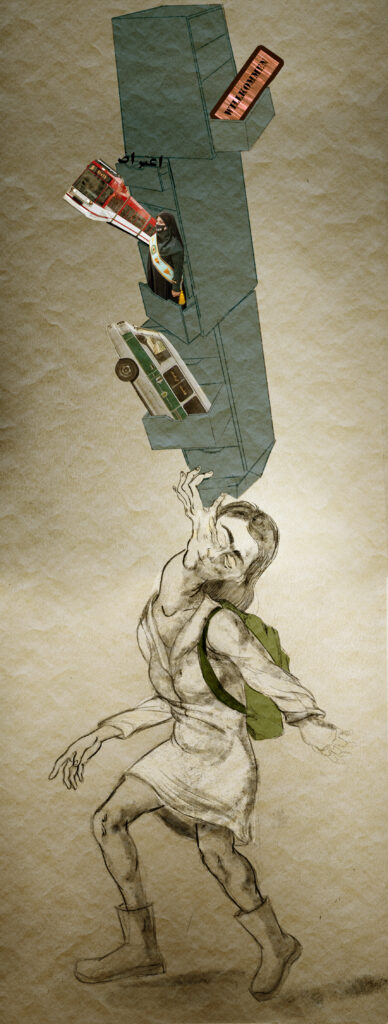
I do not want to become a filling cabinet

“if a body can express a complaint, a body can be a complaint testimony.”

This is my body. This is me carrying on, regardless of all the pain. It’s not about that experiences; the one in the train or the other one as I was crossing the street. It’s my entire life.

What are you carrying in the cabinets of your mind? I would like to hear your story and about all the objects, symbols, words that you are bearing inside your body.
If you do not wish to share your story here in the comments – out in the open – message me directly. Anonymous if you wish. Let me be your feminist ear, and allow my art to be your voice.

“to hear complain is to become attuned to the different form of its expression.”

Note: I did not share the story and the explanation about the images kept in the cabinets here. I would be glad to hear back from you and share more.

Categories
book

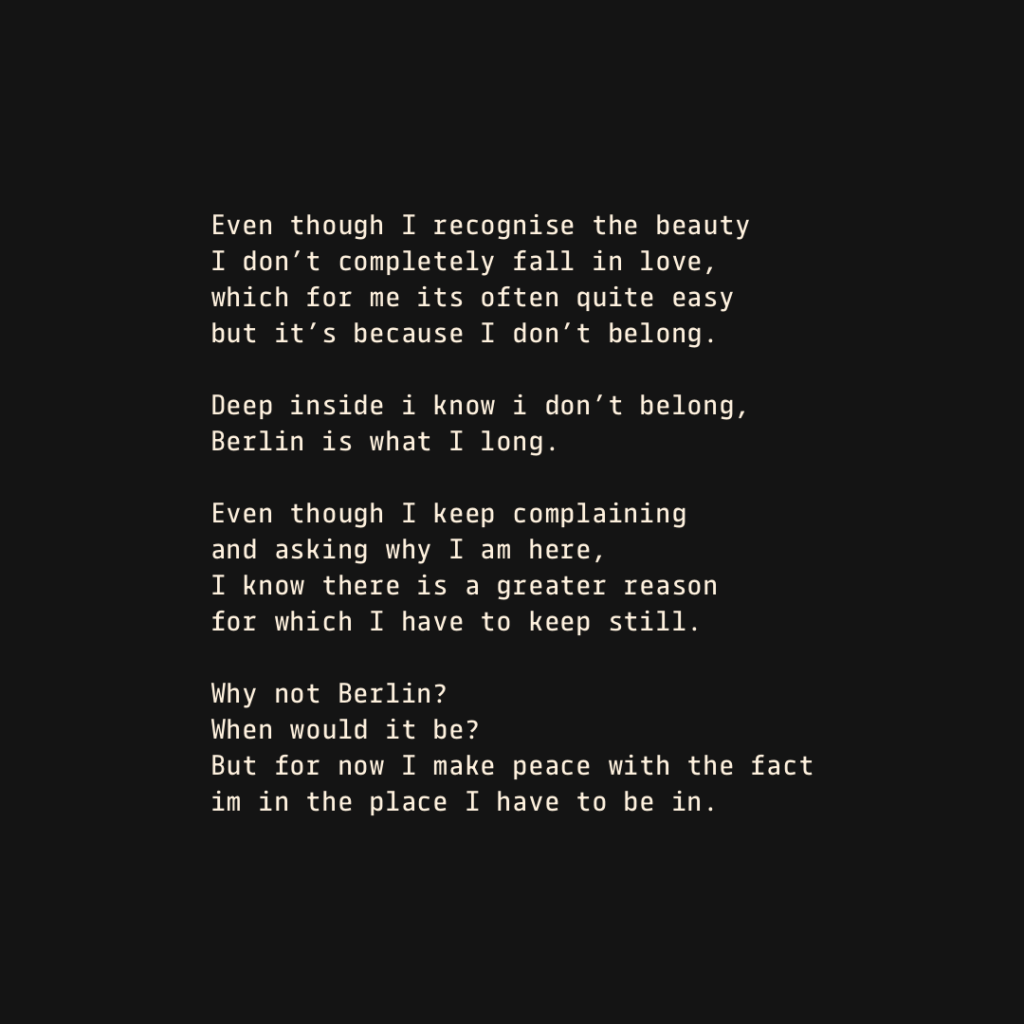
“Therefore I complain” – a poem.

THEREFORE I COMPLAIN.
Weimar. 2021. Parra.

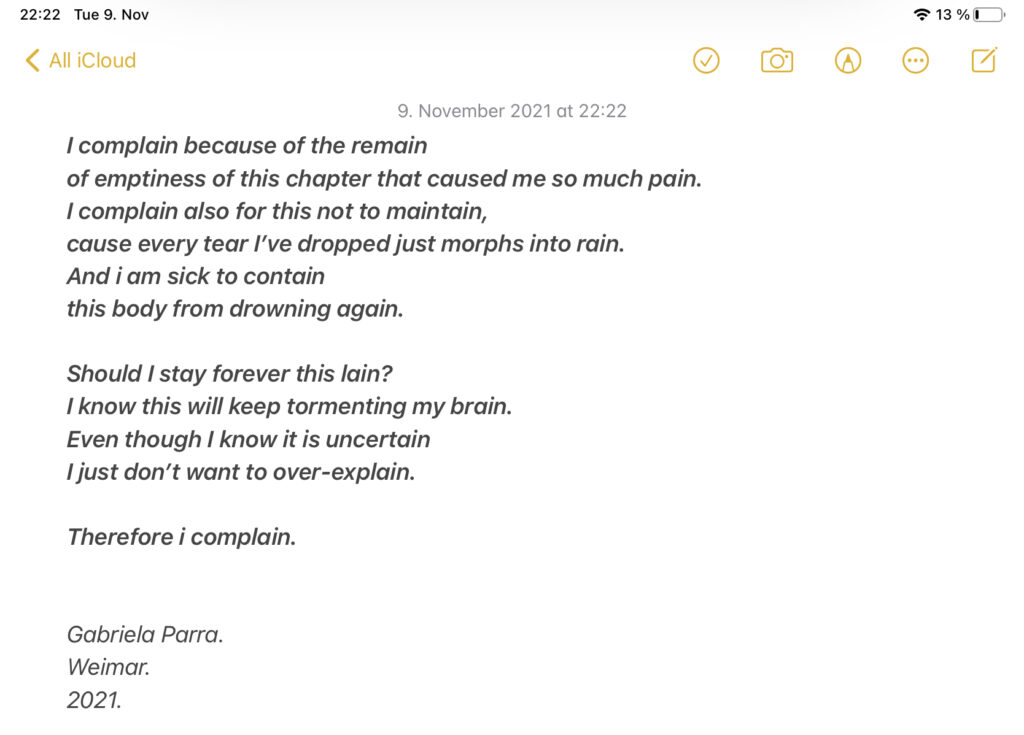
I complain because of the remain

of emptiness of this chapter that caused me so much pain.

I complain also for this not to maintain,

cause every tear I’ve dropped just morphs into rain.

And i am sick to contain

this body from drowning again.

Should I stay forever this lain?

I know this will keep tormenting my brain.

Even though I know it is uncertain

I just don’t want to over-explain.

Therefore i complain.

A poem I wrote amid the lines of Sara Ahmed’s book Complaint! 

I got inspired by the feeling that drove me into situations in which I felt so saturated by a specific experience and I just felt the need to explode and say it outloud but at the same time I didn’t want to be repetitive or simply to be a fuss to anyone in my surrounding.

This also makes me think that I am not the only person that has felt this and maybe it is one of the reasons most people avoid making a complaint or even speak up when they feel uncomfortable with something.

Categories
book

it breathes

An animated 3d model of a compliant as it was drawn by Ahmed in the book. It shows how the process is not in and out, but round and round and round.
You could lose your way, it swallows you.


Categories
book

doors and dreads

1.    The First Gathering

Our first session was an intimate one. Considering the fact that it’s been a good while since I actually sat with people who were not my close friends and family or hiding a good half of their face behind a mask, it was even more joyful.

The organisation part and introductions aside, we talked about the book cover, which is a photograph of the installation “Double-Doors II, A+B”, 2006/2007 by Rachel Whiteread. We talked about doors as façades – implying that there is a way forward, a way out. Yet all is waiting for you behind them is a wall, or better yet, another door. Leading to another door. Hoping, waiting for you to give up, to turn around. To stop trying.

It reminds me of a Polygon article I read a good while ago about the video game Bioshock: Infinite. I can’t remember much of the article – but I remember that somewhere I stumbled upon this John Scalzi quote: „Being a straight white man is playing life at the lowest difficulty setting there is.” I liked this quote, I still do, it sounds smart. Difficulty settings of life as the difficulty setting of a video game. I’d argue that the same applies to our topic, winning the game of getting through the doors. Doors will be bigger, taller, more intimidating the further you get from being an able bodied cis straight white man. And you’ll be carrying more than your own weight (and your paperwork) with you. All the things that you had to overcome, to prove, as a woman wanting to exist anywhere other than under your own roof, inside your own walls, behind a door. The very first door separating you from the world outside, from fresh air.

This is a concept that I know too well as a woman coming from the middle east (which is not a good start to anything) and from a highly religious, patriarchal and misogynistic society. The first thing you learn as a little girl in my country is that the world outside is not safe. The streets, oh specially the streets at night but streets in general – metro underpasses, university, workplace, your boss’s office – definitely not safe. Your boyfriend’s home? God no. ANYONE’S HOME – say, a co-worker you have to shortly meet to hand them some documents, an artist who is holding classes in their home – oh, dear, you’re so looking for trouble if you go there.

Just being in these places means you deserve whatever happens to you. That’s what we learn. Some hear it from others, worried moms, super-worried grandparents. Or you read someone’s experience on the internet. Then another one. then another. You hear it from a friend of a friend who had to run away from a driving car catcalling her and asking help from a police officer, only to be asked why she’s out so late at night looking like this. Your friend gets abused by her boss who had asked her to stop by his place to grab some files. Your friend is not going to tell anyone. No going to file a complaint. She knows too well where that door is going to lead. A few other doors, surly, to get her all warmed up, and a pretty good amount of victim blaming. Oh, and losing a job.

She learnt it as a little girl. And, she knows, as I do, and all the women in my country – you are not safe outside. So, anything that happens to you after you close your home’s door behind you is your own fault. You were asking for it. You had it coming.

And well, what if a woman is assaulted inside her own house? Glad you asked: what happens behind closed doors stays behind closed doors. Private family matters, right? People argue. Husbands beat up their wives, fathers cut their daughters’ throats, brothers lock their sisters inside1. Such is life.

Thinking of a door as something which is separating your (if you’re lucky) safe space from the world outside led me to another interpretation of the picture of the doors without locks, without handles: you can’t keep anyone out. Assault – be it sexual, physical or verbal – is indeed nothing but an invasion of a personal space. A door without a lock can’t keep anyone outside, it can’t keep you safe.

2.    The Book Launch

         The online book launch took place exactly after our first session. I missed my bus and had to walk an unpleasantly long distance in the dark, while listening to Sara Ahmed and other women who had one way or another contributed to the book. Some of the women whose “testimonies’’, as Ahmed calls them, were used in the book came to word, and I was humbled by their courage and inspired by their strength to show where it hurts, to show vulnerability. I imagine every time you retell a story of experiencing abuse you are reliving it, opening the wounds again and again. Questioning your actions and doubting if you did something wrong, if you – typical in where I come from, as I mentioned – had it coming.  I found myself envying those women – which does not sound right. But later as I talked about the event with a friend – also from my country – she said she felt it too. A sudden burst of loneliness hit us, as we realised how much we want to hear the same discourse in our mother language. How out of reach it still appears and how high the price of that could be.

Which brings me to another powerful aspect of the event, and the book, and the whole concept of a „feminist collective”: we are, in fact, not alone. Now, it doesn’t magically take the pain and the frustration away. But there is something empowering and comforting in knowing that. And the more people join the feminist collective the more powerful we are. We have even experienced it with Iran’s meto movement too, which has gained momentum in recent years. Women started talking, complaining, out loud, without censoring themselves, and about men, which is as horrifying as a woman can get – in the eyes of the abusers and their apologists. Big names were outed by the women who suffered harassment, especially in the art field2, and then many others got the courage to talk about past or ongoing traumas caused by co-workers, bosses, professors, friends, and family members. 

I had all these in my mind, listening to the bittersweet event. And that’s when I heard yet another interpretation of doors from one of the participants, my favourite one: doors are not always there to frustrate and disappoint, she believes. Sometimes you open a door and there’s a whole feminist collective waiting for you behind it.

Growing, and empowering. 

  1. I am of course talking about the so-called honour killing and its long tradition in my country, which is beyond the scope of this post.
  2. I do not think that anyone should draw the conclusion that for whatever reason, men who are active in the art field are more likely to commit harassment. I further believe it’s the women who play an active role here. Studying art in general is not something that most traditional families in my country would welcome, it doesn’t pay much and people involved are hippies and addicts and corrupted, so they say. For a young girl to get into the arts, especially cinema, requires a good amount of courage to begin with. Hence they are more likely not to remain silent in the face of abuse.

Categories
book

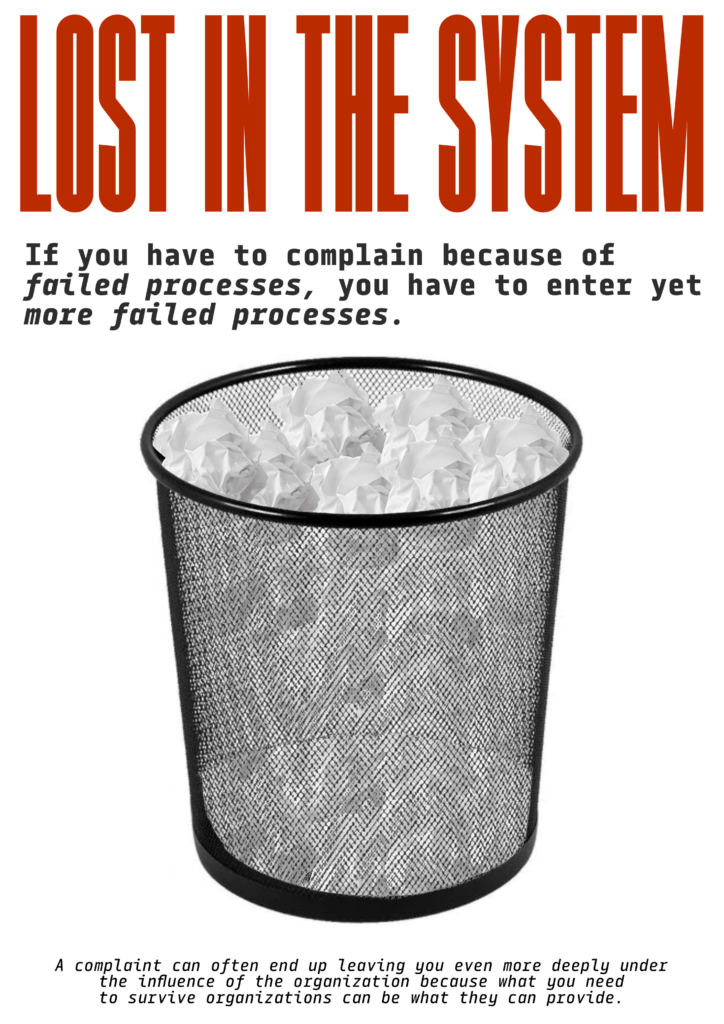
“Lost in the system” – a poster.

1. LOSTINTHESYSTEM. 2021. Parra

““lost in the system”.”
“If you have to complain because of failed processes, you have to enter yet more failed processes.“
(Ahmed 2021, p. 96)

A complaint can often end up leaving you even more deeply under the influence of the organization because what you need to survive organizations can be what they can provide. 
(Ahmed 2021, p. 99)

“The consequences of rubbish systems for keeping track of things are very different depending on who or what is being tracked. Strategic inefficiency can be how some disappearances are not counted by being deemed “lost in the system.” If you have to complain because of failed processes, you have to enter yet more failed processes.” (Ahmed 2021, p. 96).

The previous piece was taken from chapter 2 “ON BEING STOPPED” of the book Complaint! by Sarah Ahmed, and those specific words were the inspiration to make  this A1 poster, which’s aim is to criticize the way in which the process to make a complaint turns into due to the incompetency and neglect of the systems we have to deal with.

A paper bin was chosen to simulate the system itself or more specifically, the place where complaints are supposed to end up at. A spacious, “transparent” container in which more complaints can come into: “there is space for everyone”. The paper balls are of course the complaints of each individual, but they are obviously treated as trash, wrapped up and thrown among other garbage. And here I want to connote that often complaints are not even filed or archived to be proceed in even far futures… they are just treated as trash.

“A complaint can often end up leaving you even more deeply under the influence of the organization because what you need to survive organizations can be what they can provide.” (Ahmed 2021, p. 99). This phrase appears at the end of the poster to point out that your complaint can end up really under many other (not necessarily more important) processes, because normally these institutions have no interest on helping, guiding, whatsoever providing you a solution, regarding your complaints on their behaviours or proceedings. 

Categories
book

“On being stopped” – a 7 A4 posters serie.

Through the reading of chapter two of the book “Complaint!” by Sarah Ahmed I affirmed many of the thoughts that come into my mind when questioning myself on how societies work and are built up. Some of these are often related to the abuse of man-power in different institutions which was the common denominator in many of the experiences of neglect towards complaints reported by the author on this occasion.

As I saw myself once again in positions of many of the women of these stories I felt that there has to be something so rotten and unviable and disgusting in our society to keep being this much of conformists and keep allowing injustices in any space, not just in big scenarios such as institutions, universities, but also between relationships, from any type; on how reduced we can feel ourselves when we make a complaint and not being able to see how basic it is to ask for respect.

I highlighted some phrases/quotes that I liked from this chapter and tried to make something out of it. As I study Visual Communication and graphic / typographical poster design happen to be one of my passions I designed a 7 A4 posters serie. Each poster contains a quote I chose. 

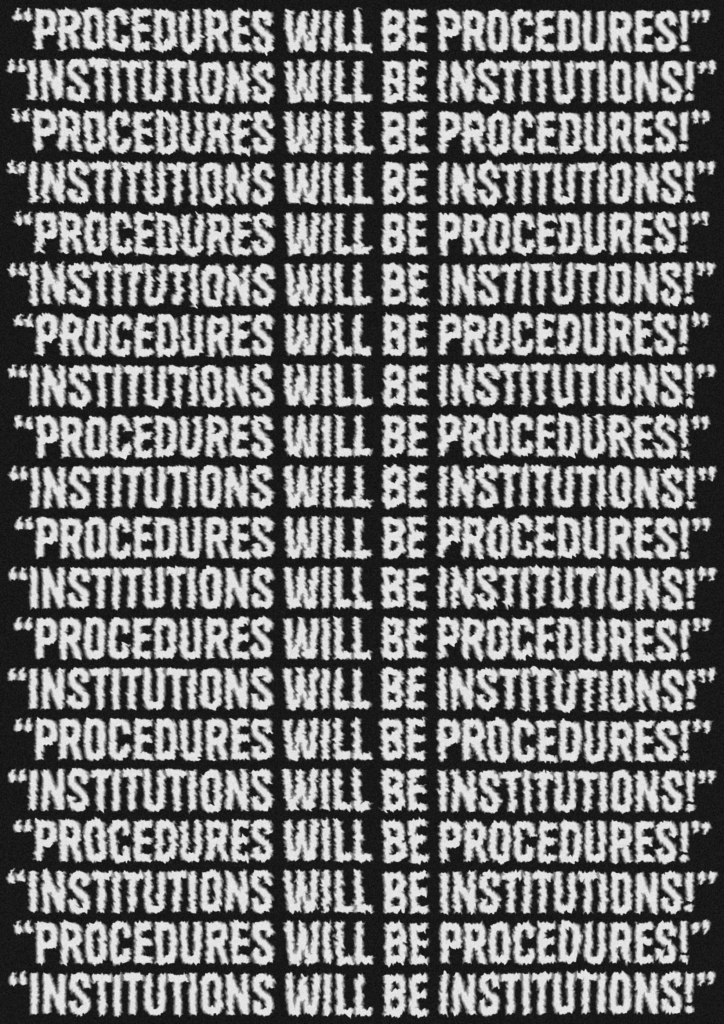
1. PWBP / IWBI. 2021. Parra
“procedures will be procedures! 
institutions will be institutions!” 
(Ahmed 2021, p. 73)

This two phrases are the clear example of what conformism sounds like to me. And while doing a complaint many doubts can come on the way that finally may lead to conformism. The action of standing in the same point without having any expectation on the result, which is, in other words, ”being stopped” – the title of chapter 2.

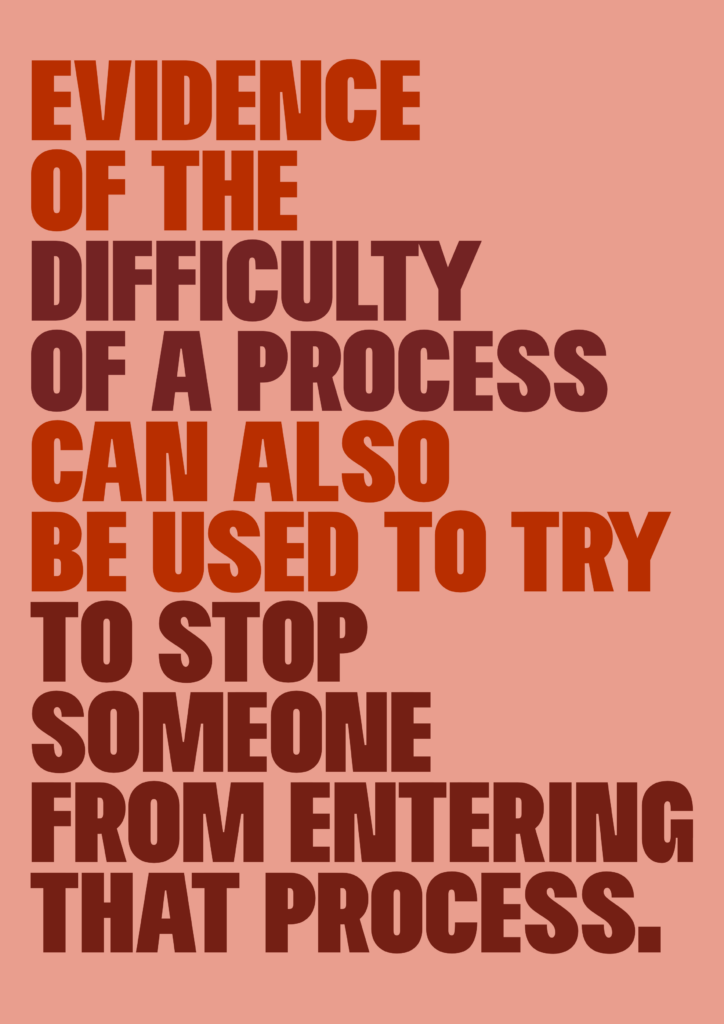
2. DIFFICULTY OF A PROCESS. 2021. Parra
“Evidence of the difficulty of a process can also be used to try to stop someone from entering that process.”
(Ahmed 2021, p. 75)

Ahmed offers these words by pointing that warnings often frighted people, and fear is also a mean of control. Really powerful I may say. When you have to face a process but previously see how tedious it is going to be, you just want to give up.

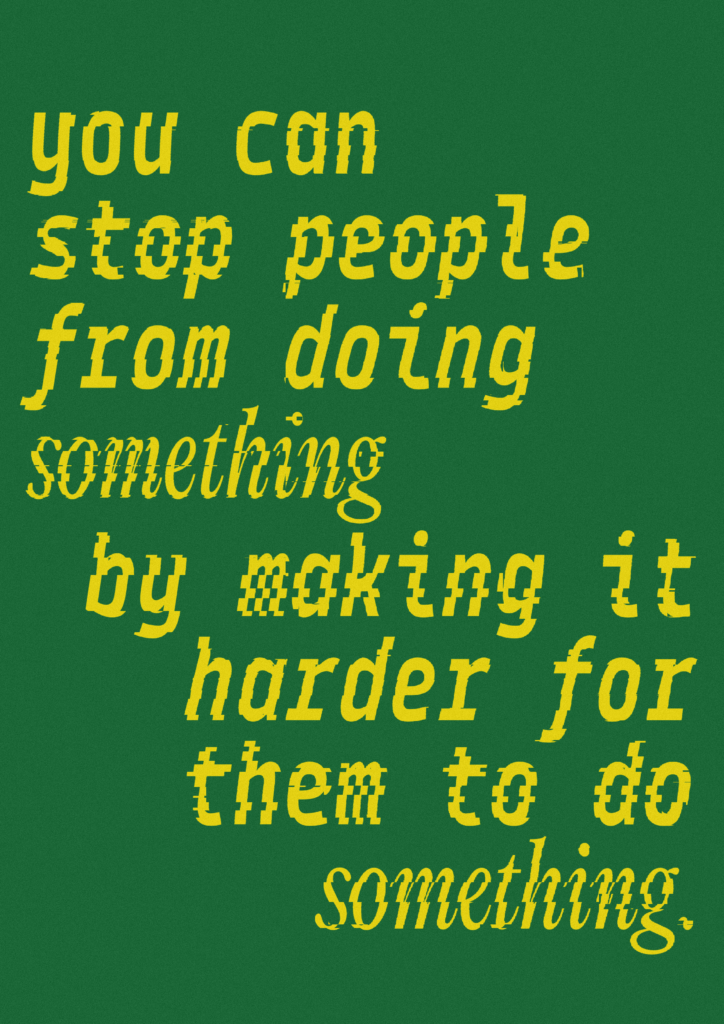
3. SOMETHING. 2021. Parra
“You can stop people from doing something by making it harder for them to do something.”
(Ahmed 2021, p. 78)

This quote perfectly fits with the previous one. 

While you recognize blockages, burdens, doubts and lack of companionship during a process, there is no reason left to pursue it, no matter how significant and dignifying it may be, the future and end do not seem to be prosper.

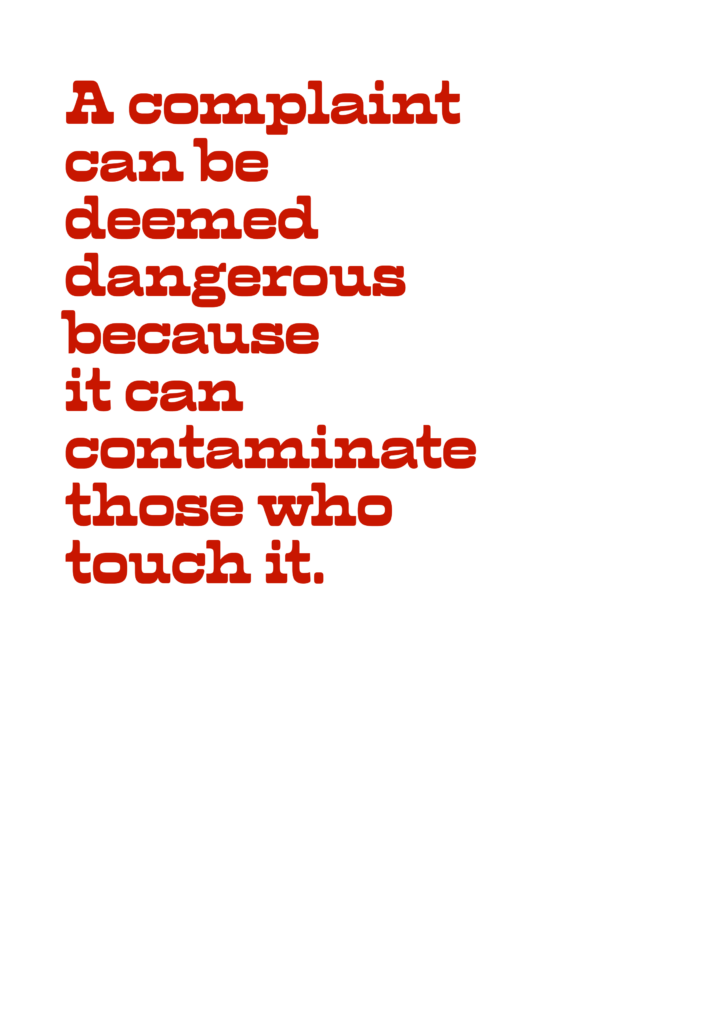
4. CONTAMINATION. 2021. Parra
“A complaint can be deemed dangerous because it can contaminate those who touch it.”
(Ahmed 2021, p. 82)

When a complaint involves various parties in a previously corrupted environment, it just does not put anyone in a fructose position because maybe many hidden and past situations may come to light through the process and can condemn the involved ones into new / not-so-convinient situations.

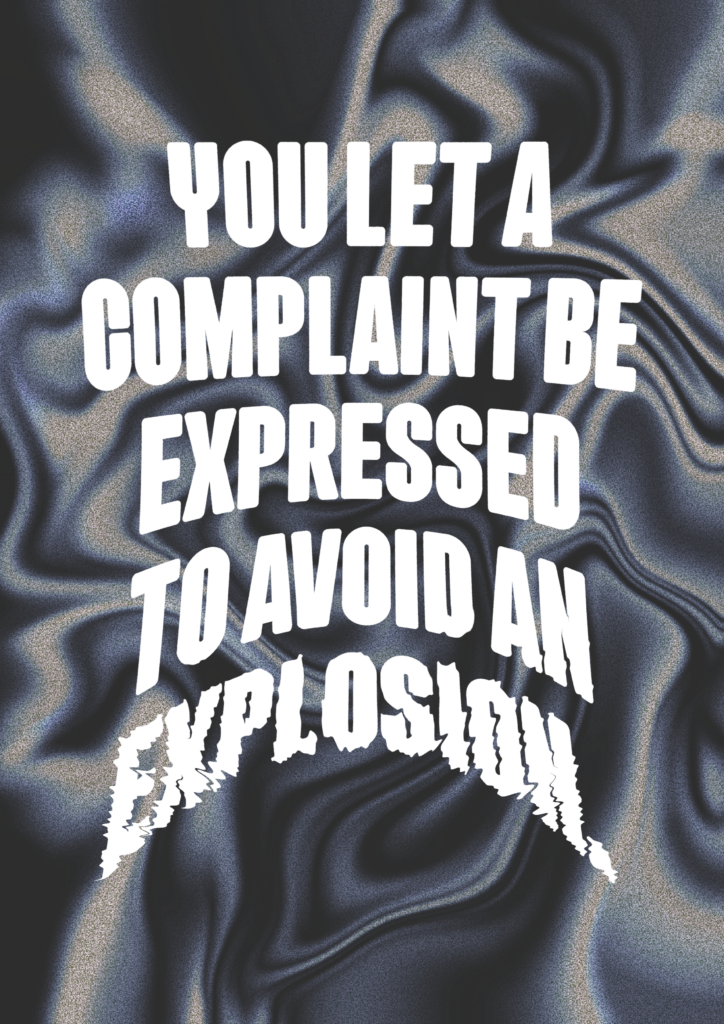
5. EXPLOSION. 2021. Parra
“You let a complaint be expressed to avoid an explosion.”
(Ahmed 2021, p. 84)

Sarah Ahmed mentioned this phrase to point out the perspective that a complaint often has a role of a valve that lets something scape to the air and then it just suddenly disappears, by avoiding an inner explosion.

I partially disagree in this case because I consider that a complaint can potentially cause an explosion if it is managed in the desired way. To make clear my point I am going to use an example: my boss has sexually harassed me. I proceed to make a complaint and it is utopically taken into account. My complaint is studied and proven. He gets fired and everyone gets notified the reason why. More people at my same job start reporting and exposing other sexual abuses in our field. The bomb now has exploded. My complaint was taken into account and has led to more people make their own complaints.

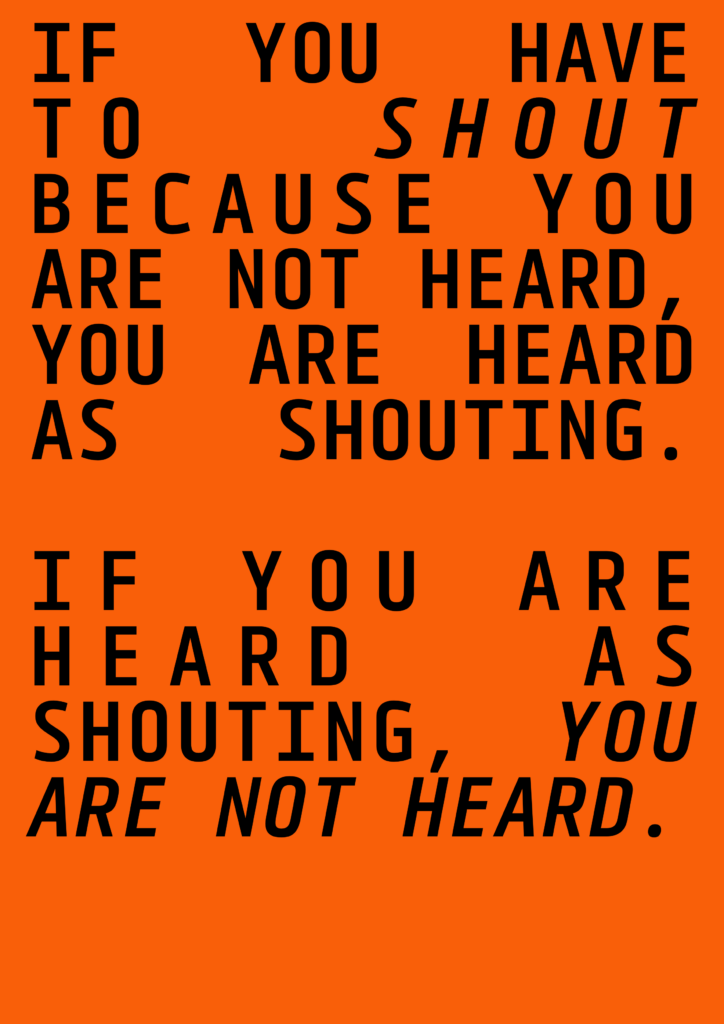
6. SHOUTING. 2021. Parra
“If you have to shout because you are not heard, you are heard as shouting. If you are heard as shouting, you are not heard.”
(Ahmed 2021, p. 89)

In my perception, there shouldn’t be a need to shout in the first place, but of course as some are in higher positions, the ones in the bottom are hard to be heard. Everyone should be heard at any context. Here it is possible to recognize how inequalities cause so many gaps, also seen throughout the spacing of the words in the poster. 

7. RESISTANCE. 2021. Parra
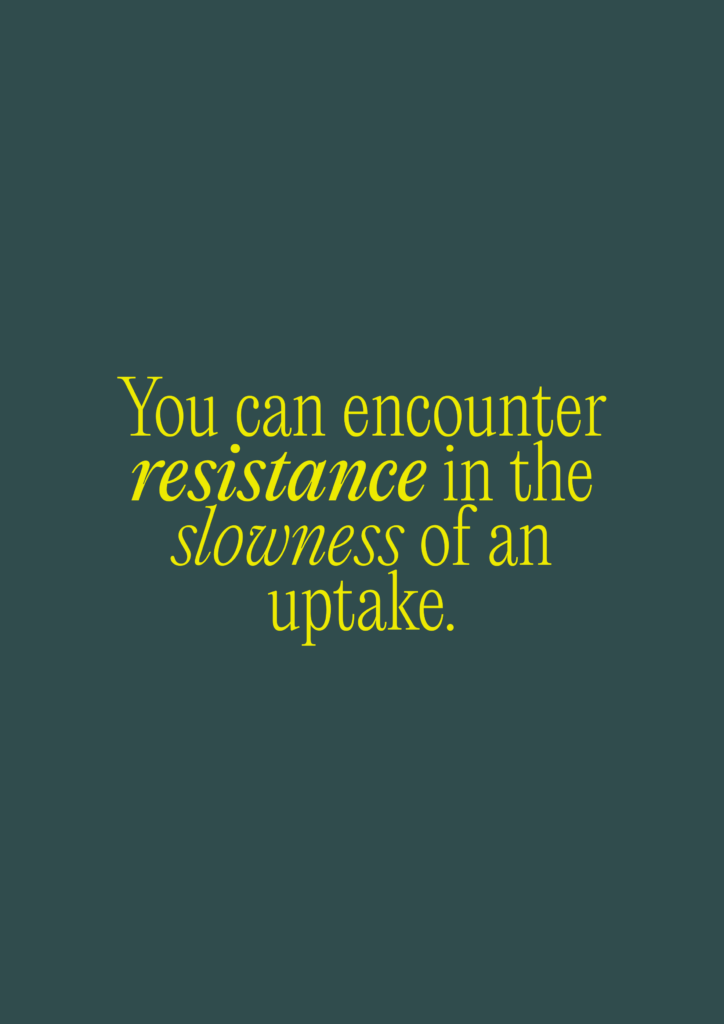
You can encounter resistance in the slowness of an uptake.
(Ahmed 2021, p. 92)

Ahmed makes this appreciation by comparing the process of doing a complaint with a wall. When there is a blockage, when something needs to be stopped. However, this does not mean that it is the end, one must wait to the the outcome of this difficult processes. And finally I interpret this sentence as the author wanting to say that resistance comes not by tearing the wall down, but thought the capacity of keeping on track without giving up.