Ich hatte eine Menge Gefühle, als ich das zweite Kapitel “ON BEING STOPPED” (Ahmed 2021: Complaint!) las. Wenn man unzufrieden ist und sich beschweren will, wird man oft von jemandem davon abgehalten: Beschwere dich nicht, die Konsequenzen werden schwerwiegend sein. Das kommt in China aufgrund der traditionellen Kultur und des Einflusses der Bildung häufig vor.
Einige Sprichwörter, über die wir oft sprechen: “以和为贵。Yi He Wei Gui.” “大事化小,小事化了。Da shi hua xiao, xiao shi hua liao.” “吃亏是福。Chi kui shi fu.”
“以和为贵。Yi He Wei Gui.” bedeutet, dass es am wichtigsten ist, dass die Menschen in Frieden miteinander leben. Konflikt vermeiden.
“大事化小,小事化了。Da shi hua xiao, xiao shi hua liao.” Bedeutet: Wenn es einen Konflikt gibt, lass die Situation nicht wachsen. Lass den Konflikt stattdessen allmählich abklingen. Wie kann man ihn reduzieren? Zum Beispiel zeige ich zuerst Großzügigkeit und mache Zugeständnisse. Dann wird sich die Person, mit der ich im Konflikt stehe, auch zurückziehen. Wenn wir alle einen Schritt zurücktreten, wird der Konflikt reibungslos gelöst werden. Natürlich ist das der Idealzustand. In der Realität ist es möglich, dass andere dich stärker unterdrücken, nachdem du nachgegeben hast.
“吃亏是福。Chi kui shi fu.” Es geht darum, den Leuten zu sagen, dass sie eine bestimmte Einstellung entwickeln sollen. Wenn es Ungerechtigkeiten gibt, versuche nicht zu streiten oder zu kämpfen, sondern lerne, geduldig zu sein. Wenn du diese Geduld lernst, kannst du eine Menge Ärger vermeiden. So kann das Leben glücklich werden.
Aufgrund dessen ist unsere erste Reaktion auf eine ungerechte Behandlung, dass wir uns damit abfinden und Konflikte und Ärger vermeiden. Wenn jemand in einer solchen Situation steht, raten viele Menschen davon ab, sich zu beschweren. Sie werden Ihnen viel über die schlimmen Folgen erzählen, die nach einer Beschwerde auftreten. Und sie glauben, dass sie dabei weise und erfahren sind. Aber einige von ihnen haben vielleicht gar keine Erfahrung, sondern sind einfach von der traditionellen Kultur beeinflusst. Beschwert man sich also weiter, nachdem man diese Rückmeldungen erhalten hat oder nimmt es einfach hin? Schwer zu entscheiden.
Zwei Zitate aus dem Buch “Complaint!” lauten:
“you are being encouraged not to complain, to “let it go” by resolving things in some other way or by hop- ing for some other resolution.” (S. 72)
“A complaint is heard as making waves, as stopping things from being steady.” (S.77)
“Thank you for calling Expedia lodging support; my name is Lucía. May I have your property ID please?”
The sentence above accompanied my early mornings through the last 11 months before coming to Weimar. I worked as a call center agent for the known French company Teleperformance. I answered the phone and replied to emails in a campaign called Expedia.
-------
Thought 1. Working as a call center agent is nobody's dream.
Thought 2. I am feeling ashamed of being a call center agent.
Thought 3. I did a 5-years bachelor's in Fine Arts in the best university in Colombia; a call Center should not be my place. ( I felt terrible of thinking about this after)
Thought 4. Whatever...I need money to do my MFA in Germany.
Thought 5. This is an experience I have to live. I should be grateful for having a job during a world pandemic.
STOP LUCY... This complaint of not having job opportunities as an artist in a country like Colombia should be a future post because this post, as I already said, is about talking to a wall.
------
Expedia is another vast “American”* company that provides services to find the “best prices” in the market to book flights and hotels (same as Booking.com). I was backstage since I only attended property owners, front desks, and other hotel employees. So, the complaints I received, I heard, were more “polite,” less “aggressive,”…
Less complaint.
It is called “customer service.” However, it is never truly about them.
The kind of complaints that came to me was usually about money. Let me explain to you how payments work for this company: the giant offers two ways to pay hotels the funds collected from travelers. On the one hand, the Expedia Virtual Cards. EVCs could be processed as soon as the guest had left the hotel; the hotelier already has the number Expedia assigned to the card. They only need to charge it. On the other hand, there are the Invoices. Invoices were always a problem because people, I mean, the hoteliers, couldn’t understand why they needed to ask for payment instead of being paid as soon as they provided the service. I heard voices comparing “our” services (Expedia’s services) with Airbnb more than once. This platform pays property owners what is owed to them as soon as travelers check out. To me, this should be the right way to act. However, big corporations never work like that; they ask for money or work in advance, but they pay in terms of 90-180 days. Thus, small entrepreneurs wear out and die.
That is what an Argentine man precisely told me once. He was distraught because Expedia had not paid the last three months to him. He tried several times to contact Customer Service to understand what was happening, but no one answered. He had the right to be upset; he had been fighting for weeks, always against a vast wall. After working a couple of weeks in his case, I realized the whole problem was absurd and easy to solve. However, internal teams passed the ball from one to the other, and anyone did anything to help this man. Almost three weeks later, I could release the money (by his right) even if it was to the detriment of my “quantitative performance,” or usually called metrics.
I felt proud of myself for having been able to solve the problem. And it was not the only case actually. After all, I was a great call center agent.
Nevertheless, during the 11 months, I always felt frustrated working for a company like this one. The trouble with capitalism and these giant money-producing monsters is that they do not have a face, they have hundreds of people spread around the world…
wait … they are not really from all over the world, they are people who, like me, live in developing countries where labor is cheaper. I cost less money than an American.*I cost less money than an American.*I cost less than an American.*
So, Expedia, as well as Teleperformance, are no human beings.
And, it was not me on the phone. It was Expedia.
It was nobody.
It was an entity that cannot be spoken to.
It was a wall. It is a wall.
Thought 5. Is this frustration the same felt by Winston Smith trying to fight against Big Brother?
Thought 6. However, Big Brother was no more than a vast machine fueled by fear and worship of the ignorant.
* Being Colombian, I shouldn’t say American to refer to the USA. I am American too. But, this is another story, another complaint.
Welcome to the Strange Fruits episode of the Voiced Displeasure. Maybe the least favorite one, but tasty, for sure. Poetic, inevitably. The main protagonist relates to the 3 sections: Juice, danger, and joy; Systems, sugar, skin, and stain; The land of rightness, emptiness, and gray color. Next time instead of the external keyboard, you might bring the fork.Have you ever heard a fruit talking? Did you find it uncomfortable? Understandable. No judgments. This is a safe space. Let´s bite.
JUICE, DANGER, AND JOY
”I am a little parasite stuck on your ceiling, watching and waiting for the right moment to grab your face. I am an angry skeleton under the thousand layers of this skin blanket. I want to get out of my colonized past.
I am the one you want to squeeze. My lemonish, bitter body is hanging on the walls of your borders. Experience the haptic touch of this nectarous object – me. Me, the stranger. You – domestic. Me – the dirt on Your floor. You – the boundary. My amorph shape stands out from the crowd, breaks the concrete, entering the void.I produce joy. Try me. I am a violent inhabitant trying to break your comfort. I am the stain spot of this system.
These little hands were holding the poles in the foreign trains and buses, being observed. My hands are being watched – the way they move, how the fingers fold and dance around the strange objects. I am the sensation. My legs are making the gaps between the foreign feet, stepping into the unknown. Kissing the strange ground, while dropping the strange juice into the dry field. My earlobes are made of sugar, melting in the strange air. My lungs are suffocating from the bizarreness of this place. Its mystifying inner shakes my foreign outer. Its breeze freezes me. I must get out.”
My charming existence. My strange fruits. Its juicy resistance, that shoots the roots.
The alluring, strange chain, keeps my existance remain.
My omnipresent stain melts the acid rain.
The land of rightness, emptiness, and gray color
Welcome to Saxony, the land that tears the skin of the beast.Welcome to the act of peeling one’s outer. Chemnitz means stones, coming from the language that I can understand, for some reason. Welcome to Chemnitz, friends. Welcome these words that are coming and be free to dive into the experience.
”The strangeness climbs through my spine, from the bottom. Slowly and precisely it covers the whole backside. I feel the structure and heaviness of my skull. My earlobes are collapsing. My head leans towards the shoulders as if it is going to fall. I feel alienated from the outside.
Some parts of my body feel numb. There is a space around my inner skin that I have no contact with. I turn my head to the right I look at one point. My attention stays in the corner of my eye creating the tension of the eye muscle. I can see the small humans inside a human, I sense how they move around me. I see the shadows of these bodies, I feel the coldness piercing my outer strongly through the borders. IAM THE OTHER. The other on many that are the same.
I slowly pull my own inside towards the outside shell. I humbly tore the skin of a creature. I peel the layers of its skin and try to get out. It lasts and feels like forever. I am the stain spot on this map. Pulling. Vibrating. Pushing. I am so alive.”
PS: NEVER EAT THE FRUITS YOU HAVE NEVER SEEN BEFORE.
The power of the glasses, “Seeing the world through the lenses of complain. After this the world can’t be unseen. It gives you an capacity. An capacity to explain what is happening”. This can be a curse and a blessing. We didn’t choose to wear these glasses. They’ve been put on our faces without requests. They’ve been put on our faces, and now they’ve become a part of who we are.
The morning the glasses found the body.
The morning dawn settled on the empty streets of Ghent. The city is still sleeping. The light is wrestling its way in. The curtains won’t let the morning lighting in.
My footsteps can be heard on the stairs. I’m finding my way to the door. Everything feels surreal. The scent inherent in this ‘famous house’. The posters decorating the white, broken walls. When the front door opens, the light hits my eyes. The glasses rest on my nose bridge.
These glasses reach further than the eyes. From the neck, to the breasts, tummy, hips, right and left leg, the ankle and the feet.
As a fear of the memorie that the skin beholds. Lines fill up the empty roll of paper. Hoping that this second skin will wear off. That the glasses will fall. Blue and black lines become conscious and subconscious reality’s on paper.
The body starts moving, the hip makes a sound, the bones form an orchestra. The violin, cornet, trumpet, bugle, euphonium and trombone are screaming.
the lines of movement, by Sofie Bussé.
As these glasses slowly become the reality.
As these glasses slowly become the reality. In one of my nightly walks in Weimar, I passed a brown café. Filled with testosterone, men leaving the house to sit around a table with their male friends and get drunk. And the cliché doesn’t stop here, one woman. At the corner of the bar, multiple layers on her face. In need of validation from all those misogynistic men around her. This is a preconceived opinion, my opinion. Soon the café disappears from my sight. And I walk further into the cold.
As these glasses slowly become the reality. The body makes a movement on the experimental sound the speakers are telling us. Intoxicated body’s are filling up the room. In our own world, we move. And as this is my reality, in which movement is an outlet, I move. The memorie of the skin, the memorie of the body, the memorie of these eyes which wear the glasses happens. The white walls of the room fill up my vision. Girls and boys dancing. Flashlights, in neon colors. The sweat finds a spot on the forehead, the heart is pounding.
As these glasses slowly become the reality the mind and body live in. We try to move and try to live with it. A new lens is placed on the world we live in today.
Das Wort „Complainer“ wird in Übersetzungsmaschinen neben „Beschwerdeführer“ auch als „Jammerlappen“ [ˈjamɐlapn̩] übersetzt. „Jammerlappen“ bezeichnet umgangssprachlich abwertend eine Person, die sich wehleidig über etwas beklagt. In Wictionary wird „Jammerlappen“ als „Flasche, Heulsuse, Schlappschwanz, Würstchen“ übersetzt, im Woxikon als „Pfeife, Loser, Taugenichts, Krücke, feiger Mensch, Unfähiger Weichling“. Zur Etymologie heißt es bei DWDS: „Jammerlappen m. ‘wehleidig klagender Mensch, Feigling’ (berlin. 19. Jh.), eigentlich (scherzhaft) ‘das zum Abwischen der Tränen benutzte Taschentuch’.“, hier heißt es zur Bedeutung: „feiger, willensschwacher Mensch“. Der Duden schreibt: „allzu ängstlicher, feiger Mensch, der sich alles gefallen lässt und nicht aufzubegehren wagt“ und informiert zur Herkunft: „ursprünglich = Tuch zum Abwischen der Tränen, dann auf seinen Benutzer übertragen“.
Dieses Übersetzungsergebnis des Wortes „Complainer“ in die deutsche Sprache durch Übersetzungsmaschinen macht Diskriminierungsprozesse sichtbar, die zum einen über den Vorgang des Übersetzens stattfinden und zum anderen durch den Einsatz von Codes verursacht werden, wobei Diskrimierungen im Code mit einem Anschein technischer Neutralität umso wirksamer sind. Diese Beobachtungen machen Gründe sichtbar, warum sich zu beschweren bedeutet, so Ahmed, nicht gehört zu werden: „To be heard as complaining is not to be heard.“ (Ahmed 2021, S. 1). Wer schenkt sein/ihr Ohr jemandem, der als ein „Jammerlappen“ stigmatisiert ist und dessen Beschwerden damit herabgewürdigt und erniedrigt werden?
Deshalb meine Beschwerde am 17.11.2021 an ein KI-System, an DeepL Translator, info(at)deepl.com:
Sehr geehrte Damen und Herren,
wir möchten Sie gern darüber informieren, dass wir bei unserer Arbeit an der Bauhaus-Universität Weimar zu dem Buch „Complaint!“ von Sara Ahmed https://bkb.eyes2k.net/BauhausUni-2021-22-S2.html festgestellt haben, dass das Übersetzungssystem deepL den englischen Begriff „complainer” u. a. in den deutschen Begriff des abwertenden „Jammerlappen“ übersetzt.
Da es in dem Buch und unserem Seminar unter anderem darum geht, Ablehnungen, Barrieren und Widerstände gegen das Beschweren und gegen Beschwerden zu reflektieren, möchte ich Sie stellvertretend für mein Seminar gern um eine Stellungnahme hierzu bitten. Denn hier scheint es sich um ein Beispiel für eine Diskrimierung im Code zu handeln, die in dem Anschein technischer Neutralität umso wirksamer ist?
Danke & freundliche Grüße
DeepL, Customer Support Specialist I Support, antwortete mit am 22.11.2021:
Sehr geehrte Frau Kleine-Benne,
vielen Dank, dass Sie uns kontaktiert haben.
Es tut uns leid zu hören, dass Sie auf diese Fehlübersetzung gestoßen sind.
Möglicherweise liegt das Problem darin, dass es sich um ein Wort ohne Kontext handelt. Aus diesem Grund raten wir in der Regel davon ab, einzelne Wörter zu übersetzen. Am besten ist es, das Wort zusammen in seinem Kontext zu übersetzen, da unser Übersetzer in der Regel den Kontext überprüft, um eine bessere Übersetzung zu liefern. Selbstverständlich werden wir Ihr Feedback an unsere Entwickler weiterleiten, um die zukünftige Verbesserung unserer Übersetzungsmaschine zu ermöglichen.
Außerdem möchte ich Sie darüber informieren, dass unser Übersetzer nicht mit den Übersetzungen von Kunden lernt, sondern mit Hilfe unserer Sprachexperten und unserer Algorithmen. Außerdem gibt es für einzelne Begriffe je nach Kontext unterschiedliche korrekte Übersetzungen. Daher kann es leider vorkommen, dass unser Übersetzer eine unpassende Übersetzung auswählt.
Wie Sie z. B. unten sehen können, wird das Wort complainer als Beschwerdeführer übersetzt, aber Beschwerdeführerin wird auch als Alternative angeboten.
Vielen Dank für Ihre Geduld. Sollten Sie noch Fragen haben, zögern Sie bitte nicht, uns erneut zu kontaktieren. Ich wünsche Ihnen einen schönen Tag im Namen des gesamten DeepL-Teams.
Mit freundlichen Grüßen
Ich habe daraufhin am 23.11.2021 Folgendes geantwortet:
Sehr geehrter xx,
zunächst vielen Dank für Ihre Antwort.
Sie haben Recht, dass das Übersetzungsergebnis des isolierten Wortes zu genau diesen Ergebnissen führt, die Sie in Ihrem angehängten .png abgefragt haben.
Ich möchte Sie dennoch bitten, sich noch einmal den folgenden Satz von deepl übersetzen zu lassen, um zu sehen, dass es sich nicht nur um ein Kontextproblem (bzw. um ein Entkontextualisierungsproblem) handelt: “You can become a complainer because of where you locate the problem. To become a complainer is to become the location of a problem.“
Danke, dass Sie unsere Beobachtung an Ihre Entwickler*innen weiterleiten,
freundliche Grüße
Wird eine Fortsetzung folgen?
Nachtrag: Am gleichen Abend des 23.11.2021 erhielt ich die folgende Antwort:
Sehr geehrte Frau Kleine-Benne,
vielen Dank für Ihre Rückmeldung.
Manchmal kann es immer noch vorkommen, dass unsere automatische Übersetzungsmaschine Übersetzungsfehler macht. Wir werden Ihr Feedback an unser Team weiterleiten, um die zukünftige Verbesserung unserer Übersetzungsmaschine zu ermöglichen.
Vielen Dank für Ihre Geduld. Sollten Sie noch Fragen haben, zögern Sie bitte nicht, uns erneut zu kontaktieren. Ich wünsche Ihnen einen schönen Tag im Namen des gesamten DeepL-Teams.
In part II: “The immanence of complaint” of the book “Complaint!” by Sara Ahmed, some examples regarding migration were pointed out to show how complaints are related with this phenomena and this precise topic opened a new vision of understanding complaints for me.
Throughout the reading of the book, I have asked myself in which situations have I made complaints, if the environments were safe, if my complaints were good and fair enough; also, in which ways have I complained in the past that were not necessarily through verbal means, among many other questions. I doubted in my interior: “is emigrating a way to complain?” and that question has been following me for 2 weeks and now, I want to break this idea down, understand it and try to find an answer.
–
(Understanding emigrating as leaving one’s own hometown/country to settle for a permanent or long time in another). In my experience, I emigrated from Colombia to Germany because I wanted to pursue my studies abroad. Besides of all of my reasons to have chosen Germany as the country in which I would started to study, and all of its influence on my specific career (graphic design); the insurance of a higher quality access to study, a better future and a better panorama of what my working life would be, were also big part of the motives to have decided to begin with this journey.
All of this could have not been possible without the finance of my parents of course and the privileges I have access to.
In my case to emigrate was a decision, taken based on the environment I was being formed into and how I do not fit in it. It was not that I was forced to. It was not that I had no other option; which I know is the only reason some people have to emigrate. It was my choice to come and in some way try to find the place I feel I belong to.
“You might make a complaint because you do not want to remain in that situation; a complaint can be an effort to get out of a situation you are in.” (Ahmed, 103). Even though a wide part of my personality and identity is influenced by latinx culture, I was not really connected to the environment I was born in. I left Colombia maybe to unconsciously stop that feeling and to allow myself to find the places, people and new experiences with which my beliefs and principles are aligned, and the previous quote of the Chapter 3 “In the thick of it” made me realize that.
Of course many of the aspects that bothered me about my city and my country: including the insecurity in the streets, especially for a woman my age, the inequality and many other sad realities that fortunately I have not had to live: hunger, corruption, violence at all levels, the complete abandonment of the government, among many others, still bother me to this day. And every time I have the chance to complain even in the distance, I take it. Every time something happens and I feel the need to express it through words or with my art I do it. But the part that confronts me is when as a consequence of my words comes the typical: “you don’t even live here anymore” as if once you emigrate you’re not allowed to complain.
I have to admit it: in the past I also did that comment. I also was that person that said: “if you left in the first place, then why do you care now?”. Well, Gabriela of 2013, because it is still a part of them!!!. Every problematic still touches their roots, their families, the things and people they know; basically it affects their realities in most of the cases. Just because they leave, it doesn’t mean it stops being part of their stories, and that’s my story too now. The things that I didn’t like before are still happening and as they are not fair, I still have the right to complain.
It is hard enough to be an immigrant. One does not belong completely to any of both places, which make us feel sometimes as passengers, or something on the line. The following quote retrieved from Chapter 4 “Occupied” describes what I exactly feel:
“A misfit occurs when the environment does not sustain the shape and function of the body that enters it.” (Ahmed, 140).
Wie wir alle wissen, ist es für Einzelpersonen sehr schwierig, mit Beschwerden gegen Institutionen Erfolg zu haben. Aber es gibt auch Beispiele für Erfolge. Ich erinnere mich an eine der größeren erfolgreichen Beschwerden in China im Winter 2015. Damals erregte es viel Aufmerksamkeit. Es ging ungefähr so:
China Mobile ist der größte Mobilfunkbetreiber in China (China Mobile ist wie Vodafone in Europa). 2015 führte China Mobile eine neue Regelung für Datenvolumen auf Mobiltelefonen ein: die in einem Monat verbleibende Menge an Datenvolumen würde nun nicht bis zum nächsten Monat aufbewahrt und direkt verrechnet werden. Diese neue Regelung sorgte für viel Unmut unter den Internetnutzern. Doch China Mobile ignorierte diese Beschwerden.
Im November jedoch postete die Schauspielerin Han Xue plötzlich einen Text auf Weibo und @ChinaMobile. (Weibo ist ähnlich wie Facebook.) Sie beschwerte sich, dass diese neue Regel von China Mobile unangemessen sei. Sie argumentierte: “Ich habe dafür bezahlt, warum sollten meine verbleibenden monatlichen Daten auf Null gesetzt werden? Ist das nicht nur eine Mobbing-Klausel?”
Han Xue ist als Star zwar nicht knapp bei Kasse, aber angesichts der Ungerechtigkeit hat sie sich dennoch entschieden, eine Beschwerde einzureichen. Nachdem dies geschehen war, drückte die Mehrheit der Internetnutzer ihre Unterstützung für Han Xue aus. Es war nicht leicht für sie, mit ihrer Beschwerde Erfolg zu haben. Sie selbst rief damals die Beschwerdeabteilung von China Mobile an, um die Angelegenheit zu klären. Der Service war zwar gut, aber das Problem wurde nicht richtig behandelt. Später hatte sie einige kleinere Rechtsstreitigkeiten mit China Mobile in dieser Angelegenheit. Das Endergebnis fiel zu Gunsten von Han Xue aus: China Mobile hat die Regelung eingestellt.
Obwohl die Beschwerde erfolgreich war, lohnt es sich, über die Angelegenheit nachzudenken. Han Xue ist ein Star und hat im Vergleich zu anderen Menschen bereits einen großen Einfluss. Ihr Beschwerdeverfahren war jedoch nicht einfach und sie verließ sich auf das Gesetz, um die Angelegenheit zu regeln. Darin kann sich auch widerspiegeln, wie schwierig es ist für Menschen, die keine Stars sind, sich über “Über-Institutionen” zu beschweren.
Ein Zitat aus dem Buch “Complaint!” von Sara Ahmed lautet:
“As far as the university is concerned, because it is the superior body, everything they say is legitimate by reason of it being the superior body. The more you challenge, the more they come back. I also found the more clearly evident the university was wrong, the more I was challenged.“ (S. 48)
I believe that invisibility for Him made me urge the visibility everywhere else. I must be loud. I must be seen. Spreading the presence wherever I can, proving my existence while being unrepeatable, unique, ubiquitous. You made me visible by hiding me. But watch out, I do have this voice.
The night felt long and exhausting. After I woke up this morning, there was a spit of trauma on my pillow. It is like many others very blurry, but while writing it I sharpen and sculpt it.
The bar was divided by many walls and halls as if it is an apartment adapted to a so-called place for celebrations. It felt as if the whole family and family from a family were standing in that celebration room. The blurry-faced shapes of human bodies, that presented my close friends were behind the celebration wall, with me, drinking vodka in a very hesitated, thirsty manner. In reality, I never drink vodka, but there I am – as drunk as Cooter Brown, celebrating. I can very well recognize the sound of Him through the walls – drunk as well, heavy smoker’s tone, intense and boisterous voice.
The agony entered the celebration room immediately after I did. Greeting the family (probably mine) and kissing the cheeks of the men that I have never seen before. The sweaty, muscular bodies are welcoming and celebrating my arrival – me being there after so long. At that very moment, I recognized just the figure of my little half-brother that I see for the second time. And then, He appeared. To be more precise in the description of this sibling relationship, the only thing we share is exactly Him. Approaching me confidently, bringing by each step this before-the-storm feeling. I trembled the celebration out of my skin. The scream was there coming from His mouth, manifesting years of anger – outrage irritated by my existence. Why is He furious? Shouting and breaking the glasses in front of my fragile, never-used-to-be-screamed-at body. I was the most visible and invisible person in the room. After more than 15 years of absence, He appears and yells all his masculinity at the female offspring. I could not hear the words, it was too loud to understand them. Fifteen years transformed into a simple spillage of anger. That might be the scream of becoming a father for the first time. At least to me.
All the girls in the world, unite. My code is being loud, being visible. My code is being patient and listening. My code is never ever in my life abandoning you, whoever you will be. My code is being strong like She is. The code of mine is taking care of the children, all the children of the world. My code has a voice must use it.
But, who wants to pass through me, must pass through my room. I yelled back. I screamed my face off, turning purple and spitting the sentences in His face while saying the words I can not understand. I am not a small girl to be shouted at – I am this deep voice that grew up from a child you never wanted.
After one drink I turn pink I scream for Him My body blinks.
To get it all out, I need some weeks Increasing my voice To fight the beast.
After just one drink I scream to protect I turn pink And there comes my act.
I am a parasite, I am the stain I exist so much that He can not obtain.
Dem ersten Abschnitt der Lektüre von MIND THE GAP! (Ahmed 2021: Complaint!) kann ich nur zustimmen. Es erinnerte mich an viele ähnliche Erfahrungen. Es ist nicht einfach, eine Beschwerde einzureichen, und es kann viel Zeit und Mühe kosten. Wir müssen eine Menge zusätzlicher Vorbereitungen treffen, vor allem, wenn wir eine Beschwerde gegen eine größere Organisation einreichen wollen, z. B. gegen eine Regierungsbehörde, ein großes Unternehmen oder eine Universität. Obwohl es bei all diesen Organisationen eine Beschwerdestelle gibt, ist das Verfahren in der Regel recht kompliziert. Oder es gibt eine lange Wartezeit, bis man es fast vergessen hat.
Ich erinnere mich an einen Vorfall in China vor einigen Jahren, er wurde durch eine Fernsehserie bekannt. Die Fernsehserie hieß “Ren Min De Ming Yi” und war seinerzeit sehr beliebt. Es ging um den Prozess, in dem sich Menschen über Regierungsstellen beschweren. Das Fenster der Beschwerdestelle war sehr niedrig und überhaupt nicht ergonomisch gestaltet. Die Beschwerdeführer mussten also eine sehr schwierige Körperhaltung einnehmen, um mit dem Personal im Inneren zu kommunizieren. Diese Haltung führte dazu, dass die Person im Inneren überlegen wirkte (wie auf den Bildern unten zu sehen).
Außerdem konnte es sein, dass sich eine lange Schlange bildete, bevor man das Fenster erreichte. Dies nahm bereits einen Großteil der Zeit und Energie in Anspruch. Und doch musste man in einer so unbequemen Position kommunizieren, dass man es wahrscheinlich keine fünf Minuten aushalten konnte. Aber es konnte eine halbe bis eine Stunde dauern, um Unterlagen vollständig einzureichen. Und dann musste man nach Hause gehen und warten, bis man eine Nachricht für den nächsten Schritt erhielt. In einer solchen Situation hat die Person, die sich beschwert, vielleicht schon ein- oder zweimal aufgegeben. Es war wirklich eine schreckliche Erfahrung und sehr anstrengend. Der Prozess war sowohl eine psychische als auch eine physische Folter. Aufgrund der Ausstrahlung der Fernsehserie wurden diese Fenster inzwischen entfernt.
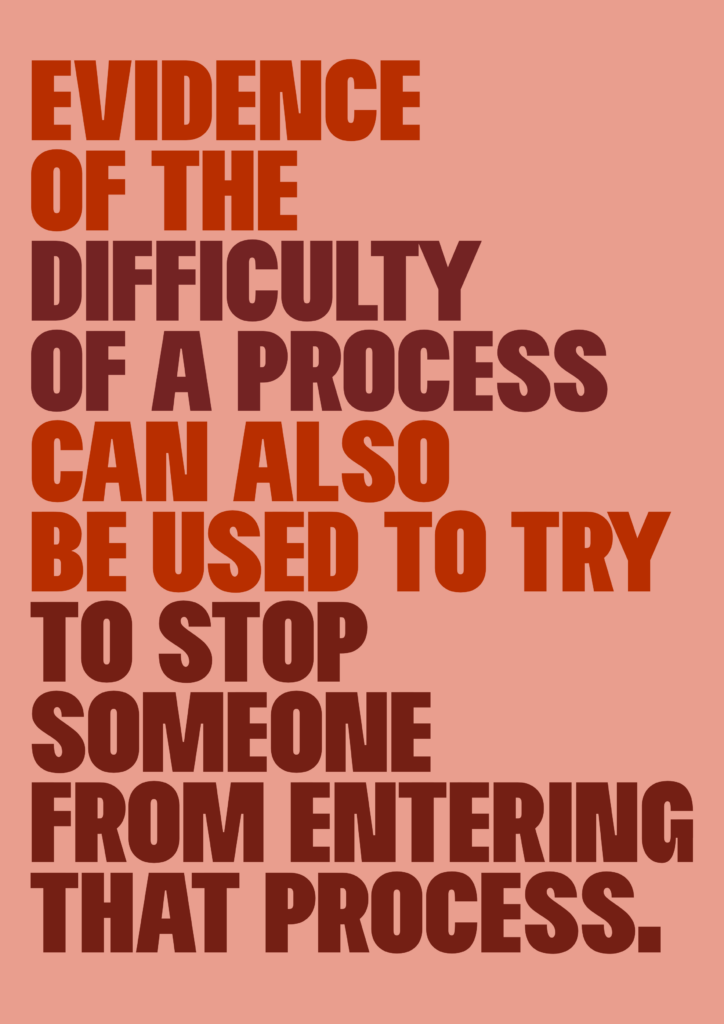
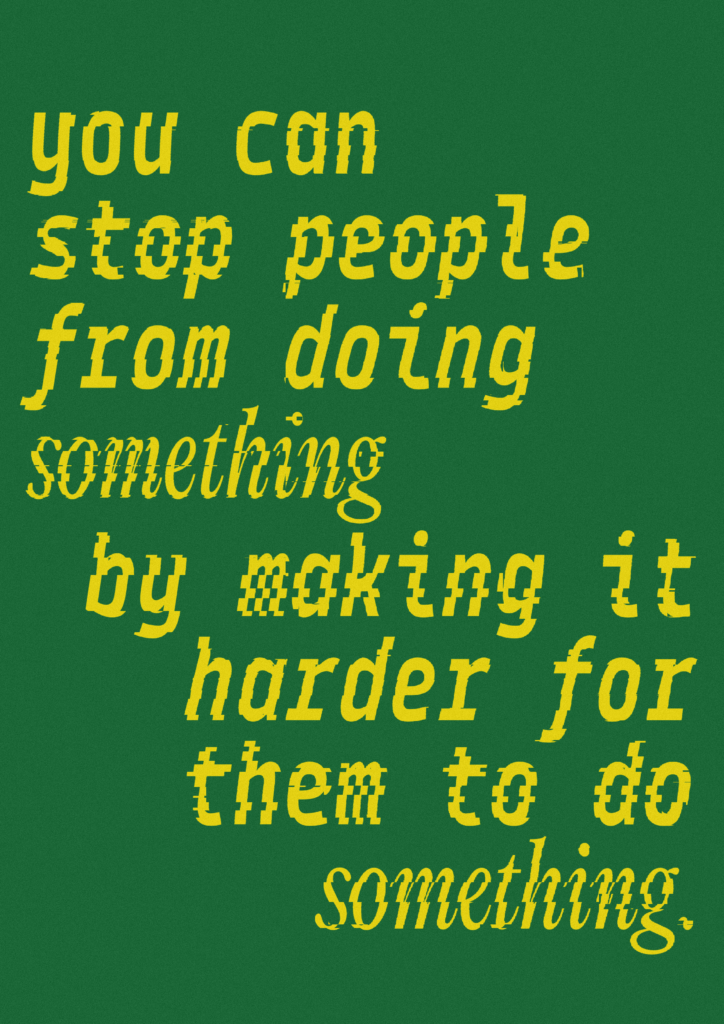
Dies ist nur ein Beispiel oder vielleicht nur eine Art von Schwierigkeit, die bei der Bearbeitung von Beschwerden auftritt. Und in der Tat gibt es wahrscheinlich Tausende von ähnlichen Schwierigkeiten wie diese. Daher ist es für eine Einzelperson sehr schwierig, sich bei einer Institution zu beschweren, und die Einzelperson wird immer die schwächere Partei gegenüber der Institution sein. Es ist nicht einfach, eine erfolgreiche Beschwerde einzureichen. Zwei Zitate aus dem Buch “Complaint!” lauten:
“It’s messy and it’s cyclical: you file the complaint, this process happens, which can cause another complaint.” (S. 37)
“Complaints end up referring to complaints; you have to keep dealing with what is not being dealt with; yes, once you start the process, it is hard to get out.” (S. 37)
Virginia Woolf in A Room of one’s own cleverly pointed out there is so much written about women by men. But not in a good way. Instead of writing about the feminist ear, I would rather write about the Marxist eye, or the postcolonial tongue or the psychoanalytical nose. The feminist ear however opens up very interesting topics where a male point of view might not be absolutely redundant.
Sarah Ahmed introduced the concept of the feminist ear on her book, Living a Feminist Life. It comes up again on Complaint!. It is a very structured concept with many interesting characteristics. The feminist ear hears those who are not heard, it is attuned to the sharpness of words, it is willing to receive complaints, it is a research method, it is an institutional tactic. The feminist ear is definitely powerful but to me is not clear who gets to wield it. As a man, my question would then be can I use it too? Or rather may I use it?
Is the feminist ear subject to the laws of physics? A complaint is definitely affected by the Doppler effect: a complaint sounds different when it’s coming your way. As a man, this is a real concern.
Before diving into the feminist ear, lets do something more simple. Lets just go inside the ear, any ear. The ear is cavernous, to venture inside would be the beginning of a journey of discovery, self discovery. The ear as a tool for introspection. Volunteers that dare to enter the world’s quietest room, another sort of cavern, report being able to listen to the inner workings of their digestive tract in full detail before asking to be removed from the room immediately for fear of losing their mind.
There’s two ears, not unlike the marxist eye(s). People are normally born with two ears and one mouth. My mother would often say one must try to listen at least double the amount one speaks. But the two ears follow a purpose, to be able to listen all around you. Surround sound. To be immersed in sound is to be able to create (or recreate) a sort of architecture of resonance.