My wife and children dragged me on one occasion to the public pool in Weimar. I have always disliked swimming pools. The following poem is inspired by this experience so mundane and yet remarkable.
Surrounded by a world in other bay; The blush went up, up, up glory of light, body and mind Cool of hair
Brought the fair view of the fresh free form, Throne of water of celestial hue, Turn away the gaze Encircled by a perfect float they fade.
Laid my fair daughter on the pool, Wild winds and breast strokes Step after step my curved feet turn, Spring of the great ethereal blue
Now, back to land with gleaming glory By way of the forest past the ash
I was the only person of color in the pool at that time. My children take after their mother who has light skin. They didn’t notice this. I did however. Being wet, cold and non white among all whites makes you think.
While I am complaining, the life is going on. “We ended up meeting in a large cafe. Although we found a relatively private corner, you could hear the hustle and bustle around us, the clattering of plates, sounds of laughter; clattering, and clattering. Being there together made a difference; hearing life go on can be a reminder that life goes on.”
—
Una denuncia es un testimonio Testimony was thus in the accounts as well as being how they took form. And what has been so important to the process of receiving these statements as testimony is receiving them together. To hear these accounts as testimony is to hear how they combine to allow us to bear witness to an experience, to show what they reveal, to bring out what is usually hidden, given how complaints are made confidential.
Esto es un testimonio sobre un fenómeno social y collective. It was clear to me the limits of what I could do.
—
Words carry a charge; you can end up being made to feel that you are the problem, that the problem is YOU words getting under our skin!!!
IMPRUDENTE
and I don’t trust the space to sound like that person. No quiero sonar quejumbrosa — Complaint can be sick speech. HABLA ENFERMIZA —
NOTHING IS GOING TO CHANGE SO WHY?
What she calls “the same narrative” is skepticism that there is any point in following a complaint procedure to complain would be to hurtle toward a miserable fate, complaint as fatalism, to leave the right path, the institutional path, to bring misery upon yourself.
a complaint canalso be framed as pointless,
Warnings can operate in the realm of the would rather than the could.
A warning becomes about what you would not do if you wanted to protect yourself, your career, and your own happiness.
2. warning can be offered in the style of a report.—- qualified support, warnings -to be more concerned with consequences than anything else
A warning is a technique of redirection: the past is used like an arrow that points to what will happen heads can dowhat they like.
WARNINGS – “rocking the boat” and “making waves”
A complaint is heard as making waves, as stopping things from being steady
Warnings can be used to remind people of the precarity of their situation.
who is bigger and who is smaller (they are bigger; you are smaller)
upset the status quo.
2. Warnings as threats,
whistle-blower scatter gun loose cannon as if the damage caused by making a complaint was a result of a failure of precision.
YES WARNING
Nodes: We learn from our surroundings. A nod is when you move your head up and down, often several times, to show agreement, approval, or a greeting.
It is striking to me how a limbo is described as a space: you make a complaint and that is where you end up; a limbo is what is opened up. To be in limbo is to be left waiting.
nodding is encouraging.
Nodding can be nonperformative. In chapter 1 I used nonperformative to refer to institutional speech acts that do not bring into effect what theyname.
To placate is to calm or to soothe. Placate derives from the word please, to be agreeable When hearing about a problem is offered as a solution, hearing becomes another kind of dissolution.
how complaints involve communicative
labor:!! ———-
I am calling the response of no response blanking.
To be blanked is to be ignored
(I think of blanking as like an eraser used to remove marks from the page.)
Blanking can be how you erase the data. Or blanking can be how you fail to record the data.
Nonending, like this book, as complaints, as fear, as tears, as nonsense world.
“It’s like you put glasses on, and now you can see it.” She emphasized that having seen the world through the lens of complaint, you cannot unsee that world,” cited Sarah Ahmed in her book.
Some years ago, I had thought of something similar. Once you become aware of something, you can’t turn a blind eye.
I became a feminist. I will never be able not to be it. I became vegetarian because I realized how is the meat industry contaminating the world. Even if I eat meat again, I will always know. Even if I truly loved it, I stopped buying fast fashion because I will always be aware of the tons of water wasted to produce a single pair of jeans.
I thought once. I cannot stop thinking I knew once. I cannot stop knowing I realized, and I cannot stop being aware I have seen, heard, and experienced how bullying and intimidation can hurt you, and now I can’t help but distrust others. I cannot stop ………….. I cannot stop ………….. I cannot stop ………….. I cannot stop ………….. I CANNOT STOP FEARING
“The instruction not to complain can be internalized, because that is what you had been taught, that to complain is to be oversensitive, to be easily affected, easily hurt, bruised, damaged. What others say to you repeats what you have said to yourself. What you say to yourself repeats what others have said to you. The work of complaint can involve an internal process of coming to terms with what you are experiencing. Even if you have to complain about something that is being done to you, whether by somebody else or by a structure that is enabling somebody else, you still have to come to terms with yourself. A complaint can feel like an existential crisis, a life crisis.” (Ahmed 2021: 114)
I am a woman; I am young, have tattoos, and like punk and emo. That characteristic makes me see myself as a professional without experience, and we are used to seeing youth as a flaw.
I was working in a private school as an English teacher. I taught in high school. I liked my job because I could share with my child, who studied there. Besides that the school was beautiful, with a lot of green and animals, we had pure air all the time.
One of my colleagues was an older man working there for a long time—that person used to teach English to the student I was now leading. And I think that is why he thought, even if that was not his responsibility, to supervise my work.
This teacher started to call me “the emo teacher,” he used that nickname without my authorization, and he used it because he could be related to the way I dressed. I like punk, emo, neopunk. I love that music and its aesthetic, but that has nothing to do with how professional I am.
He makes me suggestive comments, looks at me in a way that makes me feel uncomfortable, and harras me via WhatsApp. Furthermore, I did the whole work in the English area, and he always took all the credit.
Once, he called me at 7:00 am on a Sunday to ask me for money, and he threatened me, saying: “If you lend me that money, I will tell you what thoughts has the school principal about you and why they hate you so much.”
(I need to clarify here: I have anxiety and depression, and those comments are not suitable for my mental health. This condition was well known in the school, and he took advantage of it, so I lent him the money)
As he was a teacher working there for a long time, it was difficult for me to complain to my superiors. Especially as I said before: “we are used to seeing youth as a flaw.” I knew no one would believe me, or nothing would happen. Additionally, that process would mean something huge for my mental health lead.
As I was tough as a child, we needed to “have patience and curse quietly.” So that was what I did. I wanted to have a low profile and keep my distance from that teacher. That was super difficult because we work in the English area. I already decided to change jobs as soon as the year-end because I did not want to cut the process I had with my students.
One day I arrived at the school, everything was normal, and one person from the principal office asked me in a demanding tone that I had to go to the office. They did not even let me go to the teachers’ room to leave y stuff there. When I got into the room, the principal, the coordinator, and a lawyer waited for me. Apparently, the teacher who has been harassing me accused me of harassment because I said: “my love” to one of the students.
It is not OK to corner someone, and I felt accused without my right to defend myself. I could not believe what was going on. Saying in a lovely way to a student was not, for me, sexual harassment. I was shocked, and the coordinator said: Is there something you wanted to tell us?
Even if I did not want to complain about the abuses I received from that colleague, at this point, I saw my opportunity. It was evident that these people had no idea what was going on with that teacher.
So, I told them everything. And as proof, I showed some screenshots of the chat on WhatsApp. They were stunned. They did not have complete control of the situation (“El sarten por el mango”) as they thought.
The person that accused me was, in fact, a stalker. Could you imagine? If that behavior had to me “another teacher,” What could he do with a student? At that moment, the institution (The school and the principal) see themselves cornered. They know that my accusations are severed, and I had proof.
So by then, the narrative and their behavior had changed. The voice tone was not rude anymore. I felt relieved because I could take all out of my system. The meeting ends with the agreement that that teacher or I will continue working there. However, there would not be any process against that person. As institutions tend to do, the institution will protect that kind of people.
With time I found that that teacher is still working in the school. It is always more important to maintain the reputation than the truth. More important than protecting the institution’s students and workers. They always manage the problems under the desk without giving them a real solution. Institutions tend to wait for the environment to calm down and do nothing, which causes this kind of abuse never stops.
There are no supporting routes to this kind of case. The private schools have an inner regulation that can apply as they want. But the people do not know how is the complaint route. I feel after this experience that the complaint does not have any effect if the institution does not want to make a change.
This story was told in a meeting between two friends on the 19 of February 2022.
“The decision whether to complain is usually made in the company of others; you will most likely receive advice, suggestions, and guidance from peers as well as friends, whether welcomed or not.28 You might decide not to complain because you cannot deal with the consequences of complaint that have been made vivid to you through warnings.” (Ahmed 2021: 24)
I am a psychologist, and I work at the Women’s Secretariat, an institution created to help women who suffer or have suffered some kind of violence inside or outside their homes.
My work has to do with the “restitution” of rights that have been violated. This word causes me a lot of conflicts: Who am I to restore someone’s rights? How do you restore rights?
First of all, as civilians, we do not know our rights, just as we do not know our duties are in many cases, but if we are not even clear about this, how can we know when our rights are being violated?
In a hypothetical scenario where people know their rights, they would know when they are being violated. But even so, they would not know which routes to restore those rights. Every time a request is broken, a debt is generated. Because everyone should have access to the same rights.
With this in mind, my job is to accompany the women who contact us for help. In this scenario, I am the institution. I must activate the route to give them the legal and psychological support they need. I am an institution that helps women enter the system to achieve justice and the security that many of them are looking for.
This sounds very nice, but there are many factors against it. When a woman calls, she must explain that she must initiate a legal and psychological process. And if necessary, if her life is in danger, asylum should be sought immediately in a women’s home. These houses are temporary spaces where they can go to live with their sons and daughters in case they live with the aggressor, as happens in most cases.
After informing her of everything, I must know everything because I am also violating her if I don’t. At this moment, I feel that I am opening boxes within boxes because I must help these complaints to prosper. Still, the institution does not guarantee the professionals who work there training on the constantly changing processes.
My job is to teach her how to access the legal language because if she can express the violence, she has suffered, the system and the law can accept her. Many things can play against her. For example, if the person does not know how to read or write, I assume this role (I cannot tell her to fill out this form or read this information and tell me if she has any questions).
Another critical factor is revictimization. There are two types of revictimization: The first is to tell the story without advancing the process, whether legal or psychological. This is very painful, and doing it without purpose can make it even more difficult. The second is secondary revictimization, which is to tell the story again, but to advance the process, i.e., before an institution: family police station, judges, lawyers. In these contexts, telling the story is an end in itself, and for this reason, it is necessary.
It is imperative that the woman has her story in order and knows how to express herself coherently because the legal system does not work based on emotion. This revictimization is painful but necessary to enter the institution.
As an institution (being myself the institution when I talk to these women), I must tell them that it is teamwork and that these are slow processes. I can help them, but they must also do their part to make progress.
As a worker in the institution, the number of complaints and cases that I have to deal with is overwhelming. In 6 months, I wrote more than 200 emails and dealt with more than 250 cases. It is complicated to handle 250 psychological processes simultaneously with telephone appointments of 30 minutes each.
The complaint within the complaints
It is clear that no matter how much I want to help these women, the system absorbs you, and you end up dealing with a complaint, not a person, a cause, not a person, one more violence. But the truth is that if you do not humanize the complaint, nothing happens. Behind all the forms, hearings, emails, and calls, a woman is suffering violence. Unfortunately, the system dehumanizes us, them, and us as workers.
This story was told in a meeting between two friends on the 16 of February 2022.
“Knowing how complaints can be sticky, as well as picky, she gave herself instructions not to complain: “I told myself to shut up. I told myself not to talk, not raise questions and just be invisible.” When you have something to say but realize it would be costly to say it, you have to keep telling yourself not to say it. Institutional passing can be the effort to maximize the distance between yourself and the figure of the complainer. You might try to pass not because you identify with them or wish to be one of them but just because it is safer not to stand out.” (Ahmed 2021: 155)
I am a doctor, and I believe that complaining is for the brave. Because when we complain, we need to expose the situation we are complaining about repeatedly. In a case in which we have been violated, we have felt insecure and powerless. We must tell our story, hoping to be heard and hoping something will change. During my undergraduate internship in obstetric medicine, I was amazed by some mothers’ mistreatment when having their babies. The system dehumanizes doctors, leaving them with no more energy than they need to deliver a baby as quickly as possible. First, the shifts are so long that you don’t care who is on the other side in the end. You want to finish fast. There the system wins. A patient is just another number. Never mind that it’s the big day when the nine-month wait is finally over, and you finally see your baby’s face. It’s just another number. Secondly, the position in which mothers must give birth is not the right one. Many indigenous cultures give birth in a squatting position because gravity helps the baby come out easier, and pushing is not as painful. The system won. Doctors are used to pain. Third, there are so many women in the delivery rooms that it is impossible to provide an excellent service to all of them. The important thing is the “product,” the baby. The important thing is to get it out as quickly as possible in the best possible conditions. Cesarean sections have even been performed that was unnecessary because the breast took too long to dilate. Women have to say yes because they are not 100% informed of what is happening at that moment. The system won: How many babies per minute? Humanized childbirth is a concept where that kind of thing doesn’t happen. The mother has total control over her labor. The decisions she has to make are informed. The point is that there shouldn’t even be a “humanized birth” because all births should be like that. We women have been taught that life is not easy and that we should not complain. Because besides, if we complain, nothing will likely happen. The system has completely drained the will of doctors; everything is numbers and money. Anyone who complains about the system is a toad, that is, someone who “talks too much,” but not being a toad has led us to perpetuate an inhumane system. It has shown us to have medical appointments where the doctor cannot take his eyes off the computer. The skepticism of complaining has accustomed us to the fact that it is easier to put up with it than to complain and carry out a process within the institution.
This story was told in a meeting between two friends on the 13 of November 2021.
I have encountered many crossroads when wanting to make a complaint.
I feel like two people:
The first one thinks it will be a lot of wear and tear, both physically and mentally.
It fills out forms, makes calls in two or three different languages, and explains repeatedly. It seems to be very exhausting. In the end, I think it’s better not to do anything.
Entering the system just the idea of entering the system becomes so exhausting that there is no point in doing it. I feel anxious about entering that Kafkaesque world full of dead-end paperwork.
The second one, motivated by reading Sara Ahmed’s book, thinks that making the complaint and taking it to its ultimate consequences is exhausting but satisfying. At least I now know the system’s methods for wanting to stop me. I can already name them (nodding, circularity, blanking), which makes me able to overcome them.
Also, if no one complains, nothing will happen, but if, little by little, everyone starts complaining, things may take a different turn. The most important thing is that I know that I am not the only person in the middle of this. Unfortunately, many have suffered some violence, which perhaps has led to a complaint process. For better or worse, there are many of us, and we can help each other in the process.
Questioning the idea of complaining about how to face that big wall, that door, made me want to share it with my friends, how they had suffered some violence that they had complained about and how the institution responded to them. Also, what they perceive when they are inside the institution.
I talked to them and explained what the book I was reading was about. We set up a meeting and spoke about these types of situations. I was amazed at how the system consumes all of us, but I was even more surprised at how they continue to fight within the system. It is something that we cannot avoid, but we can accompany each other, listen to each other, be the feminist ear. And try to change the system, some from the inside and others from the outside.
“Not complaining becomes a virtue, a kind of calm patience, a positive outlook, as if waiting is what would make something fine, as if the best way to approach a wrong is to wait for it to right itself. “(Ahmed 2021: 76)
I identify with this quote from Ahmed because I have often decided not to complain, and when talking to my friends, I have realized that we are very used to enduring and staying in this “calm patience.” I think we are changing that, little by little.
The next post will be written in the first person about some experiences that some of my female friends experienced.
“In trying to get a complaint through the system, you end up taking on a role to modify the system” (Ahmed 2021: 53)
I wanto to belived that sentece of Ahmed, I want to modify the system.
Why would anyone compare a person to the character King Kong?
Why has racism been so present in Colombian elections in the last months?
What is the problem with the color of our skin?
“Francia Márquez is an Afro-Colombian human-rights and environmental activist in Colombia. In August 2020, Márquez announced her candidacy in the 2022 Colombian Presidential Elections. She is the first Colombian woman of African descent to run for the presidency. Márquez’s coalition is Pacto Histórico. In her campaign, she has advocated for women, Afro-Colombians, and indigenous communities, who have been largely excluded from Colombian politics. After a great run in the primaries, Francia became the Vice Presidential candidate for Gustavo Petro’s presidential campaign.”1
And yes, she has been compared to King Kong.
Twitter MarbelleTwitter Gustavo Bolívar
Marbelle, a famous Colombian singer and actress, used her Twitter to launch this racist media attack a couple of days ago. And I cannot understand why this is still happening. Statements like Marbelle’s only want to spread hate and intolerance through the internet. And make me also reflect in why are usually women who attack women. Where does so much hatred and envy for destroying each other come from? Without any answer, I only wanted to use this platform to complain about this nonsense attack and to share my personal opinion about Francia Marquez (even if I am not going to be able to vote from Germany this year):
She is probably the best option Colombia has to see a fundamental change in the politics of violence and corruption we are used to living in.
A reflexion on the harsh realities, mechanisms & driving forces
of discrimination & sexual assault especially within academia.
INTRODUCTION
In this paper the topics analysed are those of discrimination, sexual assault, and the mechanisms and institutions around them.While discrimination is a prejudicial treatment of a human in reference to a certain socio-physical trait; sexual assault is a non-consensual act that usually involves coercing a human into sexual activity. Both practices are irreversible and psychologically damaging to the victims. However, these traumatizing and unjustifiable behaviours are awfully recurrent among us humans.
Why are discrimination and sexual assault such common phenomena, especially within Academia; and what happens after their occurrence?
The subjects at hand will be tackled through a parallel analysis of three distinct works. Michaela Coel’s 2020 series ‘I may destroy you’, Sara Ahmed’s 2021 book ‘Complaint!’, and Karine Tuil’s 2019 book ‘Les choses humaines’.
The approach consists of linking Coel’s introspection on rape and racism along with Ahmed’s scrutiny of academic institutions with Karine Tuil’s thorough depiction of the ‘mechanisms’ of Justice.
PARALLEL ANALYSIS OF A TRIPTYCH
With her TV series ‘I may destroy you’, Coel shook small screen viewers by boldly tackling rape, racism, and institutional agencies around them. This artwork is an autobiographical fiction that challenges the status quo and faces TV viewers with touchy subjects that were long avoided on the small screen. Coel’s introspection on rape is thus a daring endeavour. Her choice to present these topics on screen was not of an easy task since they are based on events she had experienced. Yet she did it so beautifully throughout the 12 episodes of 20 mins each. Her work is a cry to make people see what they are avoiding.Much like Ahmed and Tuil did with their books; these three women chose to publish, broadcast, and be vocal about the awfully traumatic experiences of sexual assault and discrimination.
The prevalence of sexual assault & the normalisation of rape in society.
The three works at hand show us how prevalent and common sexual assault is. For instance, in Coel’s series the narrative is inspired from real life events that personally happened to her. And Ahmed’s book is a collection of heart wrecking stories that occurred in educational institutions around the world. Despite Tuil’s book being a fictional novel set in Paris France, some parts of it are openly inspired by the famous 2016 Stanford student rape case: ‘People v. Turner’. Sadly, all these testimonies are as real as it gets and occur more often than we imagine.
With the protagonist, her friends & acquaintances, Michaela Coel creates a vibrantly diverse spectrum of multidimensional characters, who all have experienced some sort of sexual assault or discrimination, and in some instances have also been the offenders. The intensified flow of information and traumatic stories sets viewers on the edge. It also uncovers the bitter reality that anyone is prone to be a victim of sexual assault and discrimination, and anyone is also capable of doing it.
Throughout Ahmed’s book one can see how easily and organically borders between public and private get crossed. How blurred together academic and intimate lines get. One complainer tells Ahmed the following:
“[…] so at the time, and especially because it happened so gradually, I didn’t really read that what he was moving through was actually a grooming process, trying to see how far he could push that boundary. It moved from on campus to slightly off campus, to his house, to dinners out.” Complaint! p.112.
It is in this grey ‘academic’ sphere that people gradually tend to abuse and get abused. Through this intimate ‘educational’ proximity, the notion of consent gets lost between the blurred lines of academic complicity and authority. Sexual assault becomes somewhat of an unspoken statement of power and dominance amongst familiar academic relationships.
When sexual relationships between members from different bodies of the academic hierarchy are somewhat normalized what happens when something goes wrong? Does the banalisation of sex, banalize sexual assault or as per Sara Ahmed: “enable it”? And if so, does this disable any form of complaint over sexual assault?
“Hierarchies can make handling harassment hard, which is how hierarchies enable harassment.” Complaint! p.120.
Remembrance & rape.
When it comes to sexual assault, most victims go through the painful process of ‘reliving the trauma’ repeatedly, especially if they want to file a complaint. This explains why so many complaints are unpronounced, unvoiced, and sometimes unheard. They are so because the victims find it very difficult to go through the process complaining. Because it requires one to remember the events of the assault which means reliving the trauma. And when institutions ask victims for ‘proof’, they forcibly re-immerse complainers back into traumatic experiences. The notion of remembrance and traumatizing memory is a common theme amongst the three works studied.
The introspective dive into the protagonist’s memory sets the pace of Michaela Coel’s series. Arabella is slowly picking up bits of memories, visions, scents of the night during which she got assaulted. The young woman is struggling to bind together pieces of her fragmented memory. She is battling between figuring out what has happened to her and staying in this limbo state of confused ignorance. And when it settles in it’s so sad and so painful to watch.
Picking up the pieces of traumatic experiences is a big mountain to climb. With every description with every flashback, complainers relive the trauma. They not only have to relive traumatic experiences but also, they’re faced with having to prove them in front of demanding ‘truth seeking’ institutions. The agonizing struggle of one having to prove their version of events is meticulously depicted in Karine Tuil’s book. This fictional novel is set in Paris around rape accusations made by an 18-year-old middle class girl: Mila Wizman against a 21-year-old upper class Stanford student Alexandre Farel. The book is a sort of an arm-wrestling match between two diametrically opposed perceptions of the same occurrence. The psychological assessment of Mila Wizman during the trial in chapter 7 shows the impact of the assault on the young girl and how hard it has been for her to be expressive about it:
“She sometimes has a hard time exteriorising her feelings, which explains the psychological collapse in reaction to the events of which she has been victim. […] She developed a very severe anxio-depressive syndrome, punctuated with anxiety attacks; she gained weight” Les choses humaines p.240.
“Elle a parfois du mal à exprimer et à extérioriser ses sentiments, ce qui explique l’effondrement psychologique réactionnel aux faits dont elle a été victime. […] Elle a développé un syndrome anxio-dépressif très sévère, ponctué de crises d’angoisse ; elle a pris du poids.” Les choses humaines p.240.
The impotence of institutions.
There is something undoubtably wrong and perverse about the mechanisms of ‘prestigious’ institutions, the values they cherish, their hierarchies and their ways of addressing (or not) discrimination and harassment. Academia, being part of these high-status establishments, is sometimes mistaken for what it truly isn’t. Just like sports, academia has always been an exclusive arena. Whilst in sports the benchmark is a certain physical ability or capability. In the latter being ‘educated’ and pertaining to a certain intellectual tribe is the prerequisite. However, academics proactively participate in the perfected art of burying their heads in the sand and ignoring the mammoth in the room. Academic institutions are torn (or seem to be) between the pretence of a renewed all-inclusive diverse image and what they historically and prestigiously stand for. This paradoxical conflict of interests between inclusivity and exclusivity is hypocritical.
“This is how turning equality into a positive agenda can become part of an institutional agenda.” Complaint! p.65.
Complaining about the impotence of institutions and their hypocrisy is asking for some sort of an academic revolution; a drastic change in the core values that constitute the essence of academia. Educational institutions are still very reluctant to endeavour in the process of rigorous effective, well implemented and meticulously followed up equality reforms. Several excerpts from Ahmed’s book show how flagrant this reluctance is:
“She also described diversity work as a “banging your head against the brick wall job,” suggesting the ease with which diversity travels has something to do with the difficulty of getting through.” Complaint! p.54.
“And that is a good way of describing what complaint often feels like: so much work not to get very far.” Complaint! p.58.
“We need to learn from this: the people who head equality initiatives can be the same people who try to suppress complaints, often by threatening and silencing those who make them.” Complaint! p.64.
In addition, in our hyper capitalistic world, academia is gravitating towards a corporation like structure. Academics are feeling less powerful and more dependent on funding and investors. This makes money and investments the agent driving all values. Funding means power, and since money is agglomerated with a handful of decision-making individuals, the shape of academia is thus in the hands of a restrained number of high-profile people. These individuals pertain to tribes that are used to a certain preferential treatment and have no interest in changing the way the world is already established. Therefore, expecting equality initiatives within academia to be fruitful and rightfully implemented is some sort of wishful thinking. We ought to start looking at academia the way it sadly is an enterprise not an inclusive charity. It has become a results-demanding economic body, an organism that invests in diversity initiatives just to create an illusion of equality.
On racism, tribalism, & the mechanisms of truths.
“wir machen die Warheit”
With all the impotent trials regarding sexual assault and the abuse of power around the world, be it in academia or outside of it, one cannot but question the system itself and the dysfunctional way society chooses to deal with such matters. The ongoing masquerade that is the Epstein, Maxwell, Prince Andrew case perfectly portrays how awfully wrongful prestigious institutions are. The mutism of institutions when it comes to certain crimes committed by the mighty powerful is just abominable to follow up with.
When pictures become irrelevant. Who makes the truth?
When testimonies are rendered to null. Who says the truth?
When people with power get away with it. Where is the truth?
“The story of what happens to a complaint is often the same story complaints are about: who controls the situation, who controls the narrative.” Complaint! p.128.
As it was mentioned earlier, control is within the hands of the rich and powerful. Money is the main agent in power relation nowadays. One can use Noam Chomsky’s ‘Manufacturing consent’ as an analogy in terms of discrimination and harassment. Institutions manufacture consent and truths that less powerful individuals are rendered incapable to contest. Institutions are not in the position to understand nor protect people at the lower end of hierarchies. This dynamic is flagrant in Tuil’s book, through it all one can see how members of the elite are capable of bending and distorting the truth in their own favour. They form a narrative out of the madness that is beneficial to them. The socio-economic & ethnic background of an offender is an incredible factor affecting the outcome of their sentence in the eyes of ‘justice’.
“It can be difficult from the outside to identify who is bullying because bullies often represent themselves as bullied.” Complaint! p.150.
At some point in the series Coel brings up the topic of racial agencies in dating. Specifically, when she talks about how appalling it is when her white female friends nonchalantly say that they prefer dating black men over white males because of the way black men treat them. This brings up the notion of preferential treatment in terms of race and how it still is an agent in human relationships. This brings us to the unanswerable question: Can we ever do or undo race judgement and discrimination?
Ahmed’s book shows us that there is “[…] that idea in people’s heads that we’ve done race, when we very clearly haven’t done race.” Complaint! p.60.
Tribalism in academia is real, the discrimination is real and so is the harassment. A specific set of people have the edge. And believing that it is becoming a unconditionally welcoming ground of diversity and inclusion is expecting too much out of it.
Looking at academia with a high regard is the wrong way of looking. One should actually focus on the rotting structures supporting the beautifully crafted facades on display.
CONCLUSION
This reflexion not only showed how critically linked power, discrimination and sexual assault are, but also how extremely common this type of abuse is. The recurrence of these damaging phenomena within academic and non-academic environments is bound to the hierarchies of institutions and the power relations these structures behold.
Power legitimises sexual assault, since notions like truth and consent can be easily fabricated or manufactured by those ‘lucky’ few with the adequate set of controlling strings. It is time to call out prestigious institutions on their wrongdoings. Complaining about the horrors of discrimination and harassment within academia is a big step forward. Now more than ever people are being vocal about their traumatic experiences and resorting to ‘unconventional’ ways to share with the world their version of events.
‘[…] or it is not true that the work of man is finished,that we have nothing more to do in the world,
that we are just parasites in this world,
that it is enough for us to walk in step with the world,
for the work of man is only just beginning and it remains to conquer all,
the violence entrenched in the recess of his passion,
and no race holds a monopoly of beauty, of intelligence, of strength, and,
there is a place for all at the Rendezvous of Victory.’
A close friend called me one afternoon a few weeks ago and asked me how and what I was doing. “I am doing great. I am currently taking pictures of benches in the train station”, I answered. This happened right after I read Chapter 4 of Sara Ahmed’s »Complaint!« in which she addresses the issue of power structures, more specifically occupied spaces. With the following quote, she primarily referred to mental spaces and invisible institutional structures that exclude and discriminate against people with certain characteristics:
“When spaces are intended for specific purposes, they have bodies in mind.”
(Ahmed 2021: 137)
However, it reminded me of classical music being played loudly in train stations during the night, spikes on balustrades and benches divided by arm rests. Those are all types and mechanisms of »Hostile architecture«. Hostile architecture describes design practices that shape public spaces to allow only the use intended by the owner (cf. Hu 2019). Through this, “a subtle expression of social division through urban design, mostly associated with the homeless” is transported (Karthik & Sanjiv 2020: 247). More specifically, hostile architecture purposefully discriminates, especially against minorities.
»Hidden Hostility« by Theresa Güldenberg & Magdalena Meißner
The art project »Hidden Hostility« by Theresa Güldenberg & Magdalena Meißner aims to create awareness for invisible design strategies by directing the view of people on the pedestrian zone on examples of hostile architecture. To achieve this, the artists selected archetypal examples of hostile architecture expressed in benches and seats and dealt with them in various installative ways. (cf. Güldenberg & Meißner 2022)
Hidden Hostility (Güldenberg & Meißner 2022)
For instance, they have wrapped various materials, like barrier tape, foam material and metal wire around public seating facilities. Watching the wrapped benches, it becomes visible how either gaps or arm rests ensure that nobody can lie down or even linger comfortably for a longer time.
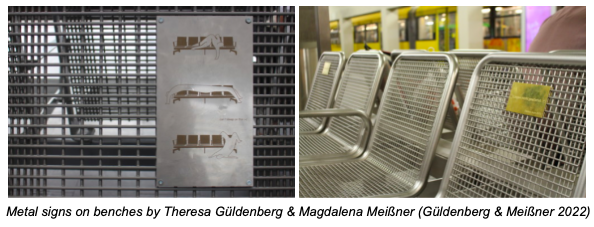
In addition to using different materials, the artists also employ statements, graphics and questions to draw attention to the mechanisms of discrimination and control inherent in the public furniture presented. Metal signs, which are attached to benches and seats by Theresa Güldenberg & Magdalena Meißner, play a particularly central role in conveying these statements. Phrases like “Der Feind ist der Freund dieser Bank” (Engl: The enemy is the friend of this bench) (Güldenberg & Meißner 2022) and illustrations, like the ones on the pictures below, express criticism and stimulate the pedestrians to think.
In the various installations of “Hidden Hostility,” the two artists repeatedly refer to a central point that constitutes the core of their work. Thus, they state that hostile architecture serves social control, unnoticed but aggressively expressing political power in public space. (cf. Güldenberg & Meißner 2022)
»Hidden Hostility« and »Complaint!«
In addressing design mechanisms that are politically used to discriminate against minorities, the artists take up what Sara Ahmed refers to as invisible power structures. The key point here is that these mechanisms usually remain hidden. In the case of hostilely designed seating in public spaces, this means: as long as you don’t have to spend a longer time in public, or even sleep there, you won’t be irritated by uncomfortable benches. Invisible power structures define whose feelings matter more (cf. Ahmed 2021: 169) – the feelings of supposedly “normal citizens” are more important than those of homeless people.
On closer examination of hostile architecture against the background of this argument, it becomes clear: public space becomes an occupied space in Ahmed’s sense through hostile design mechanisms. As Sara Ahmed puts it: “you notice a structure when it stops you from getting somewhere or from being somewhere: it can hit you” (Ahmed 2021: 141). This means that even if our society is claimed to be social and solidar, it systematically discriminates against homeless people.
The way Theresa Güldenberg and Magdalena Meißner approach this fact in their installations can be understood in itself as an act and expression of a complaint. In particular, the metal plaques with messages are an expression of complaint in Ahmed’s sense and, at the same time, have an activist character due to the aim of making people think. However, the artists do not complain about a specific institution and thus not to a specific person in charge, but address society as a whole. With their work, they try to invite people to hear their thoughts, pick them up and turn them into other complaints.
Reflection on hostile architecture
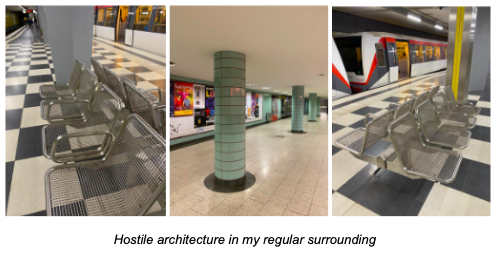
Understanding both, the art project »Hidden Hostility« and Sara Ahmed’s book »Complaint!« as an invitation for reflection, I took pictures of hostile architecture in my regular surroundings, as mentioned in the beginning.
In these pictures you see a train station that I frequently use – a train station that is equipped with divided benches and that plays loud music in the hallways the whole night. A train station that claims to be part of public transport, but in fact excludes people who can not afford to take trains, but intend to use it as a shelter in the public. Feel free to do the same and scan your environment with a critical eye, being conscious that hostile architecture turns our environment into an occupied space. And feel free to complain about it in a creative way.
References:
Ahmed, Sara. Complaint!, New York, USA: Duke University Press, 2021.
Karthik, Chadalavada; Sanjiv, E. Sripadma. Defensive architecture – A design against humanity. In: International journal of advance research, ideas and innovations in technology, 2019, Volume 6, Issue 1).