As many of you know in Spanish, unlike English, adjectives, verbs and nouns have gender. Feminine words generally end with the letter “a” and masculine words with “o”.
Faced with this, in the last decade many alternatives have been proposed to replace these vowels and build a more inclusive language. Different proposals from Latin American countries or Spain suggest the “e”, the @, or the “x” as a symbol to replace and neutralize the way in which we express ourselves, without necessarily having the connotation of gender, which is so often unnecessary.
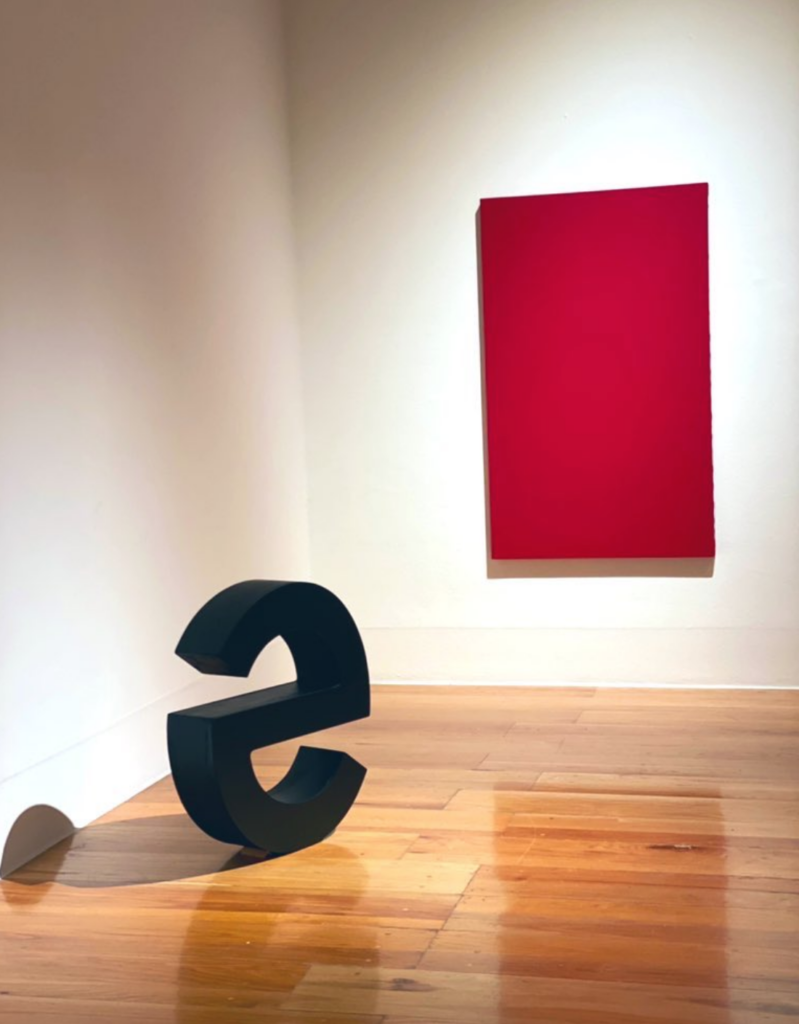
Last year, the Mexican artist Mario García Torres proposed in his last exhibition a proposal that has generated much controversy. He and typographer Aldo Arillo created a new vowel for Spanish as an attempt to solve the dilemma of gender and inclusion in the language. The vowel was created in his “Secte” project, which is part of his exhibition “The Poetics of Return”, the retrospective of García Torres in Marco. Museum of Contemporary Art in Monterrey.
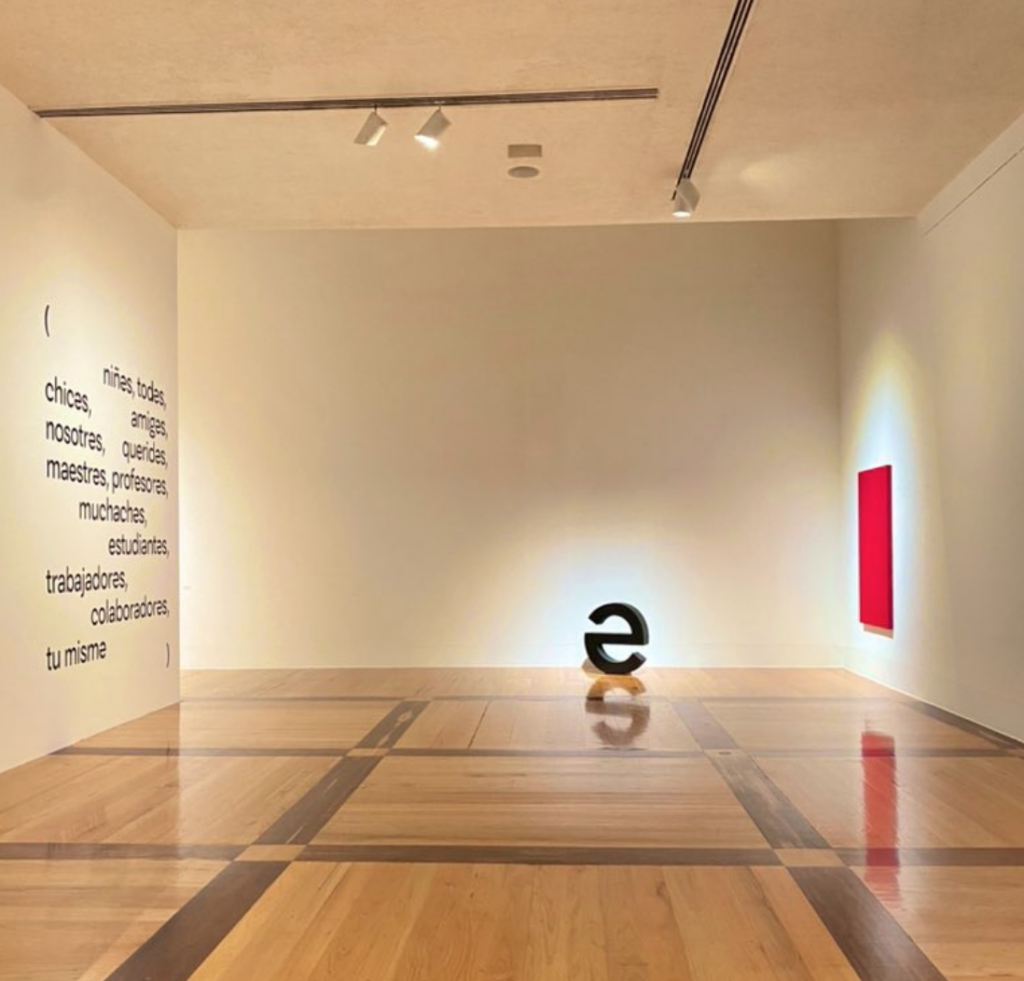
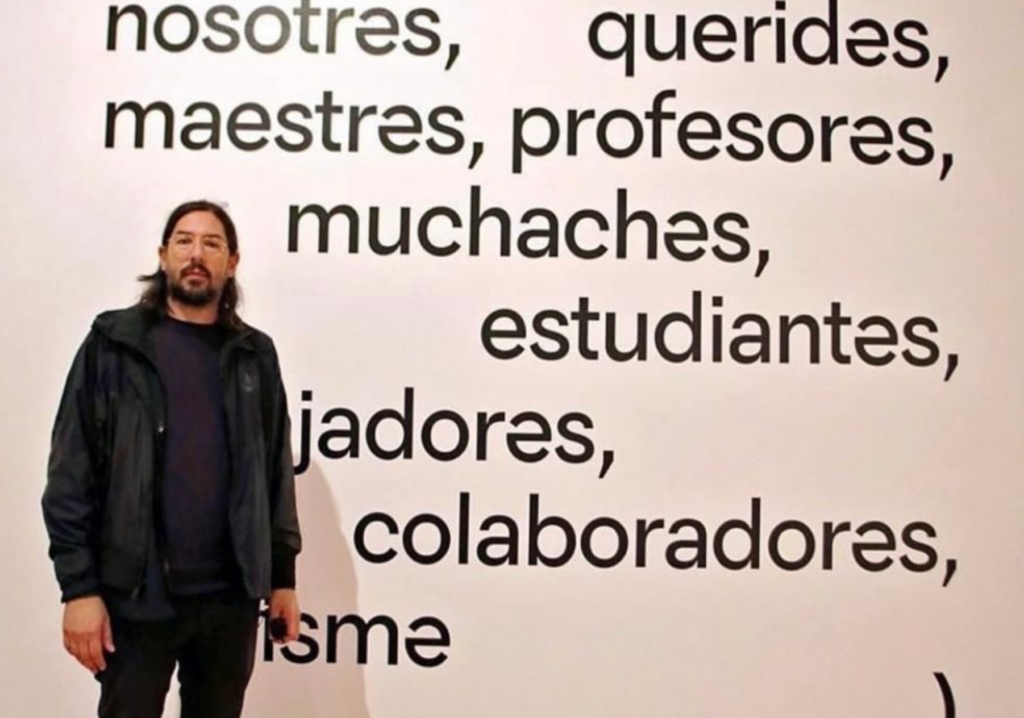
The vowel’s proposal was shown at the museum, where it was launched. There was a sculpture of the letter, a wall with words that exemplify its use and a video. “It’s a letter to try to solve the gender problem. It’s actually a ligature of three letters: a, e, and o. We did it so that it was just a specific sign and that it was a new letter that doesn’t have gender,” García Torres said in an interview. “It’s called ‘sect’ and the idea is that it becomes the sixth vowel of our vowels.”
The letter is a speculative glyph, the artist explained, and is currently only available in the NeuLeon typeface, created by Arillo. “(Hopefully) other fonts eventually begin to add this symbol. It’s not easy,” said the artist of Monclova and one of the Mexican artists with the most projection abroad. With the character, the artist and typographer propose that it can be used instead of e, @ or x, which have been used informally in inclusive language.
Arillo mentions signs like the # that for a while was used only for numbers and is now indispensable in internet culture. Several feminist movements of the 20th century have demanded an inclusive and non-sexist use of language, since in Spanish, masculine pronouns, adjectives and terms predominate. However, specialists and institutions such as the Royal Academy of the Spanish Language have resisted any type of change
“Somehow you had to have a graphic posture, how to solve this in a good way. Language is not something static, it is a living convention, which changes according to need,” said Arillo. “From a graphic and typographical point of view, this sixth vowel proposes a solution, a proposal, something to open a conversation on the subject.” *
For the creation of the vowel, the experts were based on the theory of typography. Arillo explained: “We wanted this sign to have characteristics such as legibility, harmony and rhythm, something that e, @ and x lack in this type of use.
García Torres and Arillo will present the vowel “secte” at the Association Typographique Internationale (ATypI) online congress soon, and at TypeCon, a symposium to be organized from Philadelphia. It is possible to request the letter for its use in the email aldoarillo@gmail.com.
The MAIN QUESTION HERE is: Why would a white, heterosexual and privileged man have to decide how to represent a vowel that alludes to a fight that clearly does not belong to him?
Different groups and collectives, including several feminist groups, have shown indignation and anger at the artist’s proposal. I understand why. I find it interesting to share this, to open the discussion.
It has been shown that social media, and mostly an app like instagram, is a wide space with questionable boundaries, in which a lot of bullying and harassment can happen, but also it can be the platform where one can report acts of hate and abuse – towards women and LGBTQ+ people, in the majority of the cases.
In November I was talking to a friend that lives in Berlin about my COMPLAINT!ivism? course, the topics we discuss about, the book we are getting our input from and the learnings I get from reading the blog. I told him about the second task and he sent me this instagram account and said: “give it a look, it might be of your interest.”
I am talking about “Cat calls of Berlin” @catcallsofberlin. Forehand I didn’t know what “catcalling” meant, it sounded like a very tender name to me for such an act.
It is “the act of shouting harassing and often sexually suggestive, threatening, or derisive comments at someone publicly”. (1) But still it was not clear enough to me why is it called catcalling?:
> “It’s called “catcalling” because it’s associated with those verses that are usually made to call cats, and bring them closer”. (2).
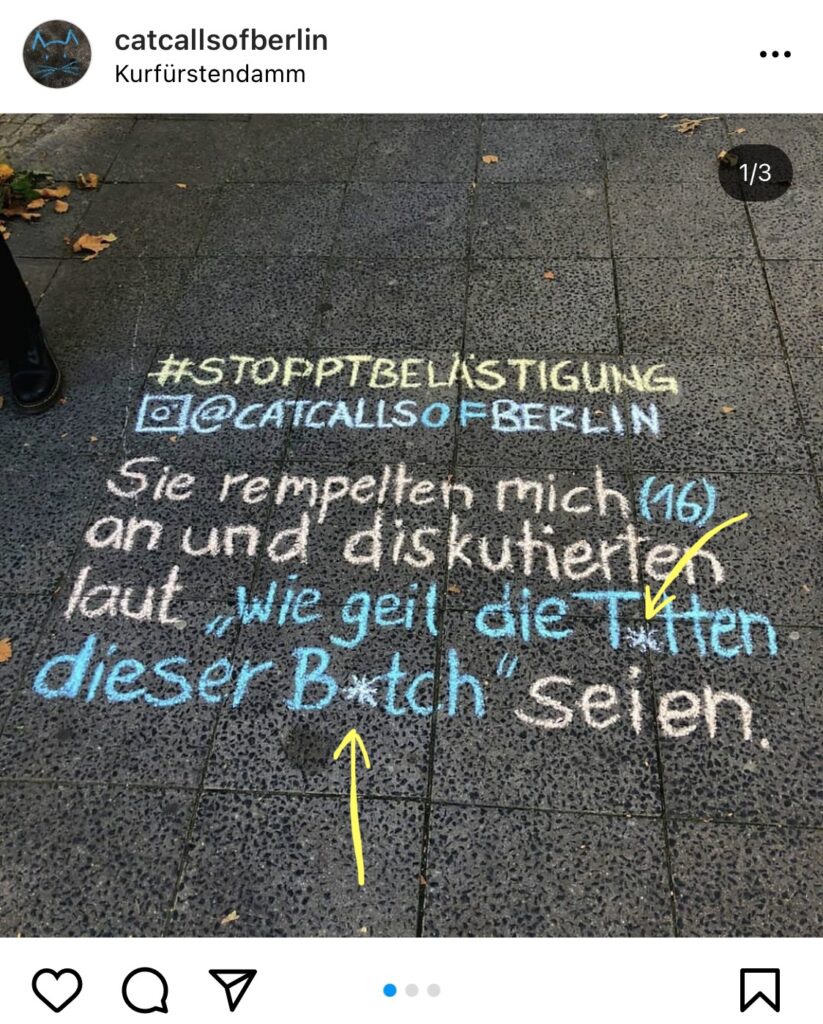
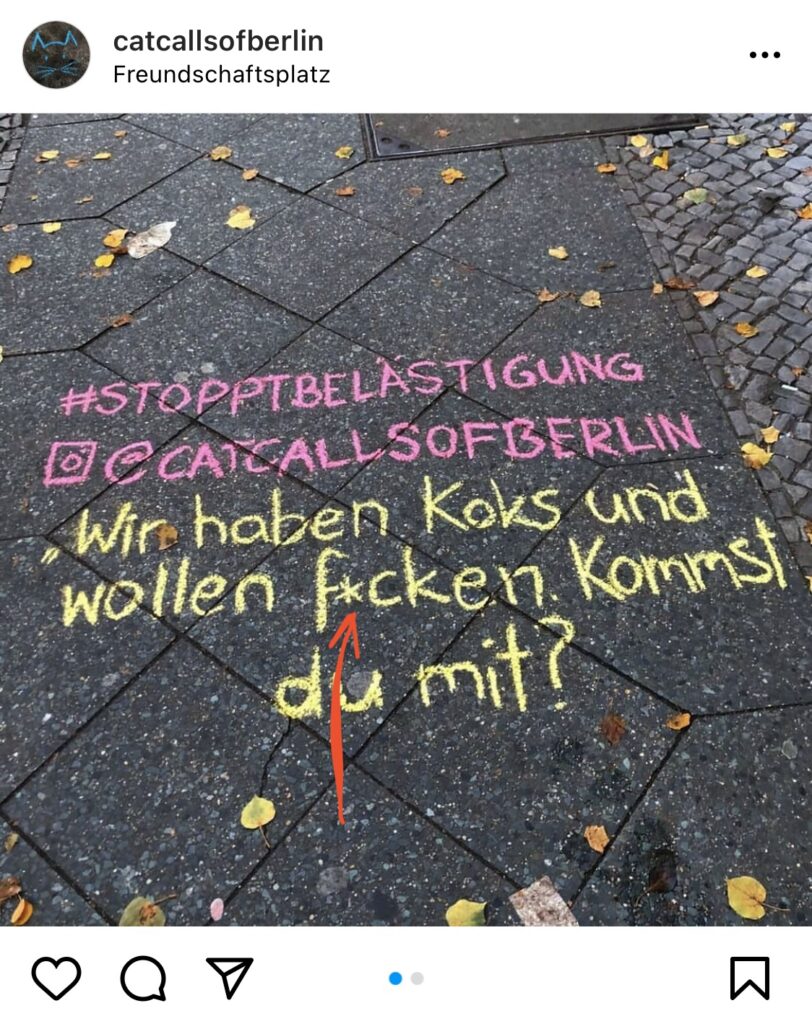
According to this the name of the account “Cat calls of Berlin” exposes the sexual threatens and comments that people have received in the streets of Berlin, and as they state it on their instagram biography, it is a Chalk art movement against street harassment.
It is an initiative carried out both digitally and analog on the streets from multiple cities, and its aim is to expose different harassment experiences through comments. People first share their testimonies anonymously through instagram direct messages, then the team writes a piece of the testimony on chalk nearby the place it happened and then post a photo of it, in addition to a screenshot of each testimony.
At first, even though I didn’t understand exactly what every message in every picture meant, I could imagine the heaviness of emotion every post carries. Not only because of the remembrance of that specific situation in which the victims were put into, but also because out of this exercise, victims are able to build empathy and advise others which places they were harassed in. This allow women, and everyone, to know in advance that something like that happened just right there, in that specific street, corner, whatever it was.
2. Deeper analysis of “Cat calls of Berlin” and its impact:
Although this movement was born in NYC, I wanted to focus on the Berlin’s account for some reasons:
Mainly because it is a city I frequent a lot, and even though I recognise I am in a more open and advanced culture towards the one I was born in, one may think that this type of comments or abuses are not that common in here, but through this account we can evidence that it has nothing to do with the place, its the people that provide this scenarios.
Reading these comments has reminded me the times I have been exposed to these types of comments; because of the way I was dressed, because of walking really late by my own, or even because I was talking in Spanish and just because I am latina makes them think I like to be exotized or approached in a vulgar/sensual way.
I haven’t faced such a comment in Berlin until now, but it triggers me that it can happen to me any day and I don’t know what to answer back nor how to react. Language is still a struggle to me and I will be surely shocked.
It was also sad to read many testimonies from really young girls ages 12, 13… To see how vulnerable women are still on the streets but hopefully there will always be someone that empaths with your experience and maybe they’ll make art out of it to encourage others and show they are not alone. Testimonies in the page oscillate from comments like: “Ey Puppe, willst du was machen?” “Hey sweety, do you wanna do something? (Posted on the 20.10.2021)”, to “Den Arsch will ich an mir spüren” “I want to feel that ass on me” (Posted on the 07.06.2019).
On one side, in these cases the victims are attacked by people they might have never seen before or even won’t see anymore. On the other side, the testimonies that appear in Ahmed’s book “Complaint” the victims and aggressors had already stablished- relationships such as: professor-to-student, boss-to-worker and so on. Which, I reiterate, does not make the experiences any more or less valid, nor traumatic, it is just a comparison to show that no matter the level of relation towards another person, if there is no consent, it is abuse.
In addition, by analyzing some aspects of this movement (which I really value and admire), I realized that the messages are written in chalk on the streets and as is know chalk can be easily erased by rubbing on it, or with the rain as it’s exposed to an open environment. It is not a material that permits that the message stays for a long time or even permanently; though the damages and the trauma are already permanent.
The purpose of the movement is to commemorate this situation even if it is not done justice in its totality, since its purpose is more to condemn this type of events and in a certain way to mortalize these acts in the space in which they were carried out, showing support for the victims. It is not their obligation to make this ‘art’ permanent, but I wonder if the reason for is to be written on chalk has to do with a fear against banning or another type of reason that won’t allow this to continue.
Of course to read this on the streets causes uncomfortableness to the eye and the dignity, but it is necessary to spread the word and the fact that it happens. Perhaps not to everybody, perhaps just to the unlucky ones, just to some unlucky cats.
Furthermore, I noted also that not all messages are written explicitly. It may be due to a restriction given from instagram under its terms in order to make the post available for everyone, or even for keeping respect on the streets, as children may read them. Which also concerns me in a way, because abusers do not have any type of respect while
doing this type of comments and they are always very explicit; but when one gets the chance to expose and denounce it, it has to be narrowed for it to be reached. In a sense, the abuser has freedom, while the victim must restrain herself/themselves.
Here I show two examples of what just was mentioned:
Posted on the 19.12.2021
Screenshot of @catcallsofberlin in instagram
Posted on the 04.01.2022
Screenshot of @catcallsofberlin in instagram
3. Conclusions and perspective after this exercise:
These types of initiatives on social media permit the spreading of warnings towards scenarios of this kind (like the ones we were able to read along the lines of “Complaint” by Sara Ahmed), as it instantly catches the eye of the pedestrians and will leave a temporary mark on the space due to the unfortunate events that happened right there. Still, the experienced harassment from the victims will never be fully portrayed and the abusers are not being loudly called nor exposed. Even though abuse happens both indoors or outdoors, in both cases one feels trapped, in presence or in absence of walls.
The “catcalling” is normalized in many specific cliché scenarios: out of a bar, near constructions, mostly near men-crowded places. But this exercise shows that it happens anywhere. There is no guarantee that one can come back home without receiving one catcall in the same day, nor even measure of the types of comments: it does not matter to the abuser if you are a 14, 18 or 25-year-old. They are going to act that manner anyways. There is no respect at all.
“Cat calls of Berlin” contributes to the exposure of harassment and abuse event but still it is not enough because abusers are not exposed fully. You are not given a name, nor a face. It may be an interesting outcome for the followers to be able to give a face to every executer of this disrespectful comments. Probably, it can warn the audience in a more direct way and perhaps it is someone you may know: it can be your neighbour, your teacher, your relative.
———
Invitation:
The movement has surpassed borders and it is possible to find accounts for multiple cities; including: New York, Boston, Brighton, Buenos Aires, Brussels, Rio de Janeiro, etc; and in Germany: Weimar, Bielefel, Bayreuth, Bonn, Bochum, Bamberg among others.
To visit their instagram page: https://www.instagram.com/catcallsofberlin/
To visit their twitter page: https://twitter.com/catcallsberlin
Website of the organisation behind this initiative: https://www.chalkback.org
Allora and Calzadilla are a collaborative duo of visual artists who live and work in San Juan, Puerto Rico.
Jennifer Allora (b. 1974, Philadelphia, USA) and Guillermo Calzadilla (b. 1971, Havana, Cuba) Since the beginning of their collaborative career in 1995, Allora & Calzadilla have worked in a variety of media to produce a body of work spanning sculpture, photography, performance art, sound and video. Allora and Calzadilla are known for their interactive art pieces in public, often addressing social and political issues and engaging questions of history, geopolitics, and culture.
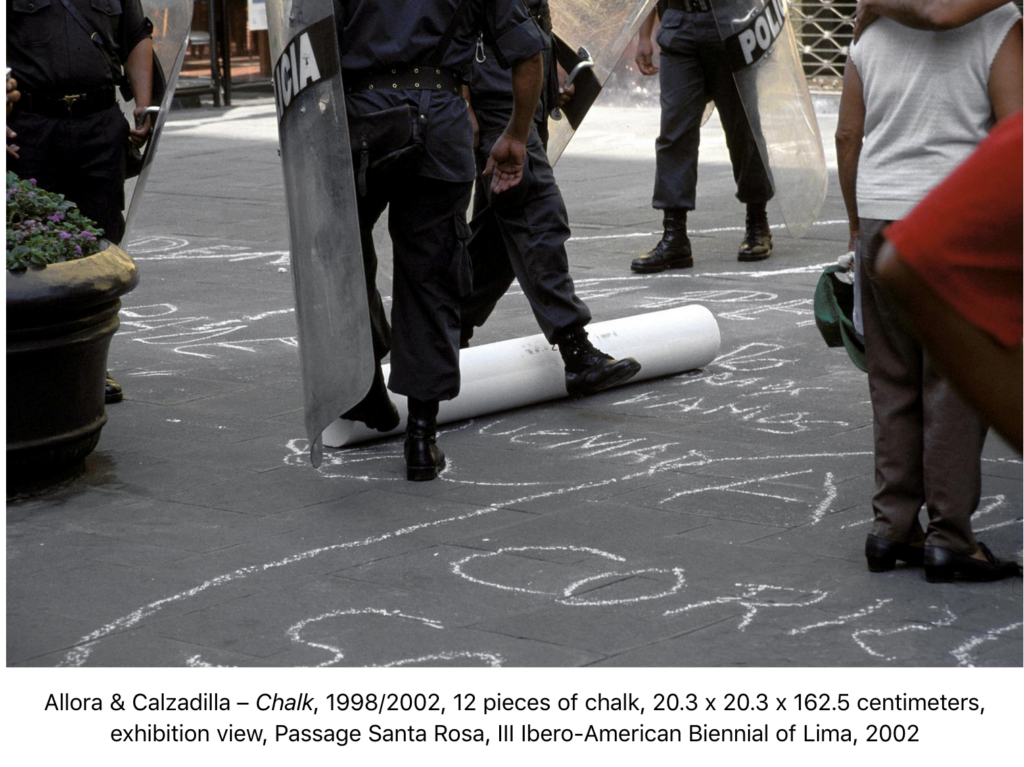
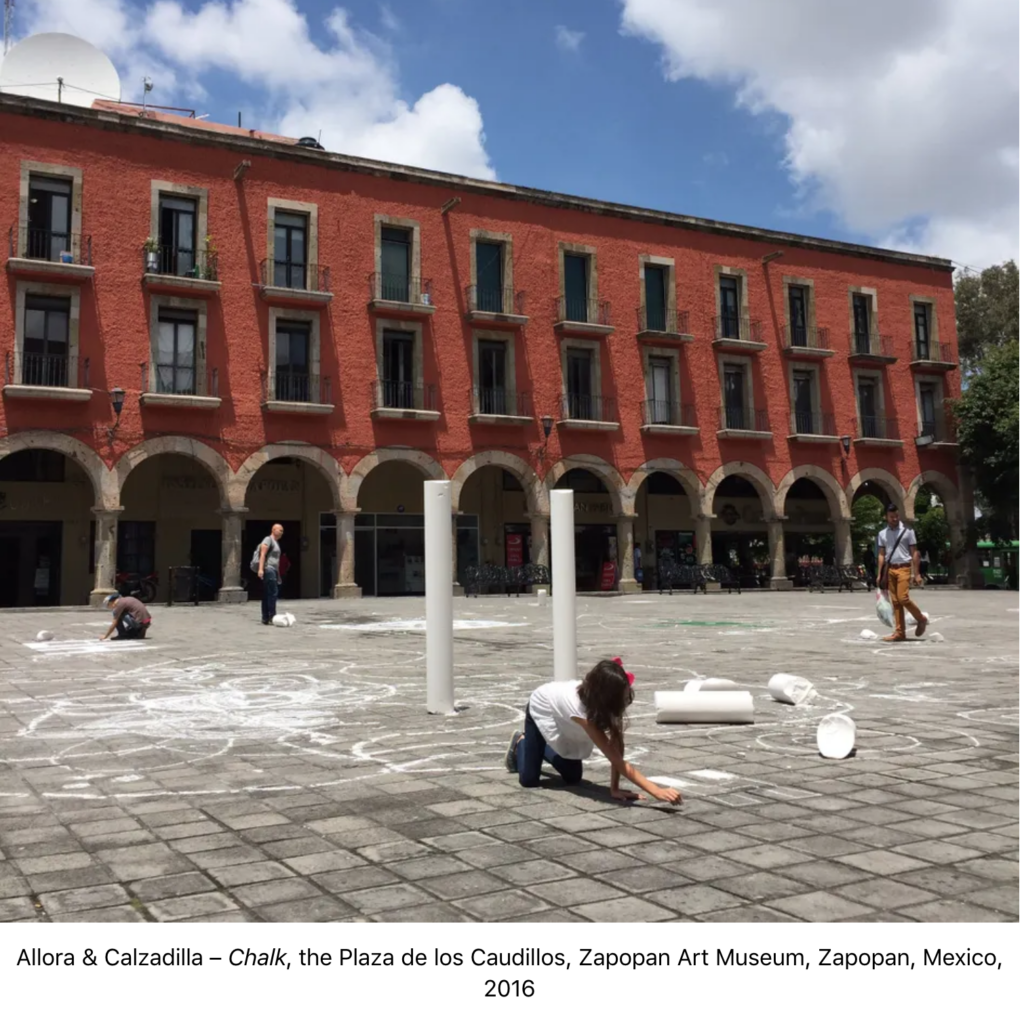
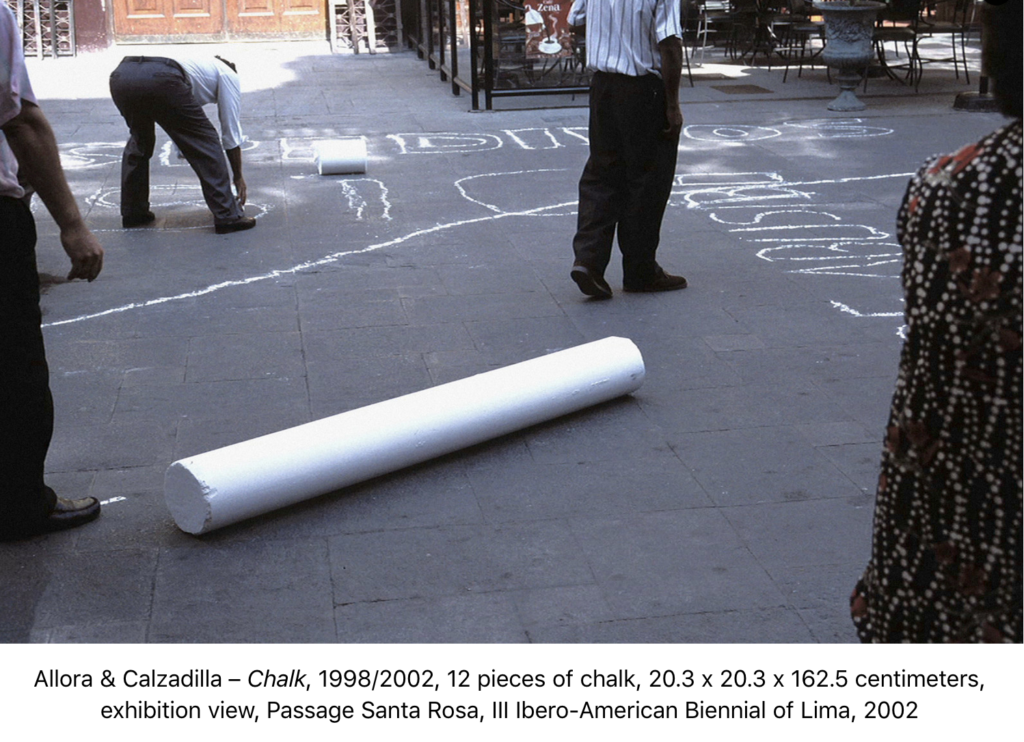
Chalk (1998) is an ongoing art project in which the artists place human-size sticks of chalk – each piece measuring 64 inches in length – in public spaces for passers-by to use as they choose.
Chalk is not a completed project. It has been presented in many cities globally, including Zapopan-Mexico, Boston, Paris, Sydney and New York. This ongoing project was also installed in the central government square in Lima, Peru, to stand as a part of the 2002 Biennial Iberoamericana. With each iteration, the character of the work shifts in response to the locals, social, and political factors
I wanted to share this to broaden the vision of the formats that a collective demonstration can have. I find it interesting to think about the complaint beyond institutional formats. I would like to highlight the simplicity of this piece as a potential for the use of public space as a huge blackboard, an extended canvas on which one can write, sue or complain.
Although the piece is not a specific call to express complaints, on the multiple occasions in which the “agents, executors, pedestrians or participants” have performed, they use the opportunity to express general discontent, complaints with the government, emotional manifestations or political positions. .
I also wanted to show this in relation to the book Complaintivism!, to see explorations of how the complaint can be thought from art, how from the idea of “installation, performance or drawing” the public space can be rethought to share the private issues.
Remarkable the game with the scale. It seems accurate to me, how a device as simple as chalk, with that school connotation that it has, by making it giant, takes on a sculptural dimension that empowers the potential writer. Removing the chalk out of class and placing it into art spaces or streets stands as a chance for the public to share their ideas and enlighten their foils.
“To file a complaint can also mean to become alienated from the history that led you to complain, an intimate alienation that you feel in your own bodily being” (Ahmad, pg. 42)
How reclaims and complaints interferes in our own bodies? Mind and body relation have been a topic that has overcome day and day more important, as studies showing their strong interconnection. Lately I read an article in an online magazine called Mental Health America which says that the intestine coating functions “a second brain”. Both intestine and brain are connected physically by the vague nerve, and chemically by hormons and neutroansmitters. Therefore they are interconnected back and forth. Consequently, the intestine is the main psychosomatic organ. A good mind influences a good intestine functioning and a good intestine functioning conducts to a healthy mind. When I swallow my complaint my body “resiente” Spanish word that means literally re-feels. Metaphorically meant that it reacts with pain. As a matter of fact I have a condition called “inflame intestine” a psychosomatic reaction in the gastrointestinal apparat. It started when I was 20 years old and comes and goes depending on the season. It was triggered by a family crisis, which in that moment was difficult to elaborate through words, with text. So, my body took the work of materializing into a feeling, an uncomfortable body feeling. Ahmad says our body can be converted into an archive, as a document. Our whole existence is involved in the process of letting a reclaim out. In my case, I have learned that when I don´t speak out the situations that bother me, if I don´t “file my complaint” my body resents and reminds me that is important to elaborate this discomfort through speech. Since my first intestine crisis I started a psychotherapy process, for many years in a row. That helped enormously. That safe space with an objective ear that heard unprejudiced became an effective way to file and convert those life complaints into a document that possible to be analyzed, letting it out of my body as a knit, out from my guts. The possibility to elaborate the difficulties of experience through text. Although the psychotherapy space is a different institonalized space, and it is not conducive to bringing grievances to any formal process, It helped at that moment to organized the ideas in order to lead them in the future to other spaces of pleading. And certainly to learn how to manage my guts.
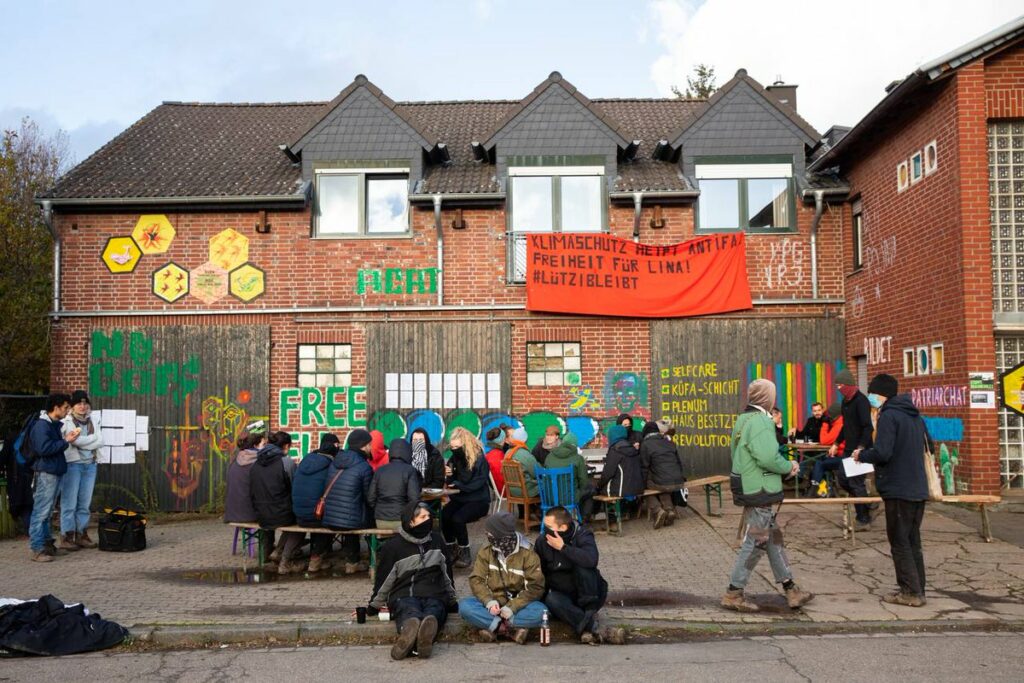
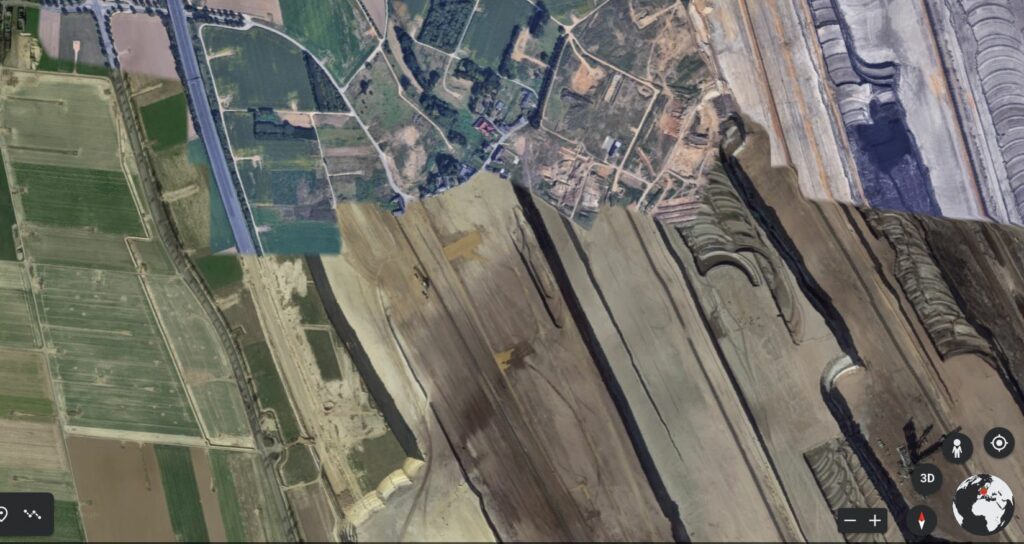
Incredible violence is happening where people are being displaced and places destroied forever. Despite of a climate catastrophy that is already happening the german governments still allows corporations to enlarge open coal mines like the one called “Garzweiler” close to cologne that is one of the largest in Europe. Twelve villages had to be demolished for it in the past, homes, protected monuments, fertile soil, insects and other creatures, roman excavation sites the whole complexity of a peace of Earth taken out by a huge digger. What remains is a incredibly large and deep whole that seems to be empty but that is actually full of complaints and suffer, of ignored voices of protest. There is a fracture on GoogleEarth were the view of 2009 and 2020 meet each other. On the satellite picture we see the village of Borschemich that stopped existing in 2017 and we see at the same time, more that 100 meters below, the ground of the new coal mine. The next village that should fall is Lützerath were only one farmer was able to stay but that is accompanied now by hundreds of squatters that moved into the abandoned houses and selfmade treehouses. They try to amplify not only the complaining voices of those who are affected locally by displacement but also those who are and will suffer from the massive CO2-Emissions of the coal. Lützerath became a fertile space of complaining, of resistance and of the creation of an alternative sphere in opposition to capitalisms extractivism.
Squatted house in the village of Lützerath that is currently under threat of destruction due to enlargement of the coal mine Garzweiler.
The village of Borschenich (satellite image from 2009) that disappeared 2017 and the open coal mine Garzweiler (satellite image from 2020) in Germany near Cologne. Fracture found on GoogleEarth.
The summary was urging to be done and therefore, we are coming back to the roots: the place where the complaints were planted, watered, and let out by the complainer-creator, to the#0.
I do wonder sometimes why I have started voicing the itchiness I encountered. The following question would be why I do art. Then again, after rereading the displeasures once in a while I always bump into the satisfying answer. Moreover, I love my army of complaints. The question would pop up: how is it possible to have an emotional connection to the displeasure? I might not be able to explain it well, but assume that for me it comes from the joy of complaining, the power of reflecting, something very personal, one-man therapy, the empathy with the protagonists of my story, and most importantly, being able to be vulnerable somewhere, more than anywhere else. The topics that I touched through my displeasures are a good base to realize what are the itchy places and triggers, more precisely the base for future complaints and that is, my complainers, what I was looking for a while. I might be my own feminist ear.
What a lovely way to burn!
STICKY DATA: Complaints framed as self-damage
Is it, now when I opened these very personal, but very public questions and realized how sticky they are? Now, when I am aware of the damage that has been made? It can not be more of destruction than actually taking the words and bringing them into action. I and my displeasures are already here, which is, as I experienced, definitely not enough. Otherwise, Ahmed would call it a fatalist process (opened and started just in order to be initiated). But I would say that if my voices are burning now, there must be the next stage. Therefore, let me complete this action until it gets visible.
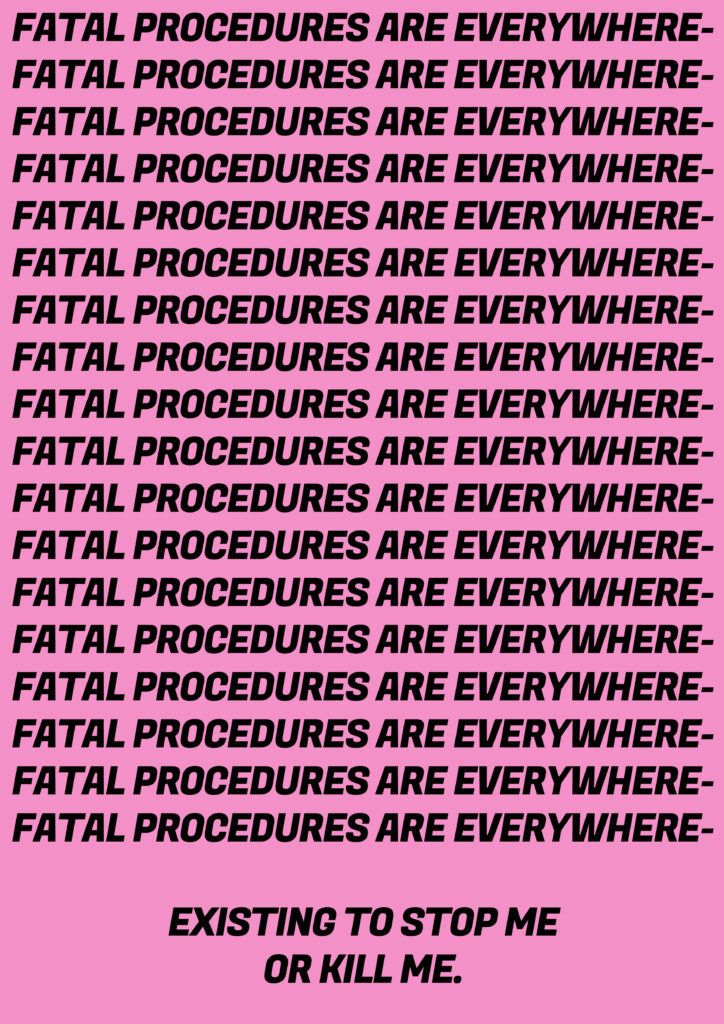
Fatal procedures, poster
WHAT A LOVELY WAY TO BURN
After voicing displeasure #The Code of Visibility, I could finally cry my life off, after months of holding it back. The wonderful moment of being able to tell him how hurt I was is not the pathetic story about my father, as I always thought. It is the voice of all the girls in the world that were abandoned, living with the thought that they made a mistake. It is the voice of the anger, the spit of the tension that pierced my belly for years. Thinking about the children that are very present in my everyday life, I pictured the visibility that their complaints are creating: the contrast of being taken too seriously, or not at all. I have been observing both their creation of visibility and complaining in front of the authorities and I actually found something useful to apply in my own practice.
Never mentioned before that I have always been disguised and repelled by the way my family structure is described in the official documents. It gave many people the right to comment and construct their own perceptions of the two members of my nuclear family. I hated the way they victimized my mom seeing her as a tortured, poor woman, the single parent left alone. Once, in the report of a school psychologist, she wrote:the child’s lack of motivation due to the consequences of her broken family. Whatever would change in my behavior, that was considered weird, it was always attributed to the crack I was born in.
Once, I cried in front of a 5 years old girl I babysat because her toy/doll family construction matched mine very well. Instead of stopping the professional cry, I started the professional complaint in front of her and the game was successful. The feminist ear has no gender and no age.
voicing the burning
#The Professional Cry is a fusion that gravitates and connects displeasures written before and after it. It is, indeed very much connected to the first displeasure #Feminine Masculinity. Both empowered my female/male voice and helped me understand the NO complaint. I was not respecting my own body, and my own little girl cried inside me every time I gave it to them. I was sexually harassed, taken advantage of. I experienced verbal abuse not knowing that what has been happening is wrong. I never told that to anyone, because they would immediately give credit to the broken family situation: seeking love more than others, daddy issues, loneliness, not having a man figure to look after, etc. I am not saying that traces of the crack are not present, but how dare you? Developing masculine femininity is a process and I prefer saying that my deep voice is therefore a social construct.
The fatal calculation, poster
This must be a professional crying class, voicing up and healing the cracks.
#The Crying Honk was, on the other hand, at the beginning very general, global, touching something outside of my body. I started writing it after the second day of my trip to Egypt thinking about the reflection on the way. After a while, it became strongly personal and I noticed that this was the task of mine, the one this life urges me to have: I am the voice of the children. I always felt this whisper more than others and whatever is the context, I ended up working with kids. At least I know whom I inherited this complaining skill from. Therefore, the more honest and radical I was, the more visible I became. This might also be called radical softness because my words are written faster than my brain can check them. I am simply unloading and emptying my cabinets within each letter.
NOWHERE TO GO, BUT READY TO BURN
So, how to treat these empty pieces of furniture that are piling up? How to fold all these tears and screams-soaked napkins? Where to store them? The collection of the voices, cabinets of displeasure, university of ears, feminist laboratory, collective hug, complaining choir – (some)where to go?
I have a trillion questions while burning on my own and some of them are adding oil on fire, while some are swallowing me even more into the topic. I am asking:
What is the difference between psychotherapy (type of a feminist ear), official complaint (including administrative process e.g), and art practice here, for me? What am I proposing and voicing?What wouldhappen when the voices are heard and the cabinet is exposed, becoming visible? Will my writings hug the people, motivate them? What do the complainers need? Is it more of the introspection and individual complaining experiences or the instruction of how to make an act?
Will anything voiced drastically change anything existing?
Until all of them are answered, until it all burns.
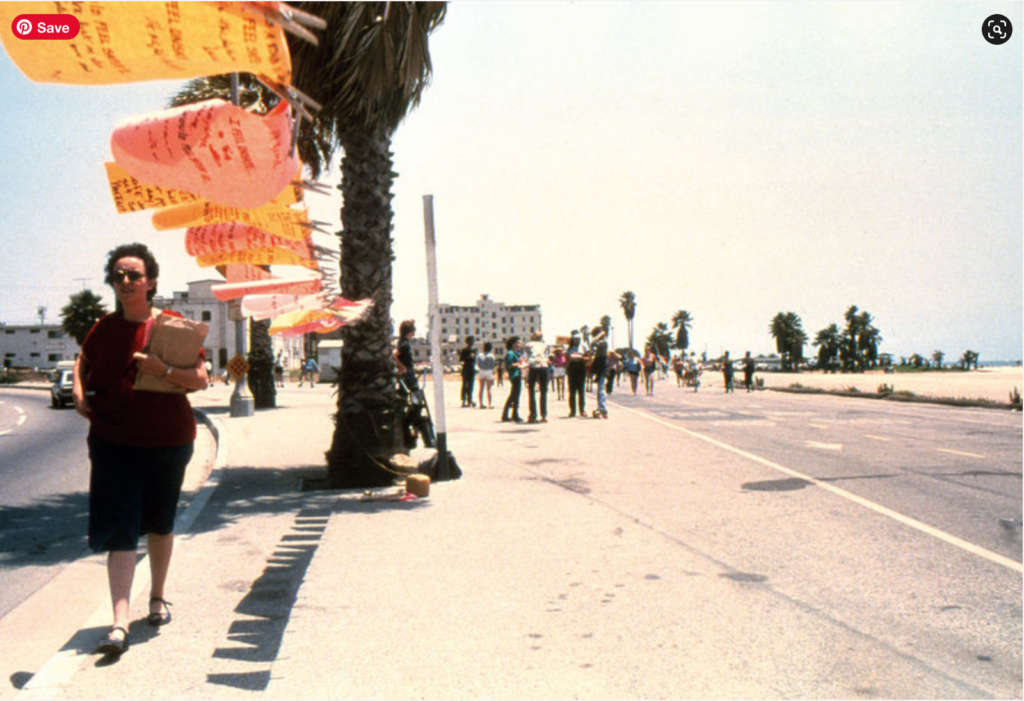
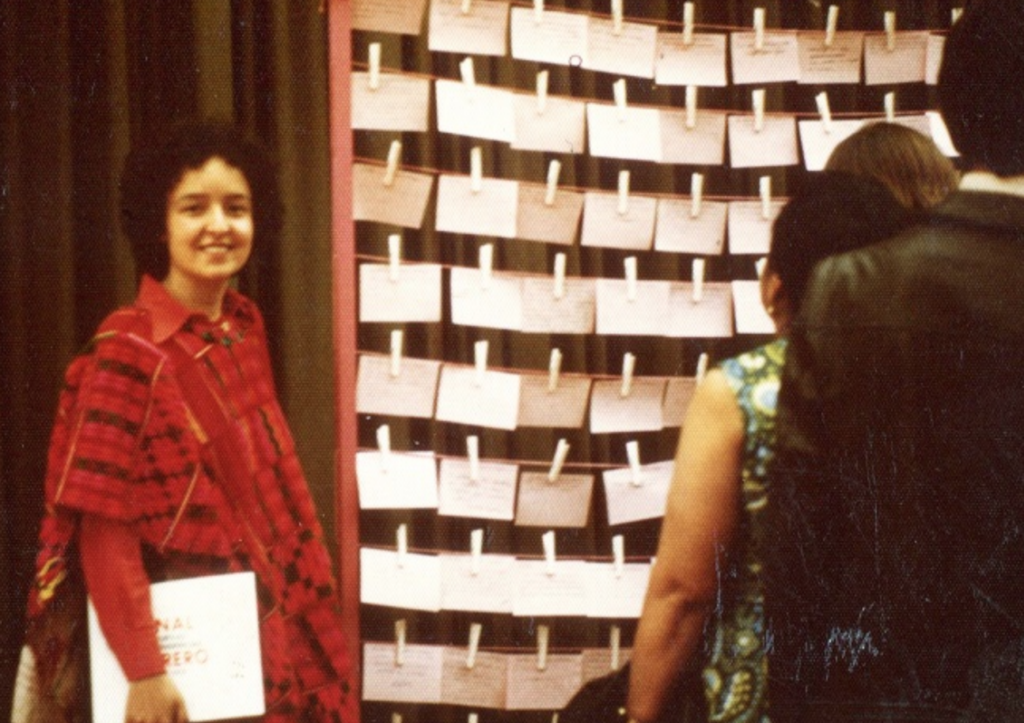
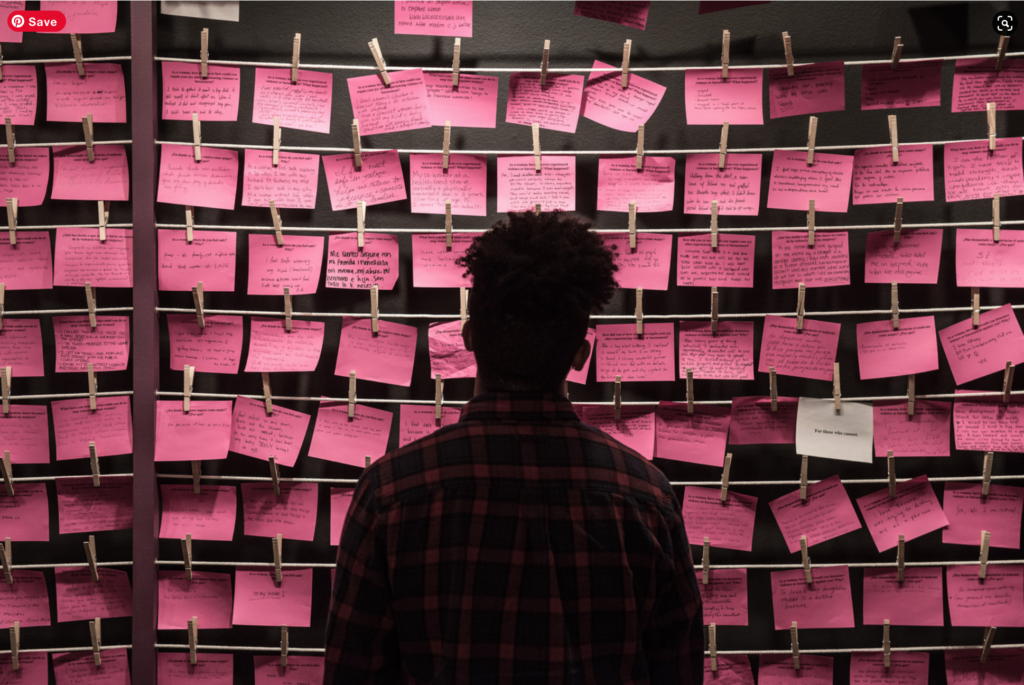
Los Angeles, 1979Museo de Arte Moderno de la Ciudad de México en 1978Mónica Mayer. Si tienes dudas… pregunte, MUAC, Mexico city, 2016
Mónica Mayer is an artist who has dabbled in drawing, photography, digital graphics and performance. Her work is characterized by being a precursor of feminist art in Mexico. Mónica Mayer was born in Mexico City in 1954. She studied visual arts at the National School of Plastic Arts of UNAM. The author began making feminist art when she was frowned upon in our country. The artists who raised their voices to express their dissatisfaction with machismo and violence against women were immediately considered lesbians and hating men. I like the idea of sharing it on this blog because I find that she is an artistic reference in the Mexican context that makes direct allusion to the idea of the complaint already in the late 70’s.
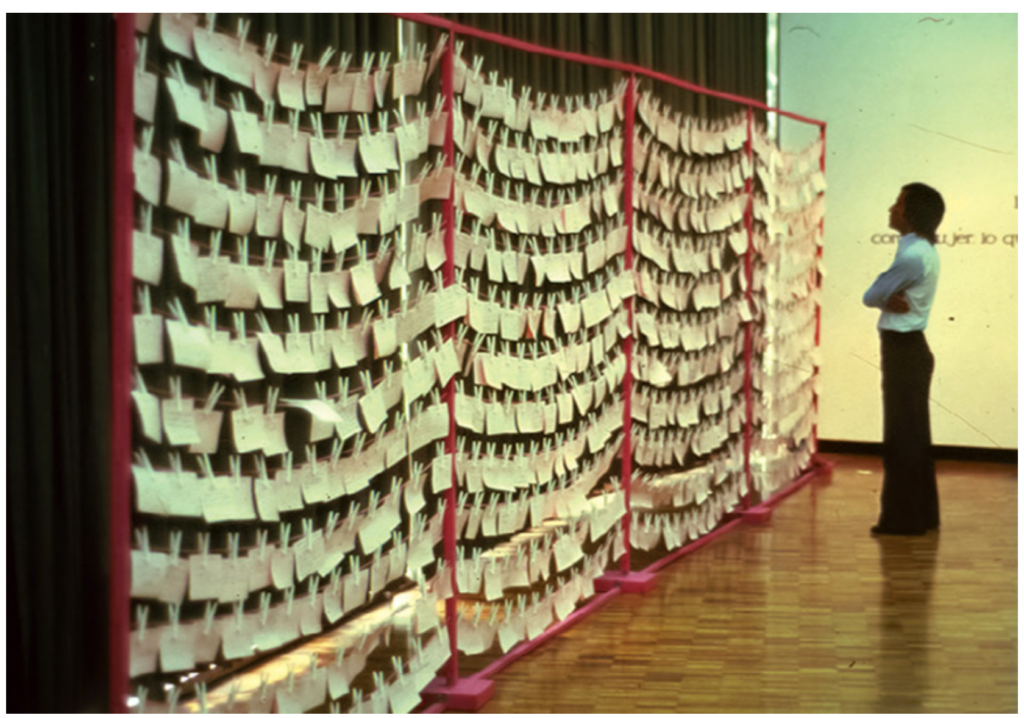
Her work “Tendedero” was exhibited for the first time in 1978 and has been replicated to this day in various educational, cultural and university institutions, even in virtual form. This work is based on hanging sheets of various sizes and colors and invites women to hang their own paper with phrases, questions, complaints or opinions. This work has been a great success because women have found a way to report and express themselves anonymously and without retaliation, especially in disadvantaged situations such as between students and teachers.
The work has been reproduced in different contexts, dates and cities throughout these 40 years.
In the mid-1970s Mónica Mayer became part of a group of artists who conceived their work within the context of artistic feminism. (POLVO DE GALLINA NEGRA) In 1978 she moved to Los Angeles to study at the Feminist Studio Workshop at the Woman’s Building. It was there that she encountered artists who were central to the US feminist art movement, such as Judy Chicago and Suzanne Lacy.
In 1978 she produced El tendedero (The Clothesline Proyect) at the Museo de Arte Moderno in Mexico City. She invited visitors to hang up small sheets of paper on which they had completed the phrase “As a woman, the thing I detest most about the city is . . .” in order to encourage a dialogue about the violence experienced by women in public spaces.
Mayer said in 2017: What has changed in forty years? The only thing that is different now is that I am not the only one doing it.
As a popular way to translate “complaining” into german one finds the word “beschweren” which has a very similar use and meaning but means, literally translated, to make something/someone heavy”. The notion of complaining that revealed so many personal and emotional stories in the context of our Seminar felt like a key to a otherwise hidden box that we all have somewhere. To share a complaint is to open this box partly, to make oneself vulnerable but also to allow strong connections to others. But the act of complaining seems to always be an interaction that transforms both the complainer and the receiver. After a seminar session of listening to a lot of complaints I understood the german word “beschweren” because I acutally felt heavier somehow. To share the burden of a complaint means to carry it together. At the same time it brings relief to the complainer which could be translated to “Erleichterung” in german (what literally means “making light”).
We all want to get rid of our heavy complains – we want to feel light. But with a full box of complaints there is no real lightness.
How could we create spaces of a collective “Erleichterung” without loosing the core of the complaint? How should the complaint be responded to enable “Erleichterung”? How can we find a balance?
Thomas Sarraceno – On Space Time Foam 2012 (Milano)
The artwork by Thomas Sarraceno came into my mind while writing the post but my text has no direct connection to the artists work or texts.
I don’t know how often I have heard this sentence before. And to be honest, it took me a while to realize that being oversensitive wasn’t in fact a bad thing. Yes, I was being oversensitive, but what if that didn’t mean I should have let go, don’t care, feel less. It meant that I have a good intuition for what feels right for me and what feels wrong. The problem is that this is often not what people want to hear from you. And I was not intimidated to tell them what they didn’t want to hear. So, I ended up being the complainer. “Oh, Fabienne disagrees with something? Is she again causing a drama? Well, that’s just how she is.” Whether at school, in my dance classes or at home: I would probably get the award of causing dramas.
What is even meant by drama?
It means not accepting everything just as it is. Running the risk of disrupting the apparent peace of a situation. Being uncomfortable. Making people face their wrongs and maybe with-it face certain emotions. Which can be hard to bear. But it also means running the risk of being wrong yourself and creating a drama over nothing. And don’t you dare causing a drama over nothing.
If you complain as a woman, you very quickly fall into a certain drawer. There is an exaggeratedly distorted image of women complaining too fast and too much. When you raise your voice, you are causing a drama. Your actions are constantly on the edge being seen as an overreaction. Keep your voice down, keep your opinion down and most importantly, keep your emotions down. If you do find the courage to speak up, don’t run the risk of mixing it up with your feelings because you will most probably end up being defined as hysterical. Hysterical: women’s favorite word. Defined as hysterical you are not just a concerned person anymore that found itself in a difficult situation it wanted to change or has experienced unfair treatment. No, now you are just “always” overreacting. Hence as a woman, if you complain you have to be even more rational, come even more strong, be even more neutral and base what you experience even more on facts, than man have to do. US-psychologists around Victoria L. Brescoll from the University of Yale noticed that when a woman is angry, she loses her status, no matter what position she is in. Within an experiment they found out that being angry as a man is seen as positive, while coming from a woman it is seen as negative.1 Women should not be uncomfortable. They should care and encourage peace. Because a woman who does not complain and does not get angry, won’t change anything about the inequality between man and women.2 As a consequence there is a tendency of women not expressing their anger and their concerns outwardly. They make it out with themselves. So, while there is this image of women complaining too much, they actually learn from very early age on to be quiet and smile.
Furthermore, as a feminist you might find yourself losing your credibility when it comes to criticizing men as for example a feminist PhD student expresses in the book “Complaint!”: “I think they thought almost that I was looking for it, like a feminist thing, you are always overreacting, blowing things out of proportion because that’s what you see everywhere.”3 It might even come to the point of questioning yourself, your own judgment when you experience sexism. “She tells herself off, even: she gives herself talking to; she tells herself to stop being paranoid, to stop being a feminazi, to stop being a feminist, perhaps.”4 When complaining as a woman and as a feminist you run the risk of being seen as a “man-hater”, one that discards everything men do. Hence everything you criticize is not perceived as being expressed because there is something wrong about what a certain man did but simply because you despise man. You are not listened to and the louder you get, the less you are heard. “The could-be complainer is also the feminist complainer, feminism it-self being charged with complaint through the exercising of old and familiar negative stereotypes (feminists as “man-hater”). Feminist complainers are called vermin, polluting agents who need to be eliminated.”5 Being afraid of endangering their status and their position within a structure might lead to woman not speaking up anymore.
Speaking up and making abuses visible is seen as a danger. It is seen as a danger and tried to be avoided, when it meaningful and impactful. Analyzing who is trying to avoid it makes visible who is in power and who wants the status quo as it is, meaning who benefits from it. “One way a complaint can be dismissed is by magnifying the demand; a demand for “equality and safety” is treated a wanting to bring an end to what or who already exists, or as separatism, a wanting not to share a space or culture.”
Being told that you are overreacting and being oversensitive is very dangerous, as by time you might lose your sense in trusting in your own judgment. We need to learn to trust in our senses. In addition we need to be open for criticism and change. Being sensitive is not something negative and is also not tied to a gender. Everybody should develop a certain level of sensitivity so we can create a space of awareness and of living with and not against each other.
Im letzten Teil ihres Buches “Complaint!” erwähnt die Autorin Sara Ahmed eine Reihe von Ideen zu Beschwerden. Einigen von ihnen stimme ich wirklich zu. Und die Sätze sind eine große Inspiration für diejenigen, die sich beschweren wollen.
“I believe in complaining, even when it’s a bad outcome, just creating that record of what happened. I am glad that it exists for me, and that if any questions are raised I have it. I did lodge a grievance, I had a go, I did try.”
“A record can be what matters to the one who assembles it; a record can be a reminder that you made an effort, that you had a go, even if that effort did not lead to institutional change.” (S. 288)
Dieses Zitat erinnert mich an einen Spruch, der mich schon oft inspiriert hat: “Wenn man sich anstrengt, hat man nicht immer Erfolg, aber wenn man sich nicht anstrengt, wird man definitiv keinen Erfolg haben.” Mit Beschwerden verhält es sich genauso: Man muss eine Beschwerde einreichen und sich die Mühe und Zeit nehmen. Letztendlich hat die Beschwerde möglicherweise keinen Erfolg. Aber wir müssen es trotzdem versuchen, um gegen die dunklen Dinge zu kämpfen.
“I leave no trace of wings in the air, but I am glad I have had my flight.”— Rabindranath Tagore
“Even going through an exhausting of processes can have creative potential. Yes, we can be in a state of exhaustion because of that process. But complaints, even formal ones, slow and tedious ones, long and drawn out, can be creative. ”(S. 289)
“I suggested earlier that even when our complaints end up in filing cabinets, we take them with us. I also noted that we don’t always know where complaints go, before they are filed. But even when complaints end up in filing cabinets, they can get out; we can get them out. Filing cabinets are temporary shelters. The more letters written, the more letters to leak.” (S. 298)
Wir alle wissen, dass die meisten unserer Beschwerden im Aktenschrank verbleiben. Der Aktenschrank ist eine sehr verbreitete Methode, um Beschwerden zu vertuschen. Aber er hat einen begrenzten Platz und kann nicht alle Beschwerden abdecken. Wenn wir also weiterhin auf unsere Beschwerden beharren und uns wehren, werden diese Beschwerden irgendwann ernst genommen werden.
Natürlich hat eine Beschwerde viel mehr Aussicht auf Erfolg, wenn sie von einer Gruppe unterstützt wird. Die Realität ist jedoch, dass viele Beschwerden von Einzelpersonen eingereicht werden. Wenn also diese ähnlichen Beschwerden als Kollektiv zusammengefasst und zusammengeführt werden könnten, wäre die Wirkung der Beschwerde sehr groß. “Two heads are better than one.” Die Autorin Sara Ahmed hat viele individuelle Beschwerden zu einem Kollektiv zusammengefasst, um dieses Buch zu schaffen. Das Buch enthält eine große Anzahl von Vorfällen aus dem Leben der Beschwerdeführer und berührt viele Aspekte des Lebens. Ja, es ist die Kraft einer kollektiven Beschwerde.