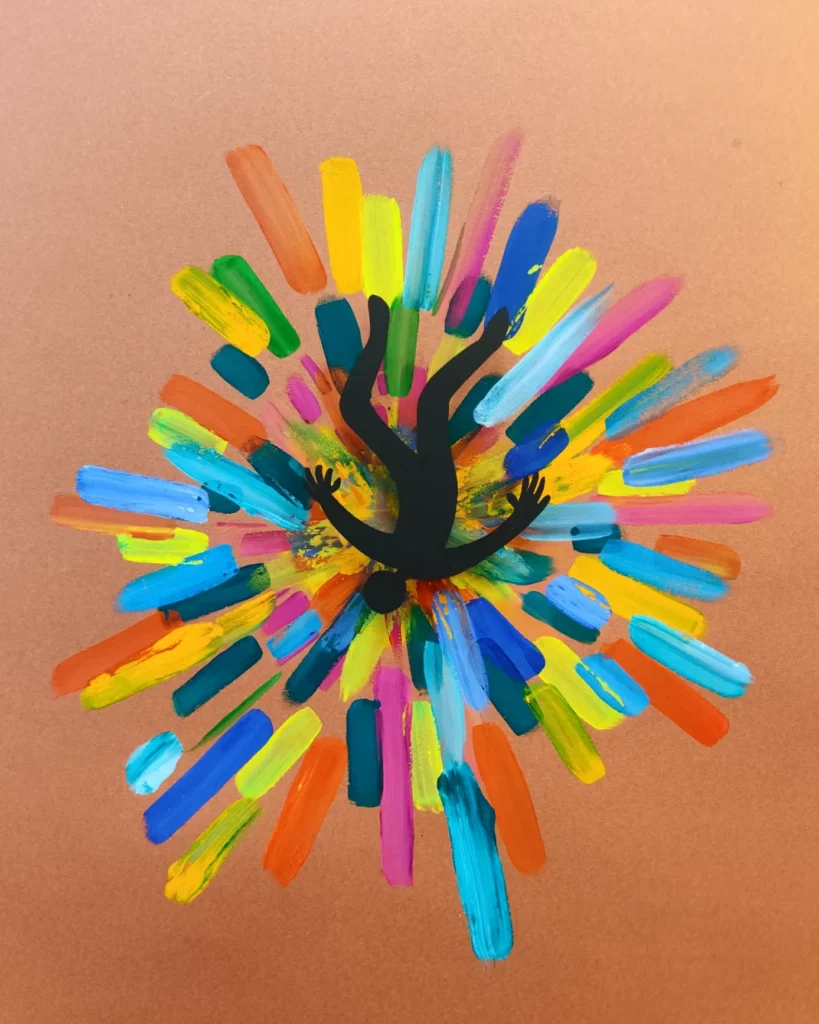
The medicines did not arrive. A bottle of 30 pills is inside a random building in Bogotá. The bottle has a label with my name on it. My body is a label. My name is a shipment, a courier company. My name is divided into 30 pills. My name. My name. My name. My name is Camilo Londoño Hernández, and I have been living with HIV since 2016. I am Colombian. I don’t have pills. I study in Germany. Do you know of any solution? Thanks in advance. Thank you. Thank you. Thank you. Thank you. Thank you. My hand hurts. It is not a deep pain. This pain is like the slowness of snow. It is not a pain to scream. I can walk. I breathe. I eat. I laugh with my friends. I call my mother. I don’t call my mother. I call my mother. I don’t answer my emails again. I write. I watch some series. I watch porn. I watch memes. I watch my cell phone all night. I watch the hours. I watch the hours. I see the hours.
I cannot sleep.
***
Viernes 26 de noviembre del 2021
Los medicamentos no alcanzaron a llegar. Una botella con 30 pastillas está en un edificio de Bogotá. Hay una etiqueta con mi nombre. Mi cuerpo es una etiqueta. Mi nombre es un envío. Mi nombre es una empresa de mensajería. Mi nombre está divido en 30 pastillas. Mi nombre. Mi nombre. Mi nombre. Mi nombre es Camilo Londoño Hernández y vivo con VIH desde el 2016. Soy colombiano. No tengo pastillas. Estudio en Alemania. ¿Sabe usted de alguna solución? Gracias de antemano. Gracias. Gracias. Gracias. Me duele la mano. No es un dolor profundo. Este dolor se parece a la lentitud de la nieve. No es un dolor para gritar. Puedo caminar. Respiro. Como. Me rio con mis amigos. Llamo a mi madre. No llamo a mi madre. Llamo a mi madre. No me vuelven a responder los correos. Escribo. Veo series. Veo porno. Veo memes. Veo el celular toda la noche. Veo las horas. Veo las horas. Veo las horas.
No logro dormir.
***
PS.
I post this diary from back to ahead in time to play and read upside down.

Publico este diario de atrás hacia adelante en el tiempo para jugar y leer al revés.
I just texted a friend in Bogota. He will be in Spain in the coming week. So, he talks to my mother while I check tickets. On Friday I will be in Berlin. Another friend will host me. By Saturday, I will arrive in Madrid. I book a hotel in the center of the city. Now, my non-treatment must continue for two more days. Life is getting wider. I look at the time it takes for the train from here to Berlin. I look at the time it takes by plane from Germany to Spain. I look at the time it takes from Colombia to Europe. I look. I look. I look. I wait. I pack. I put everything away. I take a shower. I brush my teeth. I stretch. I want to scream. I look at the weather, the clouds, the wind, the invisible sunlight. I look again. I call no one. I stop writing. I stretch again. My chest shivers. My naked back bristles from the cold. I think of the heat of Medellín. The city. The city. The city. I don’t feel nostalgia and want to scream. I watch a series, breathe, and turn off the light.
Acabo de escribirle a un amigo en Bogotá. Él viaja para España en cinco días. Él habla con mi madre. Reviso tiquetes. El viernes estaré en Berlín. Una amiga me hospedará. El sábado llego a Madrid. Reservo un hotel en el centro. Debo continuar mi no-tratamiento dos días más. La vida se ensancha. Miro el tiempo que tarda el tren desde acá a Berlín. Miro el tiempo que tarda el avión de Alemania a España. Miro el tiempo que hay en avión de Colombia a Europa. Miro. Miro. Miro. Espero. Empaco. Guardo. Me ducho. Me lavo los dientes. Me estiro. Quiero gritar. Miro el clima, las nubes, el viento, la luz invisible del sol. Miro otra vez. No llamo a nadie. Paro de escribir. Me estiro otra vez. Mi pecho tiembla. Mi espalda desnuda se eriza por el frío. Pienso en el calor de Medellín. La ciudad. La ciudad. La ciudad. No siento nostalgia. Quiero gritar. Miro una serie. Respiro. Apago la luz.
Me acuesto a dormir.
***
PS.
I post this diary from back to ahead in time to play and read upside down.

Publico este diario de atrás hacia adelante en el tiempo para jugar y leer al revés.
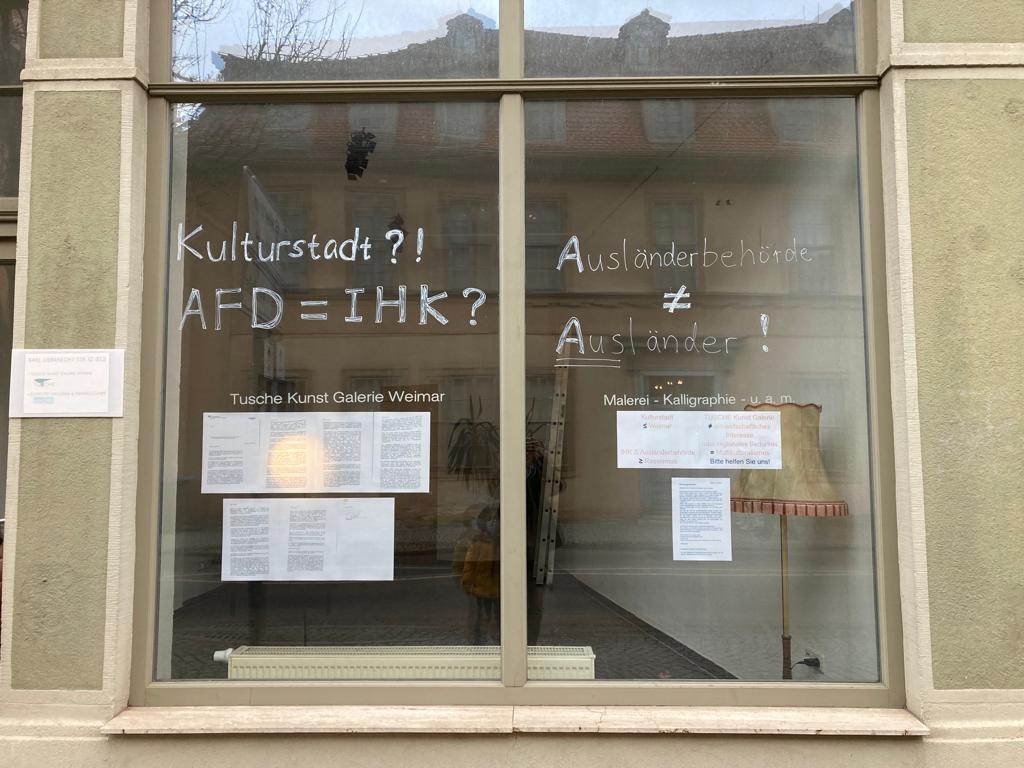
I was walking down Karl-Liebnecht-straße in Weimar yesterday. There are a couple of art galleries on that street as well as the City museum and the Bauhaus museum. You could say this is the Weimar art district if there was such a thing. I was on my way to 11m3 Projektraum, an exhibition space that my wife and I started some time ago (more on that later) when I saw something new on Tusche, an art gallery also on Karl-Liebnecht-Straße. It was handwritten white text on the window. It said:
This quasi-cryptic message was followed by a long letter taped to the window. This sparked my interest.
I started reading the letter and though I couldn’t really understand all of it at first, I translated the whole thing and I will now summarize the letter in a few bullet points:
Through the letter, the German consulate in China is denying Fuming Liu the visa to remain in Germany as Tusche gallery’s director.
The Erfurt chamber of commerce (IHK) declares after an inspection that there is no sufficient economic interest or regional need in the gallery.
After being questioned about the gallery, she could only state the names and tasks of the 2 former employees after looking at some documents which seemed suspicious to them given the small size of the business. She did not attach the work contracts of the alleged employees.
The gallery managed to exceed the projected target of 5660 euro by making 8872 euro in the first year but then failed their target of 39.000 euro profit in the following year (2020) by just being able to make 2500 euro.
There are other galleries in Weimar that offer some of the same services as Tusche and therefore an economic interest is not evident.
Fuming Liu has insufficient knowledge of German or English, which is required by law, in order to be the legal representative of a company in the German market, operating in Germany, founded under German law and subject to German law.
Fuming Liu is over 45 years old and does not have an adequate pension fund according to her age.
She can appeal the decision of the consulate.
There is so much information there. Every decision leading up to the denial of the visa is supported by German law. Everything is lawful and yet laconic (awful?) for lack of a better word. As I was reading this letter it felt as if the letter was not addressed to Fuming Liu but to me, future me. I guess what I’m trying to say is that I can relate.
I can relate to being a gallery (project space) director, a foreigner with insufficient German knowledge, not making any money from the project and always submitting paperwork wrong (or incomplete). I can also relate on a professional level, a conceptual level if you will.
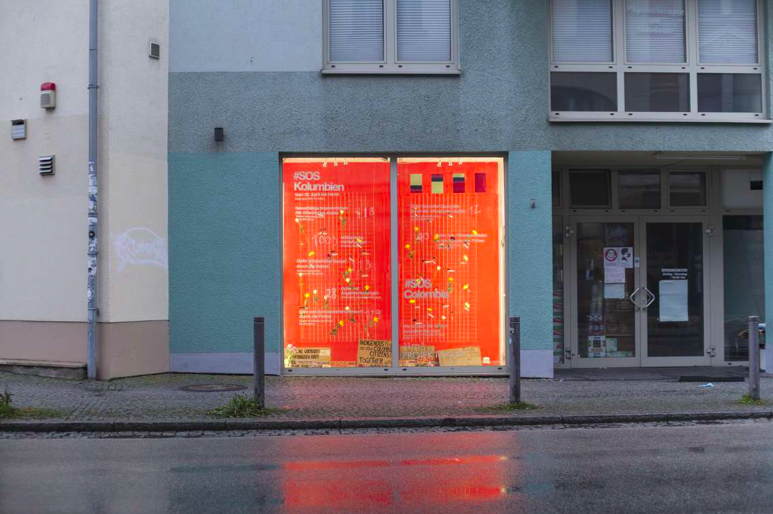
At 11m3 we did an exhibition in support of the victims of the Riots in Colombia in April 2021. We listed the number of casualties, unlawful arrests, sexual violence and dismemberments and wrote the numbers with a white marker on the glass. Very much like the writing on the window in Tusche Galerie. Our landlord asked us to take down the exhibition and not show any more art with political content. This does spark the question though: isn’t all art political? But let’s just leave at that for the sake of brevity. So through this censorship we (unwillingly) enlisted our landlord as one of our de facto curators.
In the letter the Erfurt chamber of commerce (IHK) stated there is no commercial interest in the gallery. In other words, the gallery is not interesting or put another way, the art exhibited in the gallery is uninteresting. This sounds dangerously close to the trade of art curation. The curator usually decides what is interesting to see in an exhibition space and what is not, what goes with what, what goes in, what goes out.
The parallels just keep piling up. My family is due to ask for a renewal of our residence permit and they just canceled my neighbors’. Am I next?
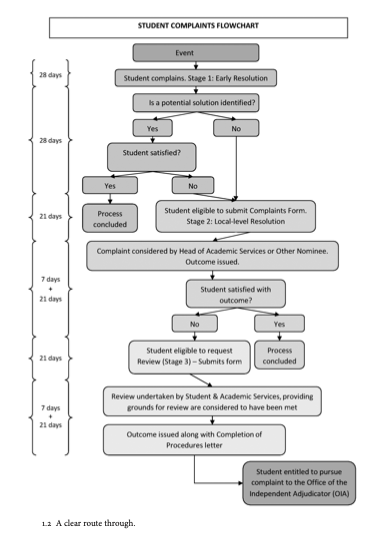
A process is a group of steps that have to be followed, in order for a task to be properly developed or to achieve a particular goal. Amid its course there may be multiple options or paths that unlink others, as it involves many aspects, characters, etc, but the purpose is that in the end, the initial goal is accomplished.
Sara Ahmed, shows in the first chapter of her book “Complaint!” a flowchart that represents the process of a student complaint. In it can be seen the multiple outcomes of this same purpose and which will be the ideal end/solution for the complaint, also by showing the possible days each step will last.
This is a clear example of the ‘concrete ways’ that lead to the solution of a complaint. In this process every factor is taken into account with dignity, for instance if the student is satisfied, and if not, the process continues; there is a path that follows hierarchy, there are stated times for every step of it. As it is clearly designed, has to be clearly developed, one can’t skip a step, nor bypass an agent.
Nonetheless, in real life scenarios and experiences from many people, such as the ones told in Ahmed’s book, the fact that these processes exist and are part of the policies of different institutions does not guarantee that the complainant will be successful.
These concrete steps have to be understood, respected and defended by any active performer of the process. If the process, in this case a complaint, does not achieve its objective, it is because of the negligence of one of the parties, that interrupts the aiming flow of the action; and also, it lets infer that it is due to strategic and particular interests in slowing down or even ending up with the process.
The word ‘concrete’ in “Complaint!” and “Cat Calls of Berlin”
Concrete as a noun is: “a building material made from the mixture of broken stone, sand, cement and water, which can be spread or poured into moulds and forms a mass resembling stone on hardening.” As an adjective is: “relating to or involving specific people, things, or actions rather than general ideas or qualities”. And finally as a verb is: “to form (something) into a mass; solidify.” (All definitions retrieved from https://www.merriam-webster.com/dictionary/concrete).
The three uses relate and fit to the topic of “complaints”. Following, the relations between them will be exposed and also compared.For this purpose, the word “concrete” was searched among the lines of Ahmed’s book to see which uses did the author gave the word.
First appearance of the word concrete in the book “Complaint!”: Chapter 2, page 92.
“A wall gives concrete expression to an experience of being stopped. A wall can be thought of not only as hard but as slow. You can encounter resistance in the slowness of an uptake.”(Ahmed 2021, p.92).
Second appearance of the word concrete in the book “Complaint!”: Chapter 4, page 171.
“The more value is acquired by this figure, the more complaint is treated as self-revelation, the less attention is given to what complaints reveal: the structures, the walls, history made concrete.”(Ahmed 2021, p.171).
Third appearance of the word concrete in the book “Complaint!”: Chapter 6, page 226.
“Many who make complaints experience direct forms of retaliation. It can be hard to evidence such experience. Retaliation can be concrete (such as lower marks), but even then, to make that claim is often to be met with disbelief (he wouldn’t do that; it couldn’t be that).”(Ahmed 2021, p.226).
In these three segments, the word ‘concrete’ plays a role as an adjective for the word ‘expression’ in the first paragraph, in the second one it is qualifying the aspects that won’t have relevance when making a complaint, and in the third paragraph it connotes how retaliations after making a complaint can be manifested.
Ahmed constantly refers to this processes like talking to or dealing with walls, or rigid surfaces. As it is described in the first paragraph: “A wall gives concrete expression to an experience of being stopped.” Even though the use the author gave to the word was not related to the previously mentioned definition for the word ‘concrete’ as a noun, it relates to the stiffness, the impenetrability of some agents that take part of a system, and that this does not allow the proper and dignified development of a complaint. Additionally, the procedure to make a complaint can be understood as “concreting” something; in other words to solidify something, to make it tangible but unfortunately in many cases, it turns into something impenetrable and hard to deal with, just like as the concrete.
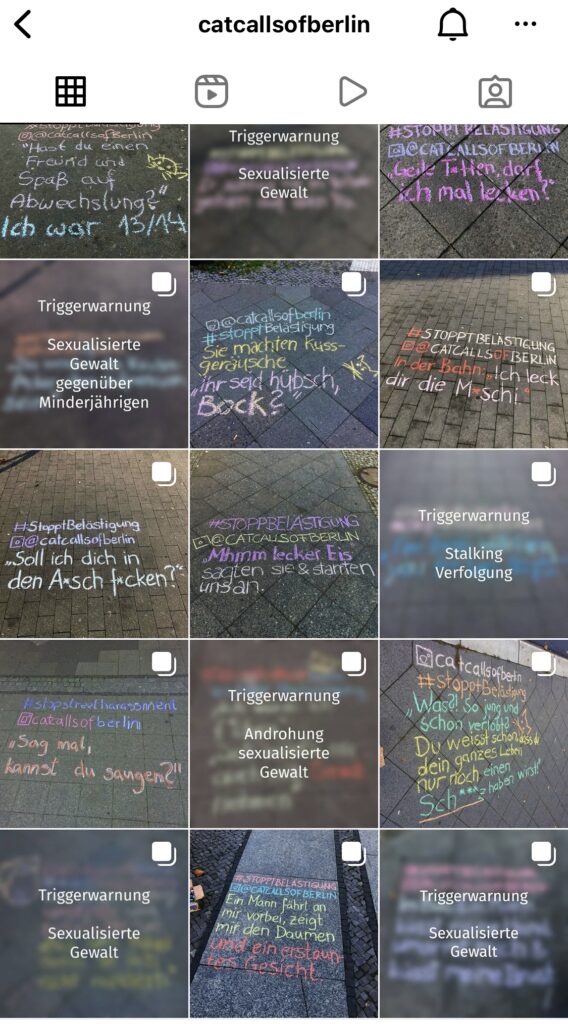
In other matters, the presence of the word ‘concrete’ in the movement “Cat Calls of Berlin” is more specific and notorious. Basically because the complaints are made explicit written on the concrete ways and it is easy to see through the gray color of their instagram feed.
“Cat calls of Berlin” is a movement exercised in an analogous way in public spaces, but it extends to its platform on instagram. It starts with the collection of different anonymous testimonies on street sexual harassment, then the team writes a piece of the testimony on chalk nearby the area they took place and then a photo of the testimony is uploaded on their social media for people to interact with.
Figure 2. Screenshot of the instagram feed of the account “Cat Calls of Berlin” (Parra 2021).
Whereas concrete is a strong material, that can not be easily manipulated under weak conditions, nor altered; it may guarantee a long maintenance of the complaints being made on it. In this case the word ‘concrete’ has the first advantage for complaints: works as a protector of a message amid the openness, free accessibility and exposure of it.
The concrete in this case is the medium, the dark canvas of this ‘artistic’ expressions against sexual harassment on the streets. These ‘concrete ways’ are inert agents that at the same time function as witnesses, if a much more poetic and advanced perspective of this problematic in public spaces is suggested.
Different meanings of ‘concrete’
Complaints are not easy and these procedures are not always the most clear tasks to be developed; even sometimes the intentions behind making these steps hard to comprehend and follow are notorious.
When it comes to human resources in any type of institution, they must guarantee the facilities, for every one involved in the system, to fulfill their needs and rights. When acts of harassment or abuse happen, it is already a traumatic experience, so: Why not stipulating ‘concrete ways’ to be followed for solving any type of problem? These institutional and systematic gaps only reveal negligence, personal profits, advantages over stabilization of the systems disguised as policies.
On one side, the word ‘concrete’ in Sarah Ahmed’s book, had the connotation of the quality of making impossible a process or an achievement that would dignify the victims; on the contrary, in the movement “Cat Calls of Berlin”, the word ‘concrete’ is represented as a protective agent. The surface and medium on which the complaints are carried through in this initiative is hard and difficult to be corrupted.
Hence, the usage of the word ‘concrete’ while referring to complaints can have multiple interpretations: it can refer to the rigidness (like the material concrete) of the process itself, or how the recipient of the complaint seems to be; it may also refer to the concreteness, clearness and specific steps these procedures to make a complaint should embody, in order to make it more efficient.
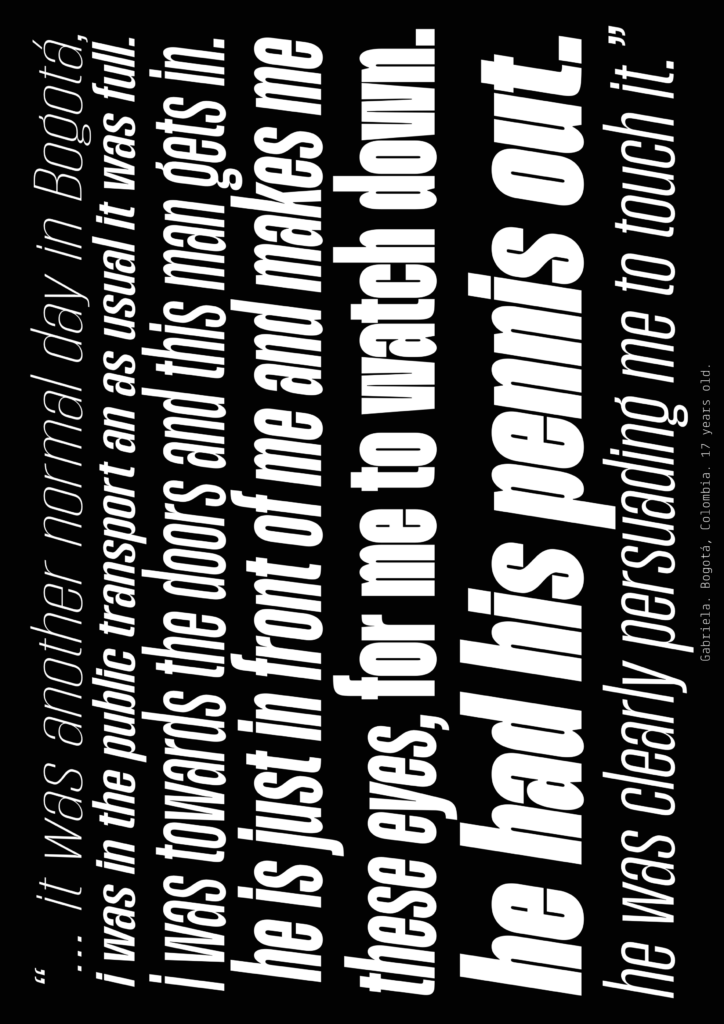
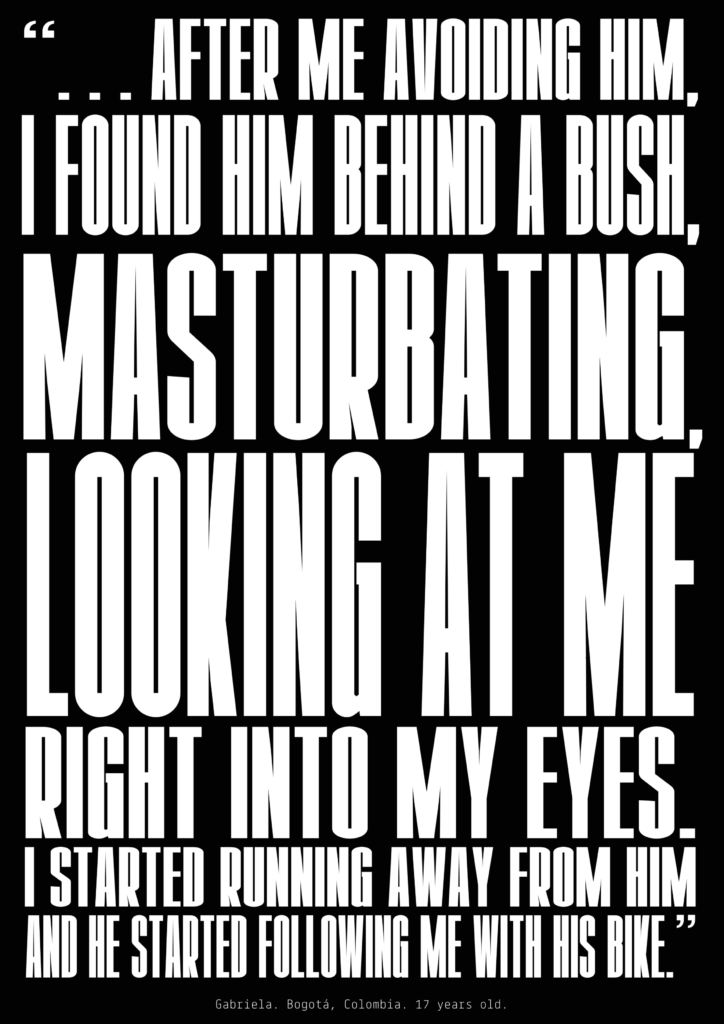
As read in “Complaint!” by Sara Ahmed it is evident to see that many women have suffered harassment and abuse in the daily life scenarios. I include myself.
In my case it did not happen in places I concurred frequently such as school, university…
I was either jogging at a park near my home or taking the public transport in my hometown.
–
I translated the hardest and most traumatic parts of these two experiences and placed them into typographic pieces.
Image 1. Poster, Personal Testimony 1, Weimar, 2022, Parra. Image 2. Poster, Personal Testimony 2, Weimar, 2022, Parra.
“Blanking can be an action performed in relation to written and spoken complaints. You can be blanked in person. A senior academic made a complaint about bullying from her head of department. Her head of department had told her he was recording their conversation during the conversation. In a subsequent meeting with administrators, she asked about this recording: “They just stared at me, they didn’t answer, they did not speak, which I just found quite extraordinary.” A blank stare can be how you are received; you say something, and they say nothing back. This is not ordinarily what happens in conversations during meetings (“I found it quite extraordinary”). She is turned into a spectacle by not being heard (“they just stared at me”). By not saying something in response to what she says, it is as if she has not said anything. When you say something, it needs to be acknowledged as having been said. This is what blanking can be doing: when someone says something, you can stop what they say from being said by acting as if they did not say it.”
“Even when you are made uncomfortable by a situation, you can still find it hard to get out of it. We learn from how hard it can be to do what you need to do to protect yourself. Who you are taught to be, how you are taught to be, polite, considerate, not troublesome, as a girl, as a student, is how you become more vulnerable, less willing or able to stop someone from pushing the line you need to protect yourself. When you know that to say no is to be judged as antisocial, it is hard to say no.”
(Ahmed, 2021, pg. 183)
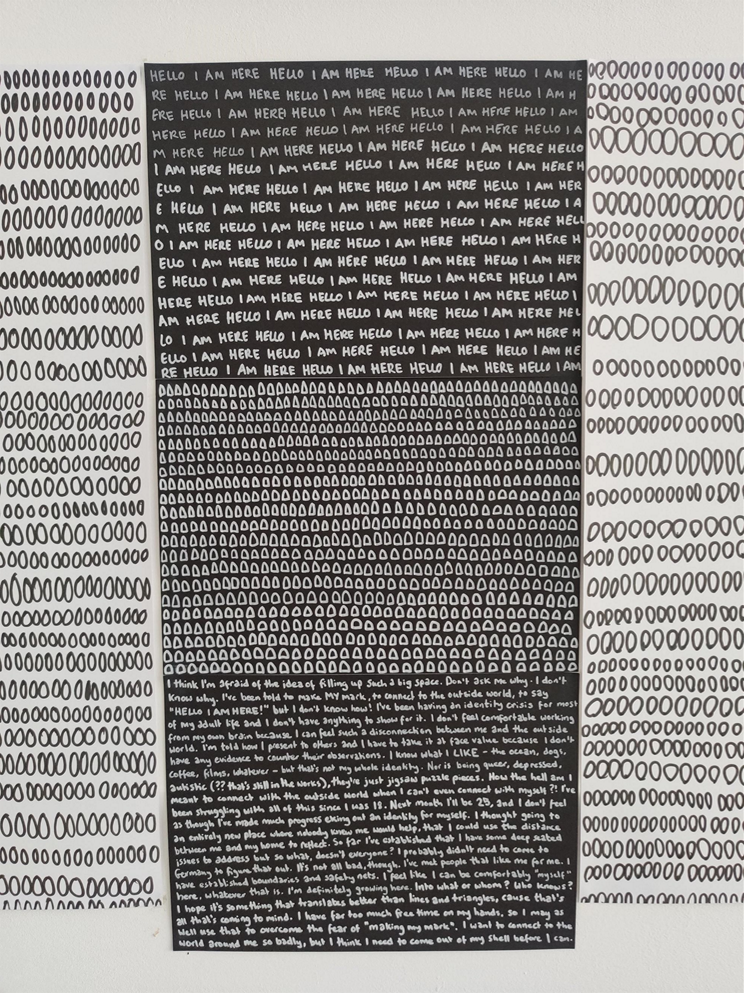
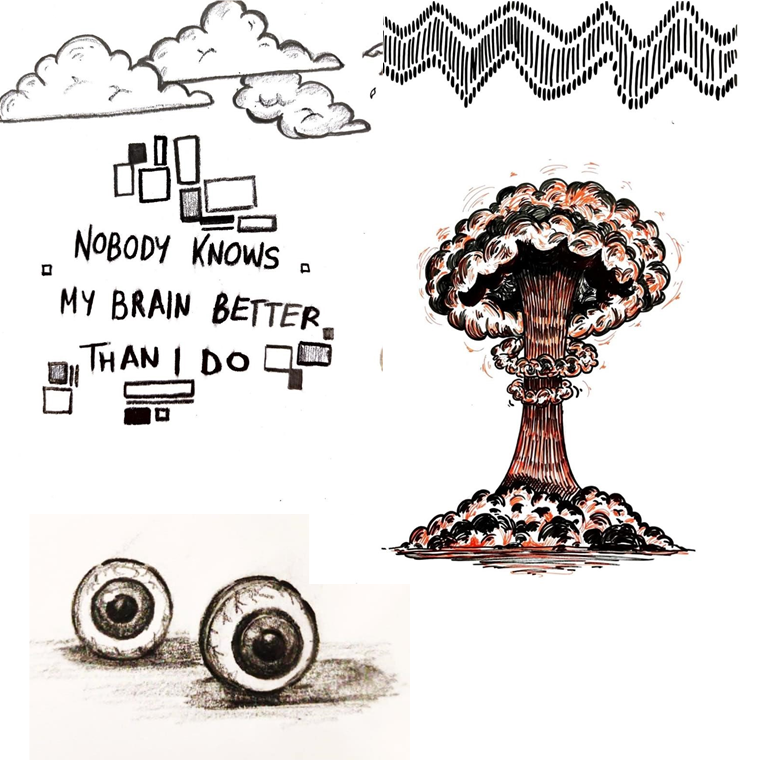
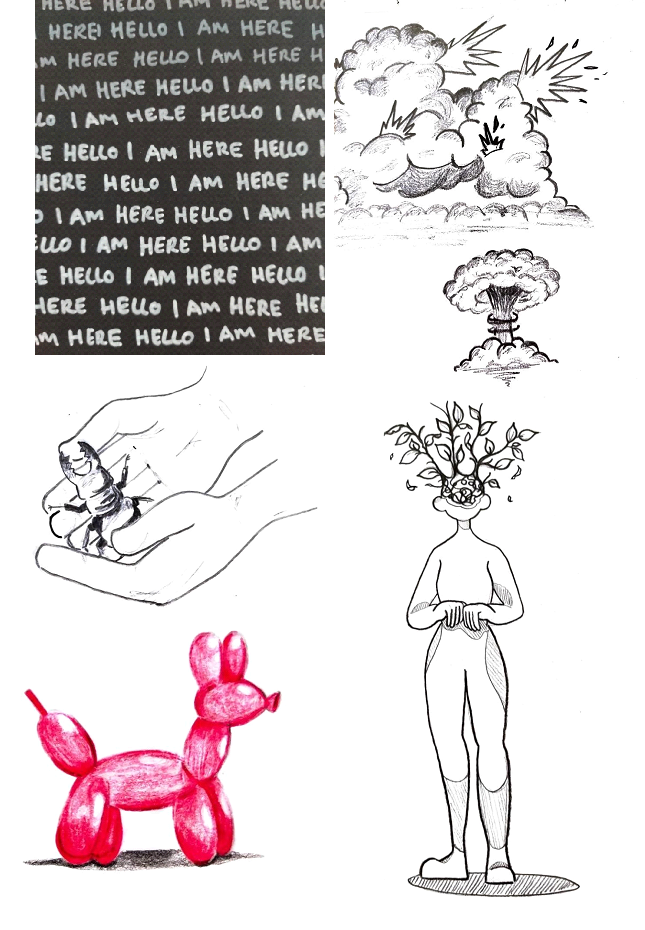
“HELLO, I AM HERE: An Identity Crisis on Paper” is my ongoing art project, in which I am processing and establishing my place in the world. The title comes from my professor: during a meeting, in which we were discussing my work, he noted that I had been trying to make my art “illustrative” and putting too much focus on creating pieces that were aesthetically pleasing. In trying to make beautiful artwork, I was not making anything that was true to who I was as a person. He told me to try drawing and writing without putting too much forethought into it, to make my mark, to say, “Hello, I am here!”
Naturally, this challenge sent me into a tailspin. Where was I supposed to begin? How could I even start to project my inner self onto the world around me? What did I want the world to know about me, and what would that look like?
So far, I still don’t really know, but the imagery that keeps emerging is painting a picture (if you’ll pardon the expression) of the parts of myself I have trouble reconciling with.
When I was 22, a therapist noticed that I struggled to maintain eye contact with her while I spoke about the challenges of working as a waitress, and how I was embarrassed about struggling to complete basic tasks in a stressful work environment. After a quick screening test, she referred me to another, outside organisation in order to test for autism.
It has been nearly three years since this referral (thanks to a hefty waiting list), and nearly every day since has been spent picking up the pieces of this bombshell. Finally, I felt as though I understood myself on a much deeper level. It became easier to forgive myself for the explosions of anger over tiny inconveniences (God help the poor soul who would change my plans at the last moment), for my thin skin and for the routines and rituals that were once thought of as “childish”. It didn’t matter that I was not formally diagnosed (nor that I am still waiting to this day): this was the key to letting myself heal from years of confusion and self-hatred.
With this monumental relief, however, came an entirely new set of challenges. A discerning lack of validation, for one. It became remarkably easy for those around me to dismiss my newfound diagnosis, primarily on the basis that I “didn’t seem autistic”. Many times I heard the old adage, “Everyone is on the spectrum!”, always from well-meaning people, probably unsure of how to respond to such a bombastic statement as “I have autism”.
Upon further reflection, I can see how such a statement could be seen as a complaint. This quote from the book “COMPLAINT!” by Sara Ahmed resonated with me:
“Correction is often heard as complaint: as being negative, assertive, demanding. Coming out can involve an intentional disclosure, but that’s not always how coming out happens. Sometimes you have to admit something to yourself before you can admit something to others…”
(Ahmed, 2021, pg.119)
This project is my concentrated effort to be assertive, to gently remind my friends and loved ones to handle me with care.
The doors in my life are two-fold. For every revolving door, every sliding door, the doors to my studio, my flat, my new way of life, a closet door.
If this door could talk it would probably scream. A piercing, blazing wail of fear, the unknown scorching the handle. The varnished oak gouged in scratch marks, peeled off stickers.
I have opened this door countless times. Slowly, haltingly, wincing at the groaning hinges. Now and then the coast is clear, and I fling the door open, delighting in the slam against the wall.
The door was forced open once.
A resounding truth, a lesson I have had to learn and teach myself, is that there is never just one closet. There is never just one set of doors. I will find myself behind that door again.